
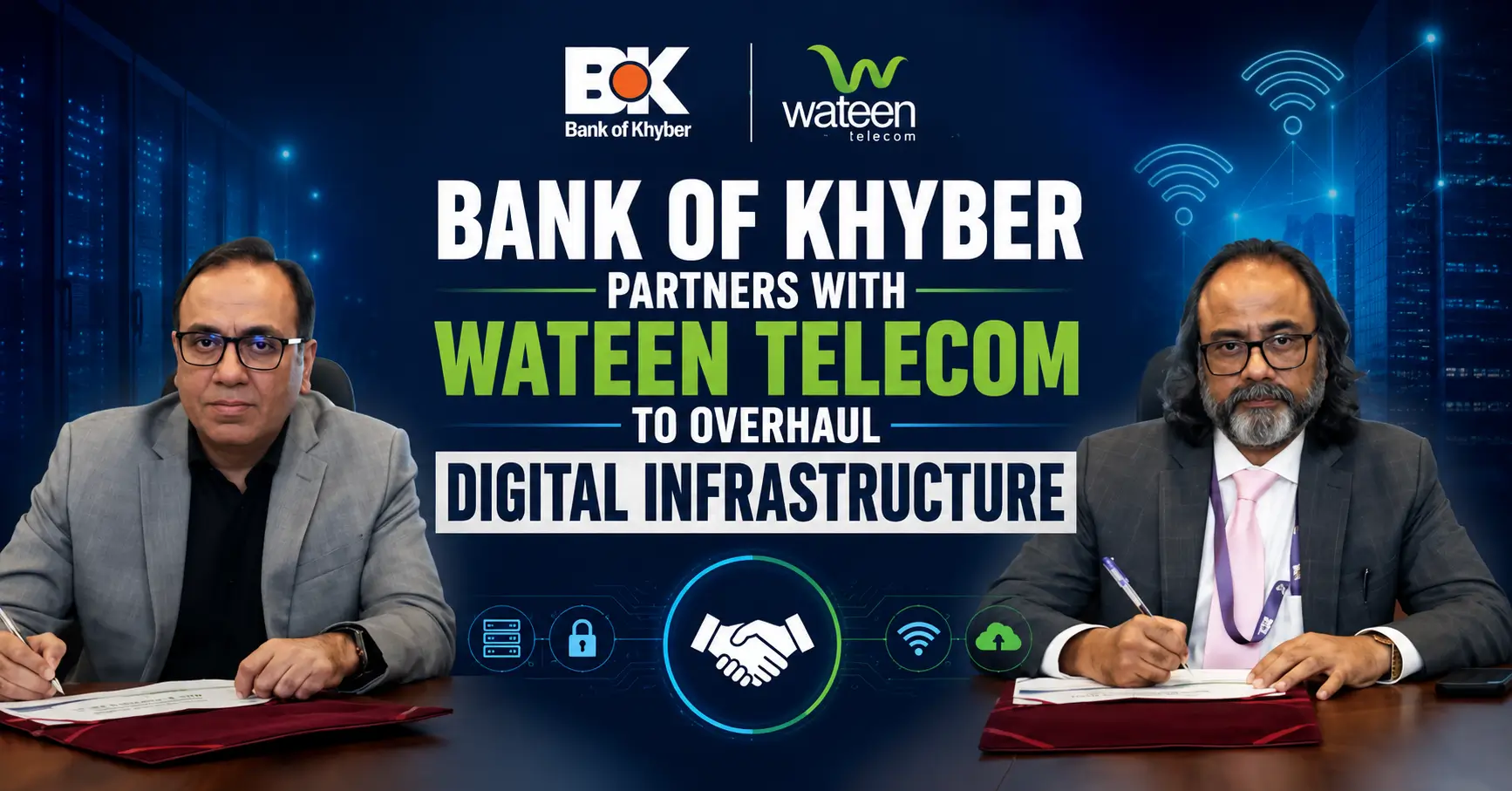

Bank of Khyber Wateen Telecom is now more than an IT vendor arrangement — it’s a signal of how Pakistani banks are rethinking connectivity and cybersecurity at the same time. The Peshawar-based lender has signed a formal agreement with Wateen Telecom Limited to roll out a centralized Wi-Fi network layered with an advanced Web Application Firewall across its offices nationwide.
The deal, signed this week, pairs one of Khyber Pakhtunkhwa’s largest financial institutions with one of Pakistan’s fastest-growing fiber infrastructure providers. For a bank expanding its digital services footprint, the timing is not incidental.
What the Bank of Khyber Wateen Telecom Agreement Involves

The Bank of Khyber Wateen Telecom agreement centers on two connected components a centralized wireless network for BoK’s offices, and a Web Application Firewall (WAF) designed to protect internet-facing banking applications. Together they form a single security-and-connectivity layer rather than two separate contracts.
Under the arrangement, Wateen will manage wireless connectivity across Bank of Khyber’s office locations, replacing fragmented, branch-level setups with one centrally administered system. The WAF component sits on top, screening traffic to the bank’s digital banking platforms against threats such as SQL injection, cross-site scripting, and bot-driven attacks.
- Centralized Wi-Fi deployment across BoK offices
- Integrated Web Application Firewall for internet-facing platforms
- Focus on securing digital banking channels, not just internal office networks
- Positioned as part of BoK’s broader technology infrastructure upgrade
Who Signed the Deal: Executives Behind the Partnership
The signing ceremony brought together senior technology leadership from both sides, underlining that this is an IT-operations-driven deal rather than a purely commercial one. Bank of Khyber was represented by Rashid Zaman Khan, Chief Information Officer, and Syed Muhammad Jafar, Head of IT Operations.
Representing Wateen Telecom were Adil Rashid, Chief Executive Officer, and Nasir Mahmood, Vice President. Senior representatives from both organizations attended, according to details shared following the ceremony. The presence of both CIOs and CEO-level executives suggests the project has visibility well beyond a routine procurement decision.
Why a Web Application Firewall Matters for Digital Banking

A Web Application Firewall filters and monitors HTTP traffic between a web application and the internet, blocking malicious requests before they reach core banking systems. For a bank running online and mobile banking platforms, this layer sits between customers and sensitive financial data.
Pakistani banks have expanded digital channels rapidly in recent years, and each new channel — mobile apps, APIs, third-party integrations — widens the attack surface. Industry cybersecurity assessments for 2026 flag financial institutions as among the most targeted sectors globally, given the direct combination of money and personal data they hold.
| Component | Function | Primary Benefit |
|---|---|---|
| Centralized Wi-Fi | Unified wireless network across offices | Consistent, manageable connectivity |
| Web Application Firewall | Filters traffic to digital banking apps | Protection against web-based attacks |
| Combined deployment | Single managed infrastructure layer | Reduced operational and security gaps |
Bank of Khyber’s Digital Banking Push in 2026
Bank of Khyber, established in 1991 and majority-owned by the Government of Khyber Pakhtunkhwa, operates more than 280 branches and sub-branches across Pakistan. It has been steadily expanding both its physical network and its digital offering, including the BoK Digital mobile app built on two-factor OTP authentication.
READ MORE: MG Pakistan Signs MoU to Export Cars to Bangladesh
The bank has also been posting stronger financial results in recent reporting periods and has been recognised regionally for shareholder returns. Layering a firewall-backed security upgrade onto this growth phase reflects an institution trying to scale digital banking without expanding its exposure to fraud or downtime.
- Government of Khyber Pakhtunkhwa holds majority ownership of BoK
- Network includes conventional and dedicated Islamic banking branches
- BoK Digital app already uses OTP-based two-factor authentication
- Recent periods have shown improved financial performance for the bank
Wateen Telecom’s Track Record in Pakistan’s Financial Sector

This is not Wateen’s first foray into banking infrastructure. The company recently partnered with The Bank of Punjab to establish an AI Factory aimed at accelerating AI-driven innovation in banking operations, a deal signed by Wateen CEO Adil Rashid and BOP’s Chief Information Officer Faisal Ejaz Khan.
Wateen has also renewed its Long Distance International (LDI) license, reinforcing its role in nationwide fiber and voice infrastructure ahead of Pakistan’s 5G rollout. Adil Rashid described the renewal as reflecting the company’s “consistent compliance, operational excellence, and contribution to Pakistan’s digital ecosystem.” The Bank of Khyber Wateen Telecom deal extends that pattern into a second provincial bank.
How This Fits Pakistan’s Wider Banking Cybersecurity Trend
Banking cybersecurity has become a defining concern for financial regulators and institutions worldwide heading into 2026, with layered defense — combining network security, endpoint protection, and identity management — increasingly treated as baseline rather than optional. Pakistani banks are no exception to this shift.
The Bank of Khyber Wateen Telecom partnership mirrors moves already underway at other regional lenders, where telecom infrastructure providers are being brought in specifically to harden digital banking platforms rather than just improve office connectivity. It suggests provincial banks are treating cybersecurity spend as core infrastructure, not an add-on.
What This Means for BoK Customers and the KP Banking Sector
For everyday customers, the practical impact should show up as fewer outages, faster in-branch connectivity, and stronger protection for online and mobile transactions. None of this is visible on the surface, but it underpins whether digital banking channels stay reliable as usage grows.
For the broader Khyber Pakhtunkhwa banking sector, the deal adds pressure on peer institutions to match similar security investments. As digital adoption climbs across the province, infrastructure resilience is becoming as competitive a factor as interest rates or branch count.
- Improved reliability expected across BoK’s digital banking channels
- Stronger defenses against web-based attacks on customer-facing platforms
- Signals rising baseline expectations for bank cybersecurity in KP
- Adds to Wateen’s growing footprint in Pakistan’s financial sector
Expert and Industry Perspective
Wateen has consistently framed its financial-sector deals as part of a national connectivity mandate. Referring to the company’s infrastructure renewal, CEO Adil Rashid said the move “reinforces our commitment to expanding the country’s connectivity backbone and supporting national 5G readiness.”
That framing extends naturally to the BoK deal: a provincial bank securing its digital perimeter through a telecom partner already embedded in Pakistan’s broader fiber and cybersecurity buildout. Whether this translates into measurably fewer security incidents will depend on execution once the rollout moves from signing to deployment.
Implications Going Forward
The Bank of Khyber Wateen Telecom agreement is a modest-sounding IT upgrade with outsized relevance: it ties a provincial government-owned bank’s digital future to Pakistan’s leading fiber infrastructure operator at a moment when banking cyber threats are intensifying. Execution timelines and rollout scope have not been disclosed publicly.
As more Pakistani banks pursue similar partnerships, the real test will be whether centralized connectivity and firewall protection actually reduce downtime and fraud incidents in daily operations — not just on paper.