


SCO digital governance is now formally on the table in Urumqi. Federal Minister Ahsan Iqbal used a closed-door SCO session on Monday to push member states toward a shared digital and AI future.
Ahsan Iqbal Proposes SCO Digital Governance Push in Urumqi
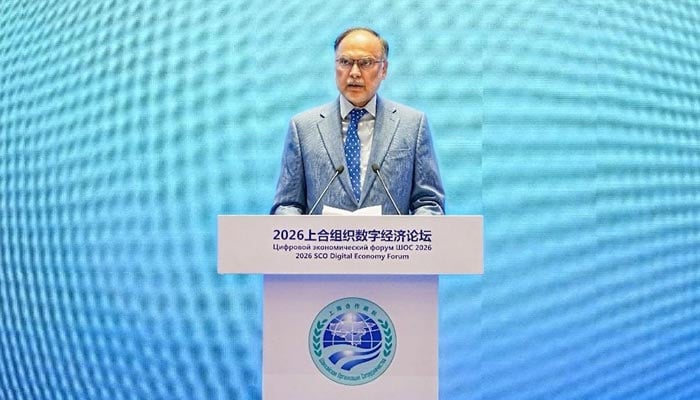
Speaking at the Ministerial-Level Closed-Door Meeting on SCO Digital Economy Cooperation, Iqbal called the digital economy “a key driver of productivity, trade, governance and human development” for the entire SCO bloc.
He wasn’t there to make a courtesy speech. Iqbal is attending the SCO Digital Economy Forum 2026 in Xinjiang, and his remarks carry the weight of Pakistan’s current SCO Council presidency.
Inside the SCO Digital Connectivity and Compute Corridor
The centerpiece proposal is an SCO Digital Connectivity and Compute Corridor — a regional network meant to physically wire the bloc together for the AI era, not just talk about cooperation in principle.
ALSO READ: Indus Waters Treaty ruling a diplomatic win for Pakistan
Iqbal described it as combining several layers of infrastructure. He was explicit that the benefits shouldn’t stop at government ministries.
- Cross-border fibre links and resilient digital networks
- Regional data centres and satellite connectivity
- Interoperable cloud and computing resources
- Access extended to universities, startups, SMEs, women, youth and remote communities
Four Priorities Driving Pakistan’s SCO Digital Cooperation
Beyond the corridor, Pakistan tabled four concrete priority areas for SCO digital governance, moving the conversation from broad ambition into something closer to a policy menu.
The clearest of these is a proposed digital trade corridor — integrating customs, logistics, e-documentation and cross-border payments so regional trade moves faster and cheaper.
Digital Trade Corridor and Cross-Border Systems
This piece targets the plumbing of trade: digital signatures, electronic customs clearance, and payment interoperability across SCO borders, an area where Pakistan’s own fintech growth gives it some credibility to lead.
| Priority Area | What It Covers |
|---|---|
| Digital Trade Corridor | Customs, logistics, e-documents, cross-border payments |
| Compute Corridor | Fibre, data centres, satellite links, cloud interoperability |
| Sovereign AI Framework | National AI capability-building, joint governance standards |
| Capacity-Building Network | Multilingual AI models, university partnerships, HR development |
Sovereign AI Infrastructure and Governance Framework

Iqbal also backed an SCO Sovereign AI Infrastructure and Governance Framework, aimed at strengthening each member’s own AI capacity while keeping development responsible and accountable across borders.
He tied this to joint research, multilingual AI models, university partnerships and human resource development — an AI capacity-building network in everything but name.
Pakistan’s Domestic Digital Backbone: URAAN and E-Pakistan
None of this is being pitched in a vacuum. Iqbal grounded the SCO digital governance pitch in Pakistan’s own reforms, framing the country as a credible partner rather than just a petitioner.
He pointed to E-Pakistan as one of URAAN Pakistan’s five pillars, alongside legal and institutional groundwork already in motion domestically.
- Digital Nation Pakistan Act 2025
- Pakistan Digital Authority
- National AI Policy
Record $4.6 Billion IT Exports Feed a $1 Trillion Ambition
Iqbal leaned on hard numbers to back the pitch. Pakistan’s IT and ICT exports hit a record $4.6 billion last fiscal year, part of a broader push away from pure services exports.
“Pakistan’s next goal is not merely the export of services, but the promotion of technology products, digital platforms and technology-driven industries,” Iqbal told the forum, linking this shift to Uraan Pakistan’s $1 trillion economy target by 2035.
Trust, Privacy and Sovereignty in SCO Digital Governance

No regional data-sharing push survives without addressing trust, and Iqbal didn’t skip it. He named privacy, cybersecurity, accountability, transparent data access and national sovereignty as non-negotiable conditions for cooperation.
This matters because SCO digital governance proposals of this scale often stall exactly here — member states rarely agree easily on data sovereignty terms once corridors and frameworks move from paper to practice.
Pakistan’s SCO Presidency and What Comes Next
Pakistan currently holds the SCO Council of Heads of State presidency, running under the theme “Turning Vision into Action: Connectivity, Innovation and Shared Prosperity” — a title Iqbal referenced directly in his remarks.
He proposed institutionalizing this SCO digital governance agenda through regular ministerial dialogue, technical coordination groups and result-oriented projects, rather than one-off forum statements.
“Pakistan stands ready to work with SCO member states to transform connectivity, innovation and trust into shared digital prosperity,” Iqbal said.
Analysis: Can the SCO Digital Governance Vision Deliver?
Ambitious regional tech corridors have a mixed record SCO’s own connectivity pledges going back years show follow-through is the hard part, not the announcement.
What’s different this time is the pairing of infrastructure asks (corridor, data centres) with governance asks (AI framework, sovereignty safeguards) in a single package, backed by Pakistan’s own legislative moves at home.
Beijing, Moscow and Central Asian members move at the same pace as Islamabad wants remains the open question SCO consensus-building has historically been slow on anything touching data sovereignty.