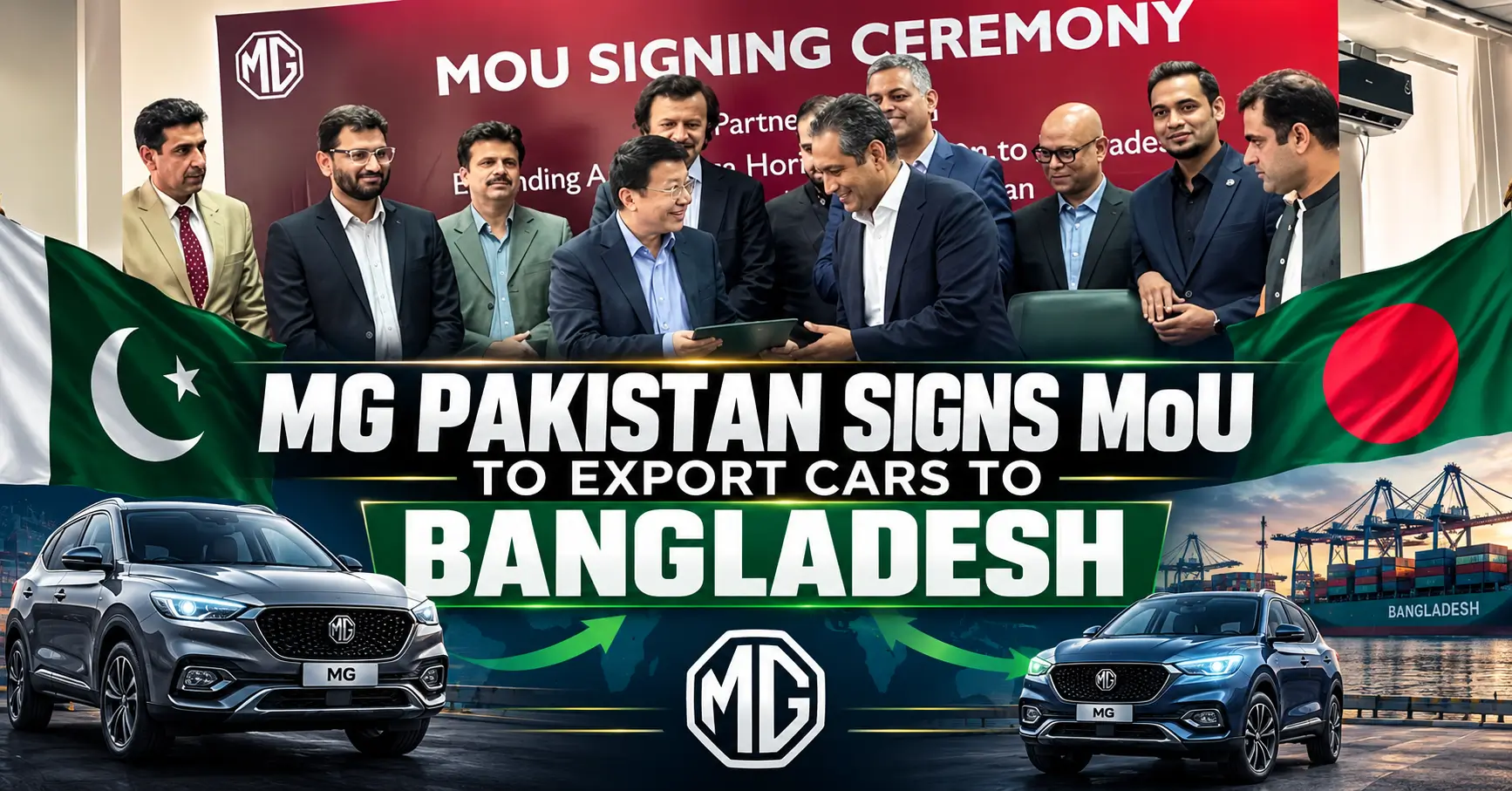

MG Pakistan Bangladesh car exports are no longer just talk. Pakistan has formally signed an agreement to ship locally manufactured vehicles to Bangladesh, with officials setting a firm target: 5,000 units by 2029. For an industry that has spent decades selling almost exclusively at home, that’s a notable shift.
The announcement came this week from Islamabad, where Special Assistant to the Prime Minister on Industries and Production, Haroon Akhtar Khan, called it a milestone moment for Pakistan’s assembly lines.
What the Pakistan-Bangladesh Vehicle Export MoU Actually Says

The core of the deal is straightforward. Pakistani manufacturers, MG among them, will begin exporting completed vehicles to Bangladesh, with the 5,000-unit figure serving as a benchmark for the next roughly three years.
Officials framed it as the first large-scale export of Pakistan-built cars to the South Asian neighbor. That’s significant, because Pakistan’s auto sector has historically imported technology and parts far more than it has sent finished products abroad.
Who’s Driving the Deal: Officials and Companies Involved
Haroon Akhtar Khan positioned the agreement inside a bigger government narrative: turning Pakistan into a manufacturing hub with Chinese investment as a key driver. He pointed to more than 150 MoUs already signed for battery production domestically.
READ MORE: Zindigi Wins TAF Public-Private Collaboration Award
He also noted that roughly 95% of mobile phones sold in Pakistan are now locally made, and that solar panel manufacturing is next on the list — part of a broader industrial push beyond just automobiles.
- Over 150 MoUs signed for local battery production
- ~95% of mobile phones used in Pakistan now made locally
- 86 licences issued for two-wheeled electric motorcycle manufacturing
- Domestic solar panel production planned to cut import reliance
MG Pakistan’s Stake in the Agreement

MG Pakistan CEO Jian Qiang Sao weighed in on the announcement, saying the automobile industry in any country needs consistent policy support and protection to grow on a sustainable footing. It’s a pointed remark, given how often Pakistan’s auto policies have shifted in recent years.
MG has been assembling vehicles in Lahore since 2020 through its joint venture, MG JW Automobile Pakistan, a partnership between China’s SAIC Motor and the local JW-SEZ Group. That existing manufacturing base is presumably what positions it to export rather than just build for domestic buyers.
Pakistan’s Wider Export Ambitions: Where This Fits
This Bangladesh deal doesn’t exist in isolation. It lands right as Pakistan finalizes its draft Auto Industry Development and Export Policy (AIDEP) 2026-31, which sets far bigger targets for the sector as a whole.
| Metric | Current / Recent | 2031 Target |
|---|---|---|
| Annual vehicle production | ~56,000 units (FY2022-23) | 500,000+ units |
| Auto exports | Minimal | $1 billion |
| Tractor production | Varies | 100,000 annually |
| NEV share of new sales | Low | 30% by 2030 |
Those numbers put the 5,000-vehicle Bangladesh target into perspective. It’s a modest first step compared to the billion-dollar export ambition, but it’s a real, signed commitment rather than another draft policy paper.
Why Bangladesh, and What Else Is on the Table
Bangladesh already has an appetite for MG vehicles — the brand is sold there through Rancon Motors, with models like the ZS and HS available on the local market. That existing brand familiarity likely made it an easier first destination for Pakistani-assembled exports.
Rincon Auto’s Managing Director, Romorau Chaudhry, added another layer: strong Bangladeshi demand for electric motorcycles, an area where Pakistan has been issuing licences rapidly. Two-wheeler EVs could end up being just as significant to this trade relationship as passenger cars.
- MG models already have brand recognition in Bangladesh
- Electric motorcycle demand flagged as a parallel opportunity
- Pakistan’s EV motorcycle licensing (86 issued) supports future capacity
Industry Reaction and the Road Ahead
Analysts tracking Pakistan’s auto sector have been cautious about export promises before. The country has floated ambitious auto policies roughly every five years, and previous targets haven’t always survived budget realities or IMF-linked fiscal constraints.
Even so, a signed MoU with a specific numeric target and named companies is a firmer commitment than a draft policy document. Whether MG and its partners can scale exports to 5,000 units within three years will depend heavily on tariff structures, localization rules, and how the AIDEP 2026-31 policy is finally approved.
For now, MG Pakistan Bangladesh car exports stand as a test case — a small but concrete signal of Pakistan manufacturing sector can genuinely go global, or whether this becomes another announcement that quietly fades.