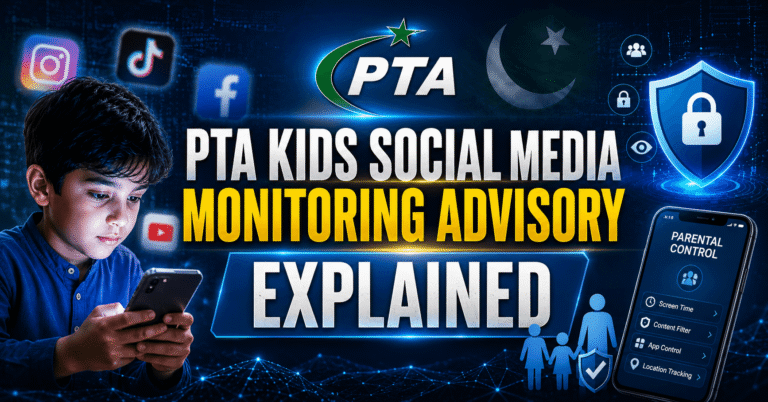

A new PTA kids social media monitoring advisory has landed at a moment when Pakistani households are more connected than ever — and more exposed. The Pakistan Telecommunication Authority issued the public notice on July 30, urging families to tighten supervision of what children do online, from Instagram reels to TikTok trends.
It’s not an isolated warning. It’s the latest in a string of regulatory advisories PTA has pushed out through 2026, each one chipping away at a different corner of digital risk.
PTA Kids Social Media Monitoring: What the Advisory Actually Says

The PTA kids social media monitoring notice asks parents to take a far more active role in their children’s digital lives. It calls for responsible internet use, closer supervision, and open dialogue between parents and kids about what happens on their screens.
Specifically, the authority wants families using built-in safety tools on major platforms. It also wants ongoing conversations at home — not a one-time lecture — about risks children may not recognize on their own.
Why Pakistan’s Telecom Regulator Is Prioritizing Child Online Safety Now
Timing matters here. This advisory arrived just one day after PTA warned the public that online activity can carry lasting consequences, and weeks after separate notices on password security and foreign SIM misuse.
READ MORE: Spotify AI Music Assistant: New Chat Feature 2026
Together, these signal a regulator shifting from reactive enforcement toward preventive public education. Child safety appears to be the newest — and arguably most sensitive — pillar of that push.
Parental Controls and Content Filters PTA Wants Families Using
PTA specifically named Instagram, TikTok, and Facebook, urging parents to activate age-appropriate filters already built into these apps. The recommendation leans on existing tools rather than third-party software, making it easier for less tech-savvy parents to comply.
Key tools PTA is pointing families toward include:
- Parental control dashboards native to each platform
- Age-appropriate content filtering settings
- Screen-time and usage limit controls
- Reporting features for flagged or unsafe content
These aren’t new features — but PTA’s push may be the first time many parents hear about them directly from a government body.
Talking to Children About Cyberbullying and Online Harassment

Beyond settings and filters, PTA emphasized something harder to enforce: conversation. Parents are being asked to regularly discuss cyberbullying and online harassment with their kids, not just install software and walk away.
The goal is recognition, not just restriction. PTA wants children able to identify harmful behavior themselves and know exactly how to report it, rather than relying solely on parental oversight to catch every incident.
Protecting Children’s Personal Data: Location, Photos and Sensitive Details
A core strand of the advisory targets oversharing. PTA flagged location tagging, photo sharing, and other personal details as common ways children unintentionally expose themselves to risk online.
The regulator separately advised against storing financial or health-related information on shared devices or online platforms — a reminder that family digital habits, not just children’s accounts, shape overall household exposure to fraud and misuse.
Inside PTA’s Wider 2026 Digital Safety Campaign
This advisory doesn’t stand alone. PTA has been building a layered public-awareness campaign for months, and each notice targets a different vulnerability.
| Date (2026) | Advisory Focus |
|---|---|
| June 19 | Password security & two-factor authentication |
| Mid-July | Hate speech and unlawful content warnings |
| ~Late July | Foreign SIM card misuse warning |
| July 29 | Digital footprint & long-term consequences of online posts |
| July 30 | PTA kids social media monitoring advisory |
Read as a sequence, the pattern is clear: PTA is moving from account-level security toward behavioral and family-level digital responsibility.
What Child-Safety Research Says About Parental Monitoring

International guidance broadly supports what PTA is now recommending. Health bodies elsewhere have encouraged parental monitoring and guidance for younger teens, particularly those in early adolescence, while cautioning against monitoring so intrusive it damages trust.
Researchers generally split monitoring into two types — active engagement, where parents talk and participate, and passive tracking through settings and apps. PTA’s advisory leans toward the former, prioritizing communication over covert surveillance.
What This Means for Pakistani Families Going Forward
For now, PTA’s advisory carries no penalties or enforcement mechanism — it’s guidance, not law. That could change if online harm cases involving minors continue rising, pushing the conversation toward firmer platform accountability.
What’s clear is that Pakistani parents are being handed more responsibility, with fewer excuses for inaction. The tools PTA recommends already exist inside the apps children use every day — the missing piece has simply been awareness.