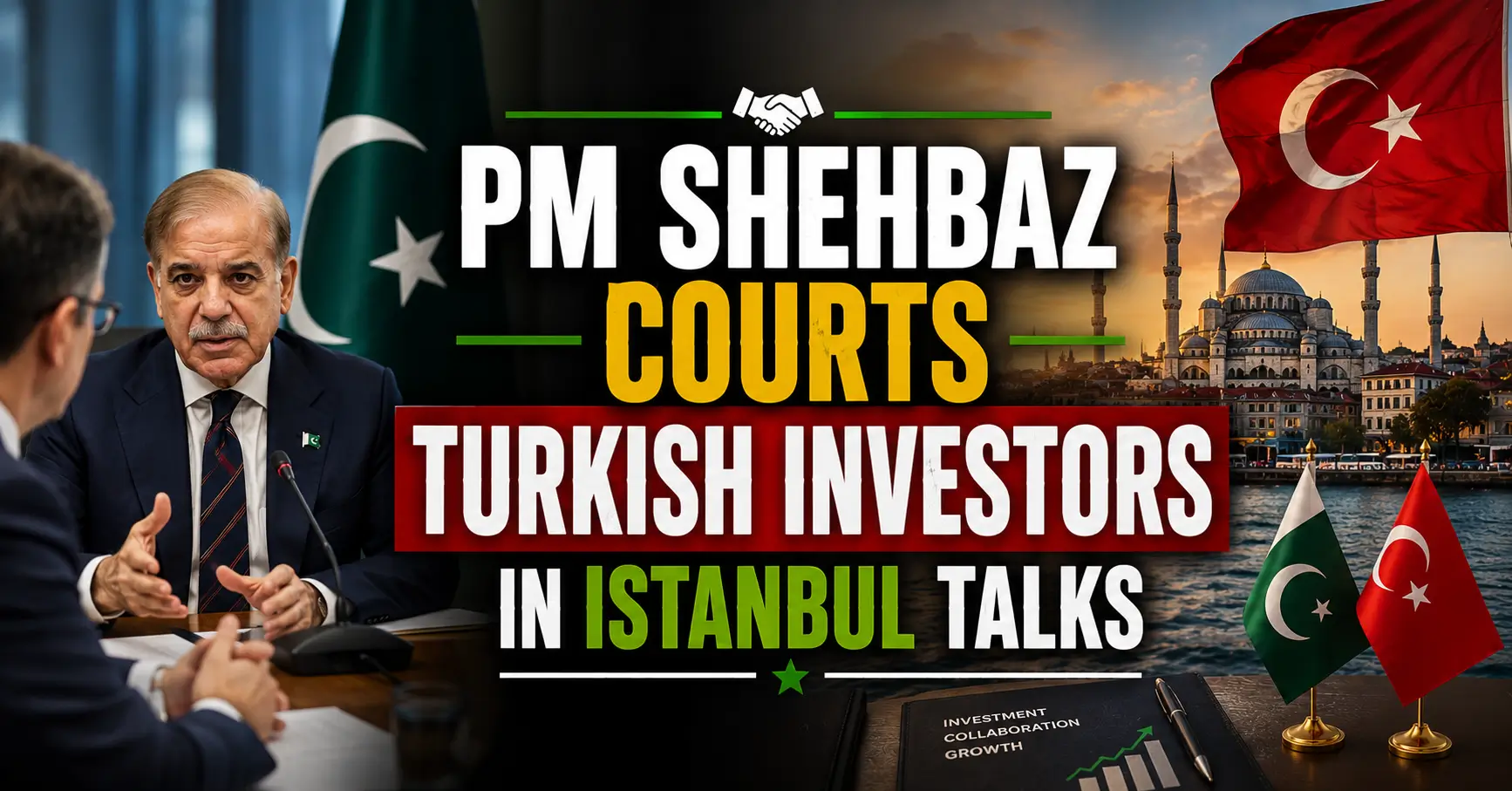

Turkiye’s President Recep Tayyip Erdogan on Saturday said Islamabad and Ankara have reaffirmed their target to increase the bilateral trade volume to $5 billion.
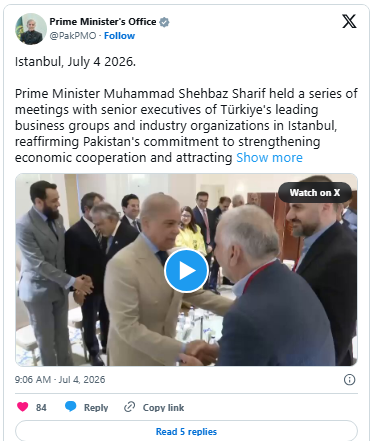
Prime Minister Shehbaz Sharif spent Saturday moving between boardrooms and palace halls in Istanbul, stacking meetings with some of Turkiye’s biggest industrial names before sitting down with President Recep Tayyip Erdogan himself. The message across every room was the same: Pakistan is open, and it wants Turkish money.
This wasn’t a courtesy visit. It was a sales pitch dressed up as diplomacy.
A Palace Meeting With Heavy Company
Erdogan received Shehbaz at Istanbul’s Vahdettin Palace, where the two leaders sat down for closed-door talks. The room wasn’t empty of consequence — Turkish Foreign Minister Hakan Fidan, intelligence chief Ibrahim Kalin, communications director Burhanettin Duran and presidential adviser Akif Cagatay Kilic were all present, according to the Turkish presidency’s own account of the meeting.
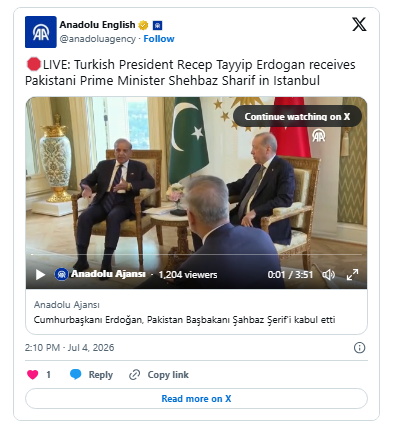
That’s not a guest list for small talk. It signals Ankara treats this relationship as strategic, not ceremonial.
Delegation-level talks and a joint press conference were expected to follow, with both governments framing the visit as touching “the entire gamut of bilateral relations,” in the words of Foreign Office spokesperson Tahir Andrabi, who had briefed reporters days earlier that trade and investment cooperation would anchor the agenda.
The Business Pitch: Sector by Sector
Before the palace meeting, Shehbaz had already been busy. Earlier Saturday, he addressed a Pakistan-Turkiye business-to-business conference alongside Turkish Vice President Cevdet Yilmaz, with Petroleum Minister Ali Pervaiz Malik, Power Minister Awais Leghari and IT Minister Shaza Fatima Khawaja rounding out the Pakistani delegation.
The pitch was specific. Shehbaz invited Turkish firms to expand into energy, mining and minerals, infrastructure, maritime and logistics, IT, telecommunications, manufacturing, agriculture and privatisation — essentially the full spread of Pakistan’s economy, according to a Prime Minister’s Office statement.
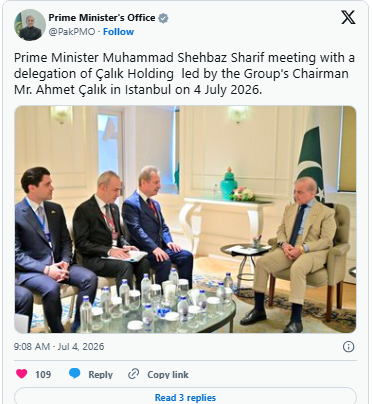
He didn’t stop at general invitations. In a one-on-one with Calik Holding chairman Ahmet Calik, Shehbaz pointed to the company’s existing footprint through Calik Enerji and GAP Insaat as a foundation to build on, encouraging deeper investment in energy, infrastructure, IT and privatisation.
Albayrak Group got a separate pitch — maritime infrastructure, port modernisation and logistics, sectors where Shehbaz said the group’s involvement could reshape Pakistan’s connectivity ambitions.
READ MORE: PM Shehbaz Approves Rs11 Billion for South Asian Games 2027
And in a meeting with Rifat Hisarciklioglu, president of the Union of Chambers and Commodity Exchanges of Turkiye (TOBB), the prime minister floated something more structural: a standing institutional mechanism for regular private-sector engagement between the two countries, plus an invitation for TOBB to bring a high-level business delegation to Pakistan.
The SIFC Card
Every pitch carried the same closing argument — the Special Investment Facilitation Council. Shehbaz repeatedly pointed to the SIFC as proof that Islamabad has built a “one-window” system for strategic investors, working across federal and provincial lines to cut red tape.
Whether that reassurance lands depends on whether Turkish capital actually follows through, something Pakistan has struggled with before when foreign pledges outpaced disbursed investment.
The Turkish side, at least publicly, sounded receptive.
Business leaders “reaffirmed their interest in expanding investments and developing long-term partnerships across a range of strategic sectors,” the PMO said, describing confidence in Pakistan’s economic trajectory.
A Digital Corridor Pitch to Turkcell
The most forward-looking meeting of the day may have been with Turkcell CEO Ali Taha Koc. Shehbaz used the sit-down to unveil a concept his government is calling the Pakistan-Turkiye Digital Corridor — an initiative aimed at strengthening regional digital connectivity, enabling secure cross-border data flows and integrating digital infrastructure between the two countries.
The ask to Turkcell was concrete: explore long-term collaboration in 5G deployment, network optimisation, spectrum management and technology transfer, with an added nudge toward local manufacturing of telecom equipment and digital skills development.
Koc’s response, per the PMO readout, praised Pakistan’s “forward-looking digital transformation agenda” and confirmed Turkcell’s interest in pursuing partnerships in telecommunications and emerging technologies.
Why the Timing Matters
This visit didn’t happen in isolation. Shehbaz arrived in Istanbul on Friday straight from Tehran, where he had attended the funeral of Iran’s Supreme Leader Ayatollah Ali Khamenei — a moment of regional upheaval that has kept Middle East diplomacy on edge. Erdogan and Shehbaz reportedly used part of their engagement to discuss the fragile Iran-US ceasefire and prospects for a durable peace framework, alongside the economic agenda.
The two leaders also agreed to convene the 8th High-Level Strategic Cooperation Council meeting in Ankara later this year, a sign that Saturday’s talks are meant to feed into a longer institutional track rather than stand alone.
It follows an April meeting between the same two leaders on the sidelines of the Antalya Diplomacy Forum, and last week’s signing of three MoUs between Pakistan and Turkiye on power-sector cooperation, technical collaboration and knowledge sharing.
The Real Test Ahead
Pledges and palace meetings are the easy part. What Pakistan needs now is capital that actually lands — factories built, ports upgraded, spectrum allocated. Turkish business leaders sounding optimistic in a PMO statement is not the same as signed term sheets.
Islamabad has leaned on the SIFC narrative before to court Gulf and Chinese investment, with mixed results on actual disbursement. Whether Turkish firms move faster than that track record suggests will be the real measure of Saturday’s diplomacy.