
Pakistani pilgrims planning a religious visit to Iraq have been put on serious notice. The Ministry of Religious Affairs and Inter-faith Harmony issued an official circular on 22nd June 2026, warning Zaireen and Ziarat Group Organizers (ZGOs) to strictly comply with Iraqi visa conditions — or risk being turned away at the border, permanently.
Iraq Raises Alarm Over Visa Misuse by Pakistani Pilgrims
The Government of Iraq has formally expressed concern to Pakistani authorities over a troubling pattern it has been observing at its immigration checkpoints. Iraqi immigration officials have noted cases in which individuals obtained visas as part of family groups but then arrived at the border without their accompanying family members — raising fears that some pilgrims are using religious visas to pursue purposes not declared in their original applications.
This is not a minor procedural complaint. Iraqi authorities have made their position crystal clear: if you misuse your Ziarat visa, you will face consequences — and neither the Pakistani Embassy nor any other authority will be able to help you once entry is refused.
The circular, signed by Section Officer (Ziarat) Muhammad Mujahid Khan and bearing reference No. 1(1)/2026-Ziarat, was addressed to all registered ZGOs and widely distributed through media and the Ministry’s IT department for maximum reach.
What the New Guidelines Actually Say
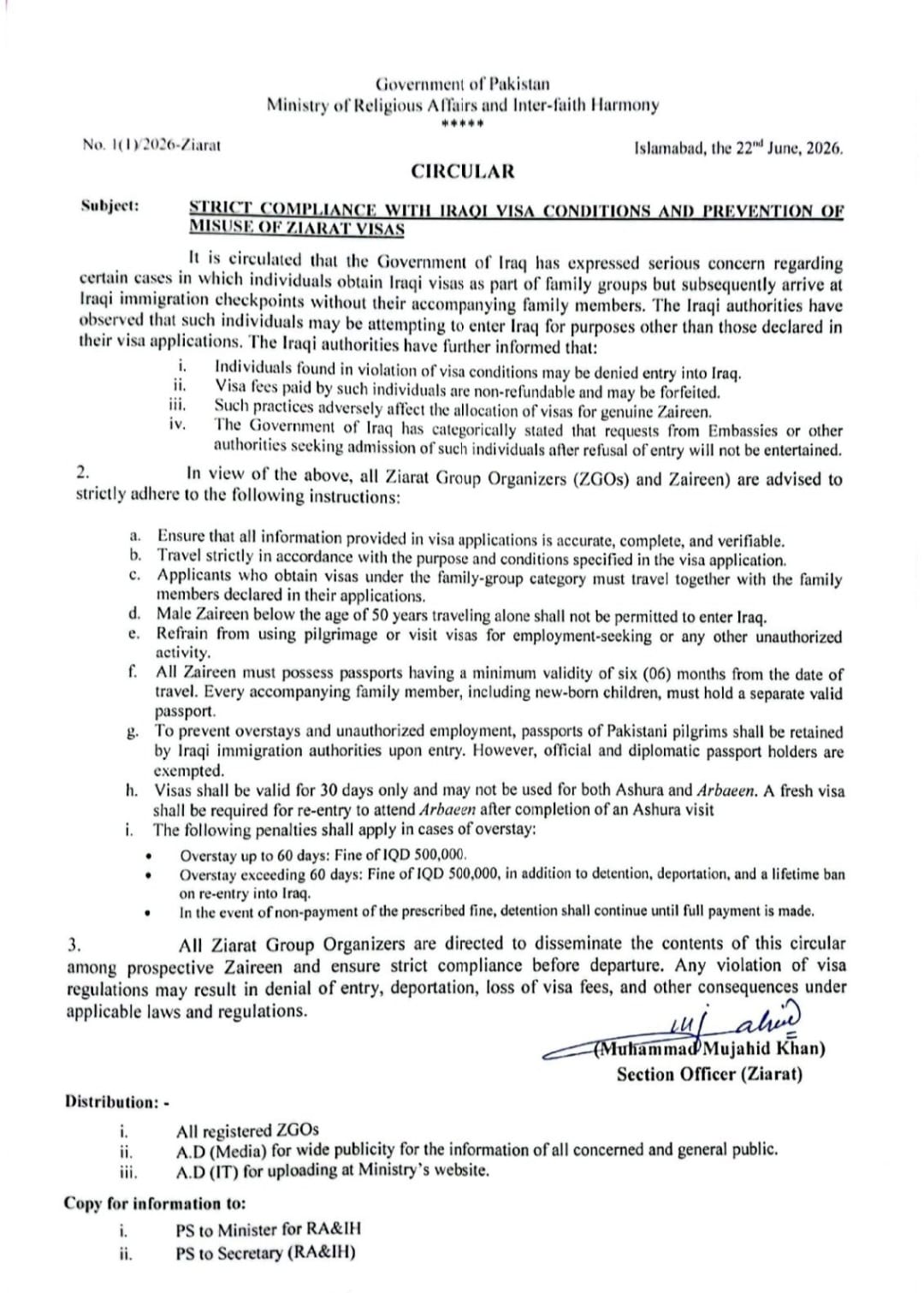
The Ministry of Religious Affairs has translated Iraq’s concerns into a firm set of instructions for all Zaireen and group organizers. These are not suggestions — they are mandatory compliance requirements.
Key rules every pilgrim must follow:
- All information submitted in visa applications must be accurate, complete, and verifiable
- Pilgrims must travel strictly for the purpose stated in their visa application
- Family-group visa holders must travel with the same family members listed in their application — no exceptions
- Male Zaireen below the age of 50 travelling alone will not be permitted to enter Iraq
- Pilgrimage or visit visas must not be used for employment-seeking or any other unauthorized activity
- Every pilgrim, including newborn children, must carry a passport with a minimum six months’ validity from the date of travel
- Passports of Pakistani pilgrims will be retained by Iraqi immigration authorities upon entry to prevent overstays and unauthorized employment — though official and diplomatic passport holders are exempt from this rule
That last point will come as a surprise to many first-time Zaireen. Handing over your passport at the Iraqi border is standard procedure for Pakistani nationals and is managed by the designated Mandoob (representative) of your licensed travel company.
One Visa Cannot Cover Both Ashura and Arbaeen
An important rule that many pilgrims overlook: a single Iraqi Ziarat visa cannot be used for both Ashura and Arbaeen visits. Visas are valid for 30 days only, and a fresh visa will be required for re-entry to attend Arbaeen after the completion of an Ashura visit.
This matters enormously for those planning back-to-back religious observances. Pilgrims who attempt to remain in Iraq between the two events without the appropriate documentation will be considered overstayers and will face the penalties outlined below.
The Penalty for Overstaying in Iraq Is Severe
Iraq does not take visa violations lightly — and the financial and legal consequences of overstaying are significant.
Overstay penalties:
- Up to 60 days overstay: Fine of IQD 500,000
- More than 60 days: Fine of IQD 500,000 plus detention, deportation, and a lifetime ban on re-entry into Iraq
- If the fine is not paid, detention continues until full payment is made
These are not theoretical penalties. The Iraqi government has made it clear that it will enforce them — and that no embassy or outside authority will be entertained once a pilgrim has been refused entry or flagged for a violation.
The Iraqi government has categorically stated that it will not entertain requests from embassies or other authorities seeking admission for individuals who have been refused entry. In plain terms: once you are turned away at the Iraqi border, Pakistan’s Embassy in Baghdad cannot get you back in.
Who Is Responsible — Pilgrims and ZGOs Both
Pakistan’s Ministry of Religious Affairs has placed responsibility squarely on two groups: individual Zaireen and the Ziarat Group Organizers who coordinate their travel.
All registered ZGOs have been directed to disseminate the contents of this circular among prospective pilgrims and ensure strict compliance before departure. Any violation of visa regulations may result in denial of entry, deportation, loss of visa fees, and other consequences under applicable laws and regulations.
This is significant. If a pilgrim is turned away because their ZGO failed to properly brief them or allowed them to travel with inaccurate documentation, the organizer faces accountability too. Pakistan’s broader Ziarat Policy, which replaced the older Salar system, was specifically designed to make licensed ZGOs accountable for transport, housing, and the welfare and regulatory compliance of their pilgrims.
For ordinary Pakistanis who book their Iraq trip through a travel agent, this means you should be asking your ZGO pointed questions before you travel — and getting answers in writing.
Why This Warning Matters Now
Religious tourism to Iraq’s holy cities — Najaf, Karbala, Samarra, and Baghdad — is one of the most spiritually significant journeys for Pakistani Shia Muslims. Hundreds of thousands of Pakistanis travel to Iraq each year for observances like Ashura and Arbaeen. The scale of this pilgrimage has grown considerably in recent years.
But this scale has also brought problems. Some individuals have exploited the family-group visa category to travel alone, raising concerns at Iraqi checkpoints. Others have overstayed their visas to seek informal work. A few have used religious travel as a cover for purposes entirely unrelated to pilgrimage.
The Iraqi government’s patience with these violations has run out — and Pakistan’s Ministry of Religious Affairs is now acting as the enforcement relay, making sure the message gets to every pilgrim before they board a flight to Baghdad or Najaf.
For genuine Zaireen — those travelling sincerely for religious purposes with accurate documentation — these rules should not be a barrier. They are designed to protect the integrity of the visa system so that Iraq’s doors remain open for authentic pilgrimage.
Checklist Before You Travel to Iraq for Ziarat
If you are planning a Ziarat visit to Iraq in 2026, here is a practical checklist based on the Ministry’s circular:
- Ensure your passport is valid for at least six months from your travel date
- Every family member — including newborn children — must have their own valid passport
- All information in your visa application must match your actual travel plans
- If you applied under a family-group visa, you must travel with those same family members
- Men under 50 must not travel alone — group or family travel is required
- Do not plan to use a single visa for both Ashura and Arbaeen — apply for a fresh visa for Arbaeen
- Your passport will be held by Iraqi immigration upon entry — this is normal procedure
- Confirm your ZGO is registered and has briefed you on all compliance requirements
- Keep a copy of all your documents separate from your passport
Final Word: Travel Right, Travel Safe
The message from Islamabad and Baghdad is simple: the privilege of Ziarat travel depends on pilgrims honouring the conditions under which they are admitted into Iraq. Those who follow the rules will have a smooth, spiritually fulfilling journey. Those who misuse the system risk losing not just money and their place in the pilgrimage — but potentially their ability to ever return to the holy shrines again.
If you are a Zaireen preparing for Iraq in 2026, read this circular carefully, verify your documentation, and book only through a Ministry-registered Ziarat Group Organizer.
Are you planning a Ziarat trip this year? Share this article with fellow pilgrims so they travel informed and protected.
People Also Ask
Can Pakistani men under 50 travel alone to Iraq for Ziarat?
No. As per the June 2026 circular, male Zaireen below the age of 50 are not permitted to enter Iraq unless travelling with the family members listed on their visa application.
What happens if a Pakistani pilgrim overstays their Iraqi visa?
Overstaying up to 60 days carries a fine of IQD 500,000. Overstaying beyond 60 days results in the same fine plus detention, deportation, and a lifetime ban on re-entry into Iraq.
Can I use one Iraqi Ziarat visa for both Ashura and Arbaeen?
No. Ziarat visas are valid for 30 days only. A separate fresh visa is required to attend Arbaeen after an Ashura visit.
Why will Iraqi immigration keep my passport at the border?
To prevent overstays and unauthorised employment, Iraqi authorities retain Pakistani pilgrims’ passports upon entry. Diplomatic and official passport holders are exempt from this rule.
What are the responsibilities of Ziarat Group Organizers (ZGOs)?
Licensed ZGOs are responsible for ensuring pilgrims have accurate documentation, disseminating Ministry circulars, and ensuring full visa compliance before departure.