
Trump and Iran Seal Historic Islamabad Peace Deal — Here’s What Actually Happened
After months of missiles, blockades, broken ceasefires, and marathon negotiations, the United States and Iran have done something that once seemed nearly impossible — they’ve signed a deal to end their war.
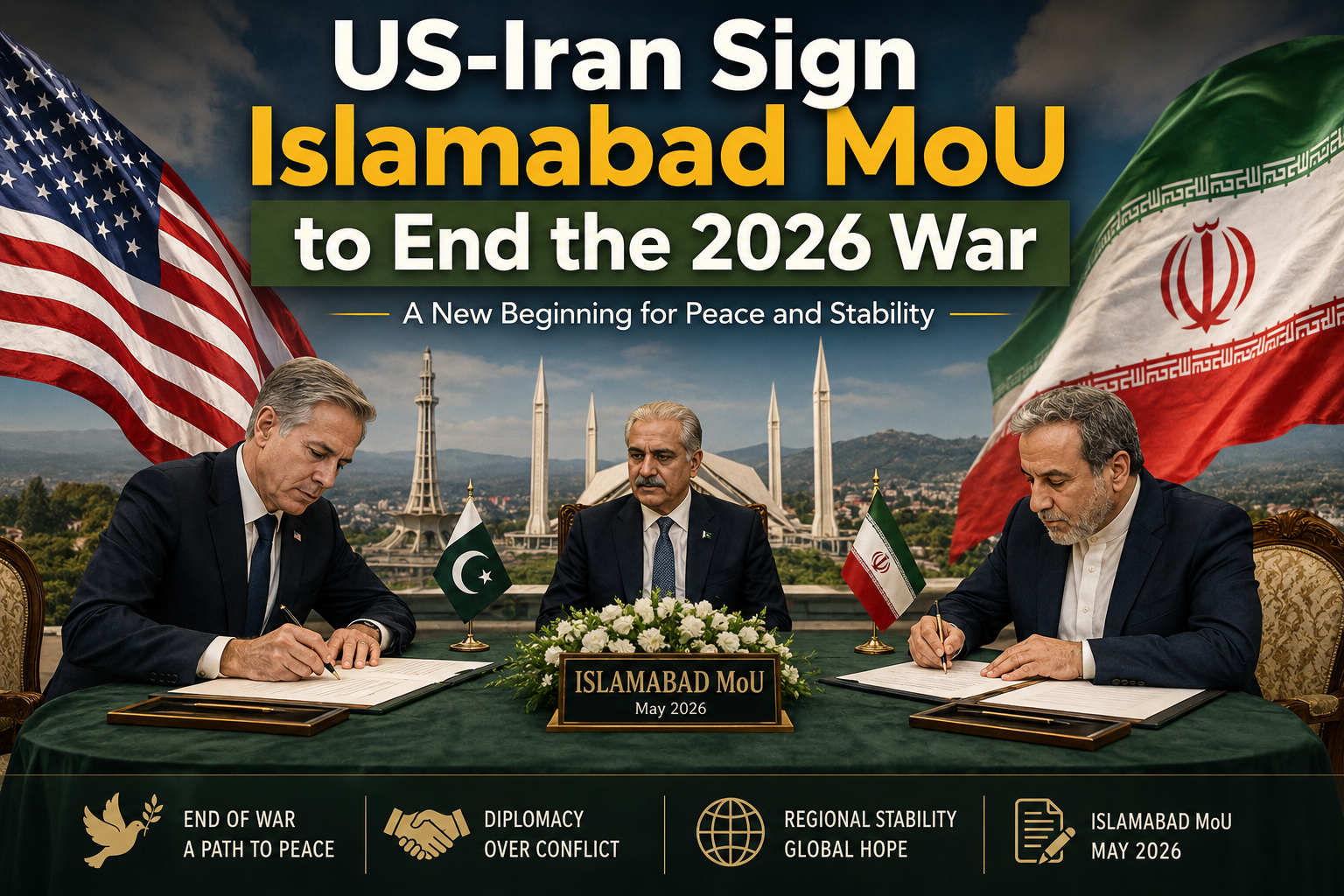
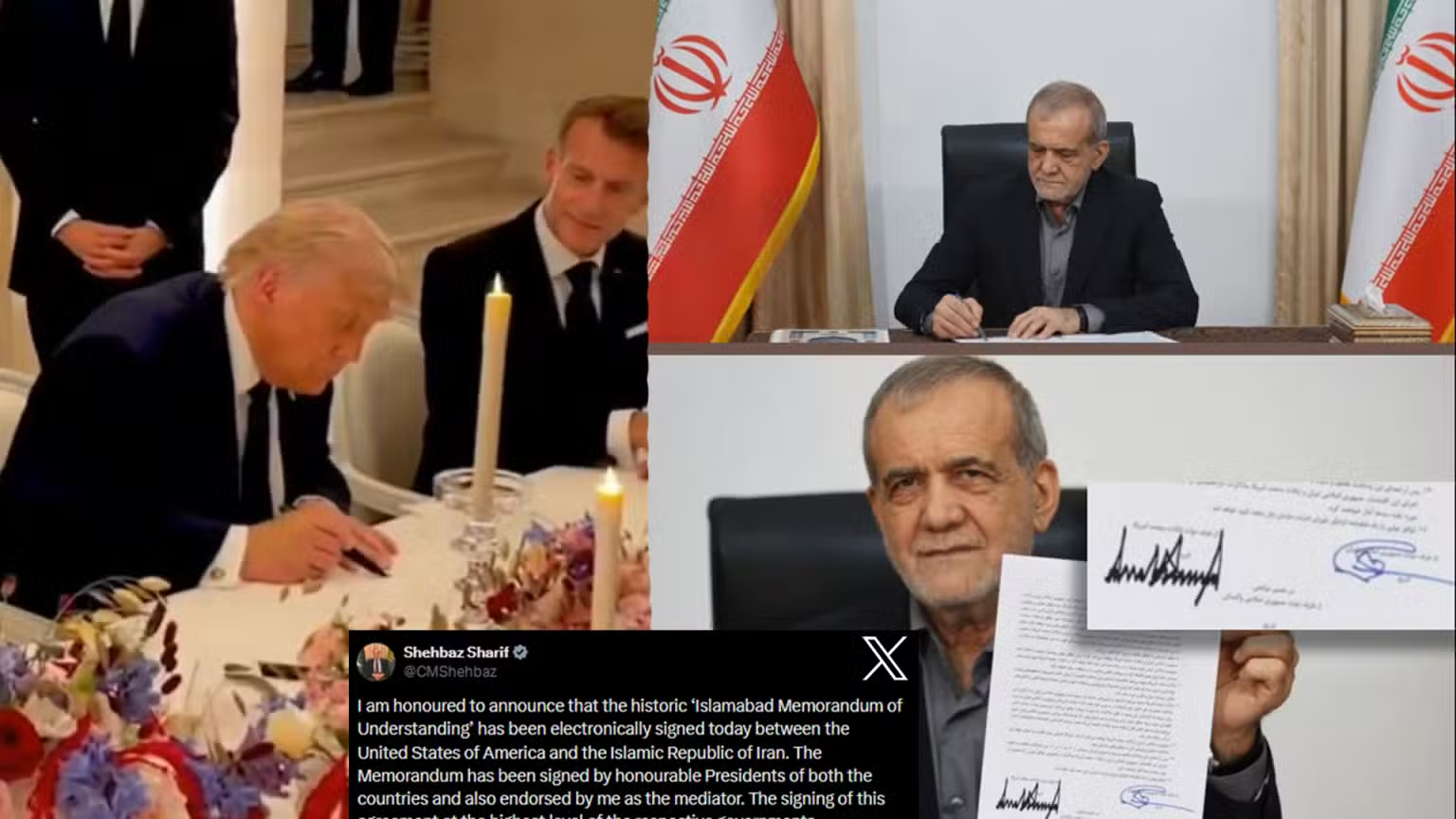
President Donald Trump and Iranian President Masoud Pezeshkian remotely signed the Islamabad Memorandum of Understanding on June 17, 2026, formally putting a stop to the deadliest conflict in the Middle East in decades. Pakistan, whose quiet and relentless diplomacy made these talks possible, has every reason to call this a win.
How It All Started: A War Nobody Expected to End This Way
The road to this Islamabad MoU was anything but straight.
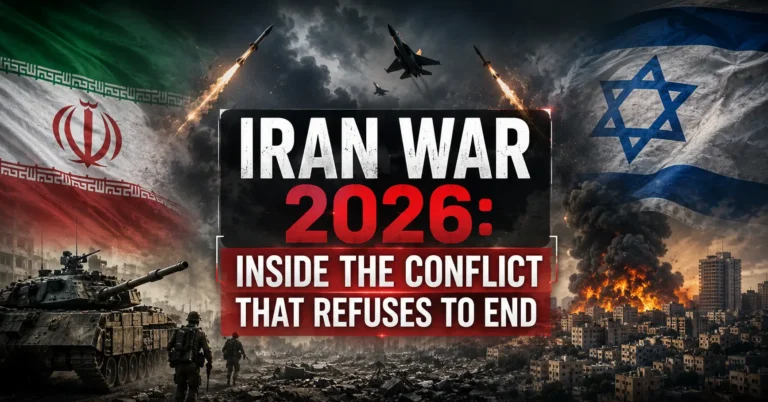
On February 28, 2026, the United States and Israel launched coordinated airstrikes against Iran — targeting its nuclear facilities, missile infrastructure, and military leadership. Iran’s Supreme Leader, Ali Khamenei, was killed in those strikes. Tehran hit back hard, closing the Strait of Hormuz — the chokepoint through which nearly one-fifth of the world’s oil and natural gas passes — and launching missile attacks across the region.
By early March, Trump was publicly declaring he would accept nothing short of Iran’s “unconditional surrender.” Oil prices spiked. Global markets shook. The world watched nervously.
Then Pakistan stepped in.
Pakistan’s Quiet Diplomacy That Changed Everything
Islamabad had been working behind the scenes since the earliest days of the conflict. Pakistan’s Prime Minister Shehbaz Sharif, Field Marshal Asim Munir, and Deputy PM Ishaq Dar led a mediating team that managed to get both sides into the same room — something the United Nations had failed to do.
The first major round of face-to-face talks happened on April 11–12, 2026, when US Vice President JD Vance, special envoy Steve Witkoff, and Jared Kushner flew into Islamabad. The Iranian delegation included Foreign Minister Abbas Araghchi and Parliament Speaker Mohammad Bagher Ghalibaf. Those talks lasted 21 gruelling hours but ended without a deal. Vance flew home. Trump said he “didn’t care.” Iran said there were “gaps on major issues.”
Then Trump imposed a full naval blockade on Iranian ports on April 13 — one of the most aggressive economic moves in modern US foreign policy.
What happened next surprised almost everyone.
The Ceasefire That Barely Held
Even as the blockade tightened, Pakistan kept pushing. On April 7, Trump had already agreed to a two-week ceasefire brokered by Pakistan after Iran offered its own 10-point plan. That ceasefire was shaky from the start — both sides violated it multiple times. The Strait of Hormuz didn’t fully reopen. Iran launched drones into Iraqi Kurdistan. Israel bombed Beirut twice, nearly derailing the talks each time.
But Pakistan didn’t give up. Islamabad kept referring to the process as an ongoing “Islamabad process” rather than a one-off failure, signalling to both Washington and Tehran that the diplomatic channel was still open.
By early June, the pieces started falling into place.
The Deal: What’s Inside the Islamabad MoU
On June 12, 2026, Pakistani Prime Minister Shehbaz Sharif announced that the US and Iran had reached a “final, agreed-upon text” for a peace deal. He said: “Peace has never been this close as it is now.”
Three days later, on June 15, US Vice President JD Vance confirmed that representatives of both countries had digitally signed the memorandum.
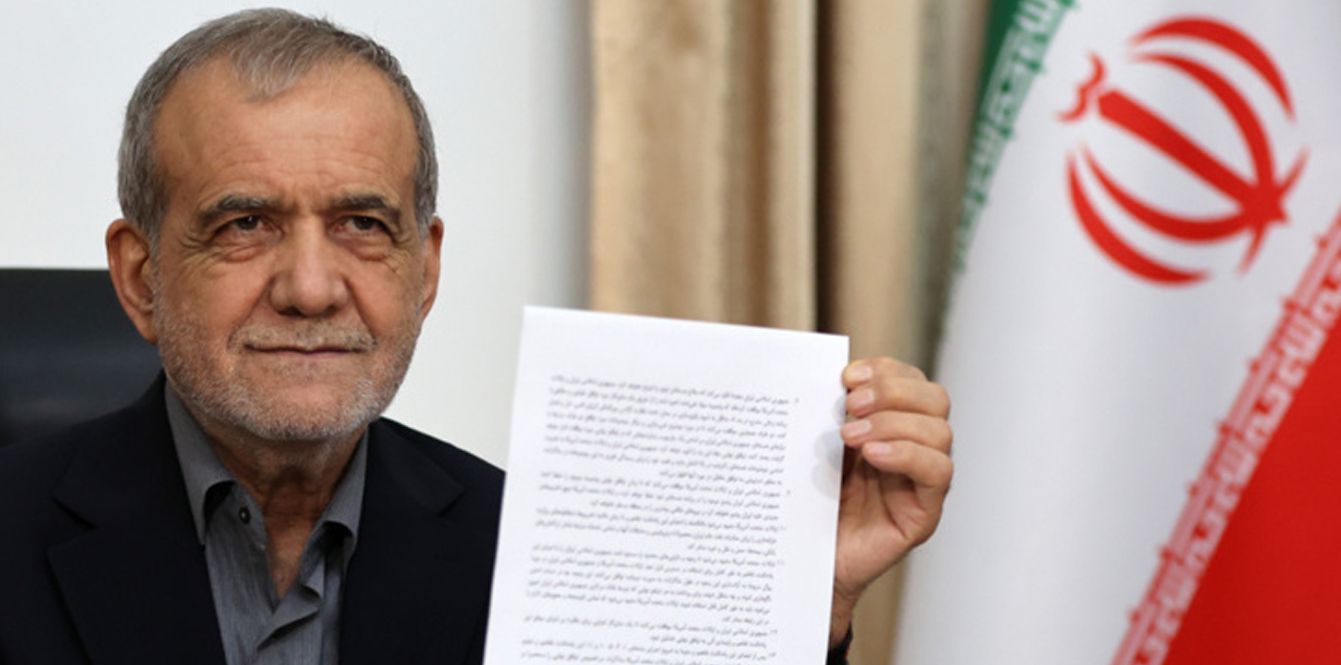
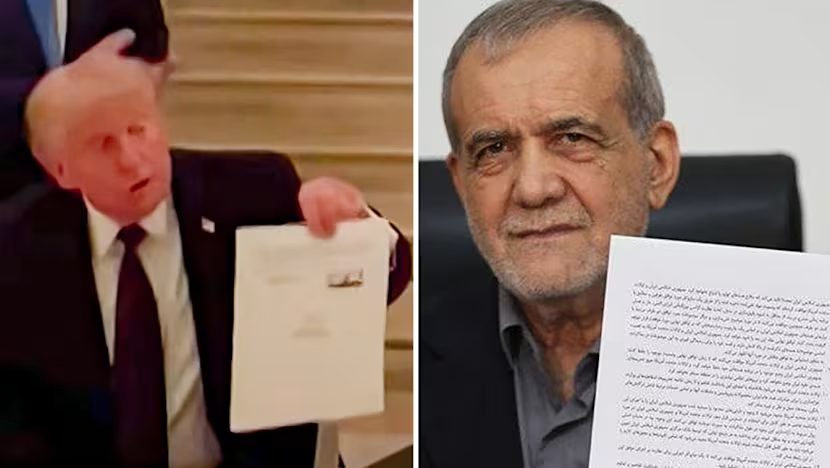
Then on June 17 — the day before the formal ceremony — Trump signed the Islamabad Memorandum of Understanding during a dinner with French President Emmanuel Macron at the Palace of Versailles, following the G7 summit. Pezeshkian signed separately from Tehran on the same day.
The full signing ceremony is scheduled for June 19, 2026, in Switzerland.
So what exactly does the deal contain? Here are the key points:
- Immediate ceasefire on all fronts, including Lebanon, effective from the signing date
- Reopening of the Strait of Hormuz to commercial shipping, toll-free, for 60 days
- End to the US naval blockade of Iranian ports
- 60-day extension of the ceasefire during which further negotiations will take place
- $300 billion reconstruction fund for Iran, along with the release of frozen Iranian assets
- Sanctions relief tied to Iranian compliance with the deal’s terms
- A commitment by Iran to never develop or procure nuclear weapons — though the verification details are still to be worked out
The framework is a 14-point document. It is explicitly described as an initial framework, not a final peace treaty.
What’s Still Not Settled
The Islamabad MoU is historic, but it leaves some of the most difficult questions unanswered — deliberately.
Iran’s nuclear program remains the biggest unresolved issue. The US is pushing for a 20-year moratorium on enrichment. Iran reportedly won’t go above 10 years. The details of inspections, verification, and what “dismantlement” means for facilities already damaged in the 2025 bombings are all to be negotiated over the next 60 days.
The deal also makes no mention of Iran’s ballistic missile program or its network of proxy groups across the Middle East. Both of those were considered deal-breakers by American hawks not long ago — yet they’re not in the text.
Israel was not part of these negotiations. Prime Minister Benjamin Netanyahu made clear his government does not consider itself bound by the agreement and that Israel will “preserve its freedom of action” against Hezbollah in Lebanon. Combat between Israel and Hezbollah has dialled back since the signing, but it has not stopped.
How the World Reacted
The reactions have been dramatic and deeply divided — which tells you something about how consequential this moment actually is.
In Iran: Hardline newspapers called the deal a “surrender to the United States.” The Paydari Front, an ultra-conservative faction, publicly threatened the chief negotiators Araghchi and Ghalibaf. But reformist outlets praised it as a path out of economic pain and military exhaustion. Iran’s state media framed it as a victory — arguing that Iran had forced the US to accept terms that included massive financial compensation.
In the US: Stock markets rallied. Oil prices eased. But Republican Senator Lindsey Graham was openly skeptical of Pakistan’s mediating role and cast doubt on whether Iran would hold up its end of the bargain. Trump himself claimed the deal would “fundamentally transform the Middle East for the next 50 years” — while also warning that military strikes could resume if Iran doesn’t follow through.
Globally: The Council on Foreign Relations noted that reopening the Strait of Hormuz alone would have immediate relief effects on global energy markets and supply chains. The BBC described the mood in Europe as “relief, with caution.”
Pakistan, for its part, celebrated quietly but unmistakably. Islamabad emerged from this crisis as a serious diplomatic player — something it hadn’t been seen as in decades.
Why This Moment Matters Beyond the Headlines
Let’s be honest about what this deal is and what it isn’t.
The Islamabad MoU is a ceasefire framework with major economic incentives attached. It is not a comprehensive peace agreement. It doesn’t resolve the nuclear question. It doesn’t address Iran’s proxies. It doesn’t mention ballistic missiles. Israel is not part of it, and fighting in Lebanon has not fully stopped.
But here’s what it does do: it ends active military operations between the United States and Iran. It reopens one of the world’s most critical shipping lanes. It creates a 60-day window — a real one this time, backed by financial incentives — for both sides to move toward something more lasting.
As the Council on Foreign Relations noted, the deal means Iran is committing, at least on paper, to never acquiring a nuclear weapon. That is a significant public position for Tehran to take, even if enforcement remains the real test.
The $300 billion reconstruction fund is also extraordinary. As one analyst described it, if fully delivered, this would be the most financially lucrative agreement Iran has ever signed — surpassing even the 2015 nuclear deal.
What Happens Next
Under the terms of the Islamabad Memorandum, the clock starts the moment it’s formally signed on June 19. From there:
- The Strait of Hormuz must begin reopening to commercial traffic
- The US naval blockade of Iranian ports ends
- Both sides enter 60 days of intensive negotiations on nuclear issues, sanctions relief, and the release of frozen assets
- If both sides agree at the end of 60 days, the ceasefire can be extended further
- A final deal, when reached, is to be endorsed by a binding UN Security Council resolution
If Iran fails to comply — particularly on nuclear commitments — the US has indicated it reserves the right to resume military action. Trump reportedly warned Iran that he would restart attacks or position the US as “the guardian of the Middle East” if a final nuclear accord is not reached.
Final Thought: A Deal Built on Pakistan’s Patience
The US-Iran Islamabad MoU is one of those rare moments in diplomatic history where something genuinely unexpected happens. A war that began with the killing of Iran’s supreme leader and the bombing of its nuclear sites — a war that global leaders feared could spiral into something far worse — has, at least for now, stopped.
Pakistan made that possible. Islamabad’s role as mediator will be studied in foreign policy schools for years. Shehbaz Sharif and Asim Munir managed to keep two deeply suspicious, deeply hostile governments talking long after the talks had apparently collapsed.
The next 60 days will determine whether this is a genuine turning point or simply a pause before the next crisis. But for now, for the first time since February 2026, the guns between the United States and Iran are silent.
That matters — wherever you sit, and however you see this conflict.