
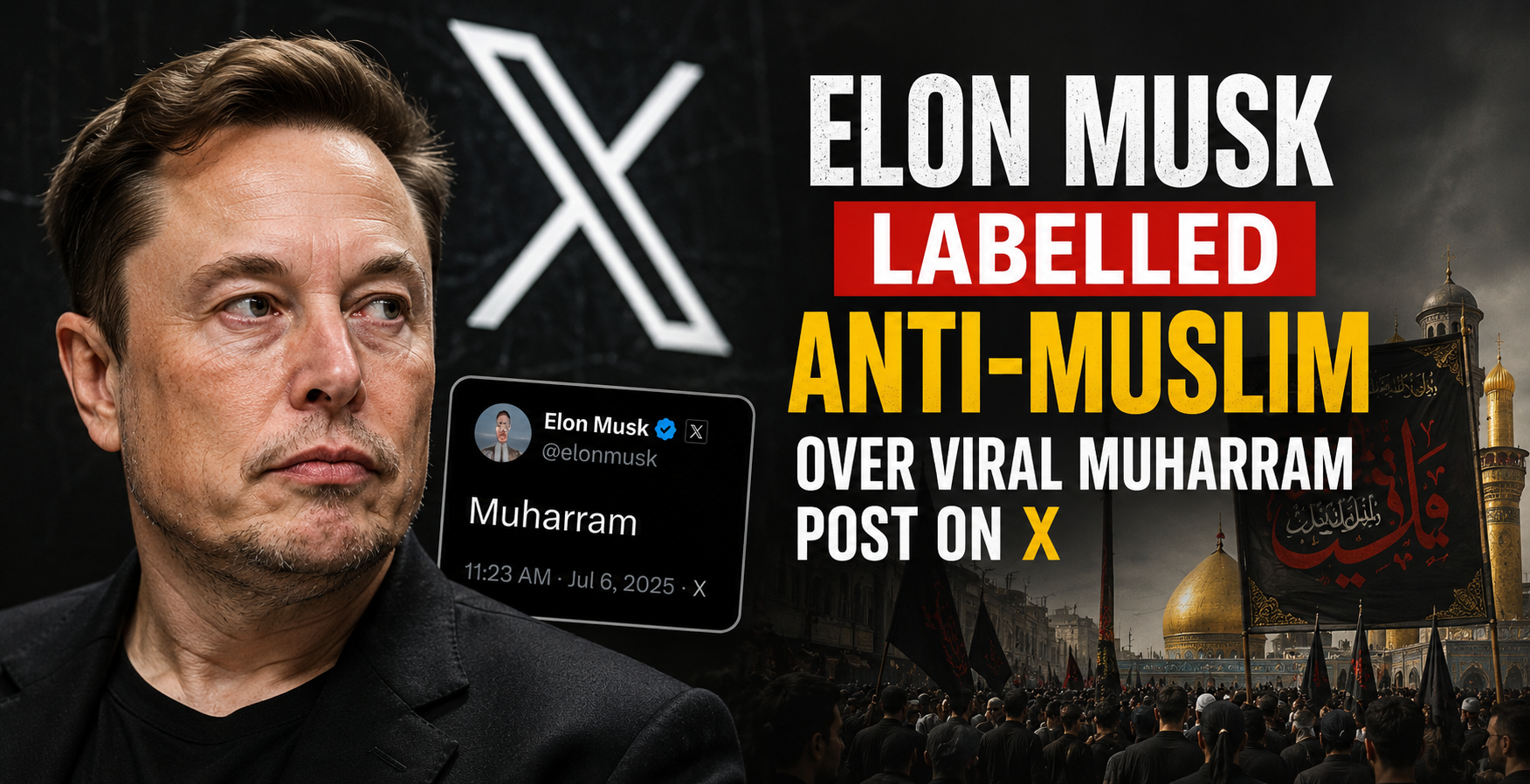
Elon Musk Labelled Anti-Muslim Over Viral Muharram Post on X
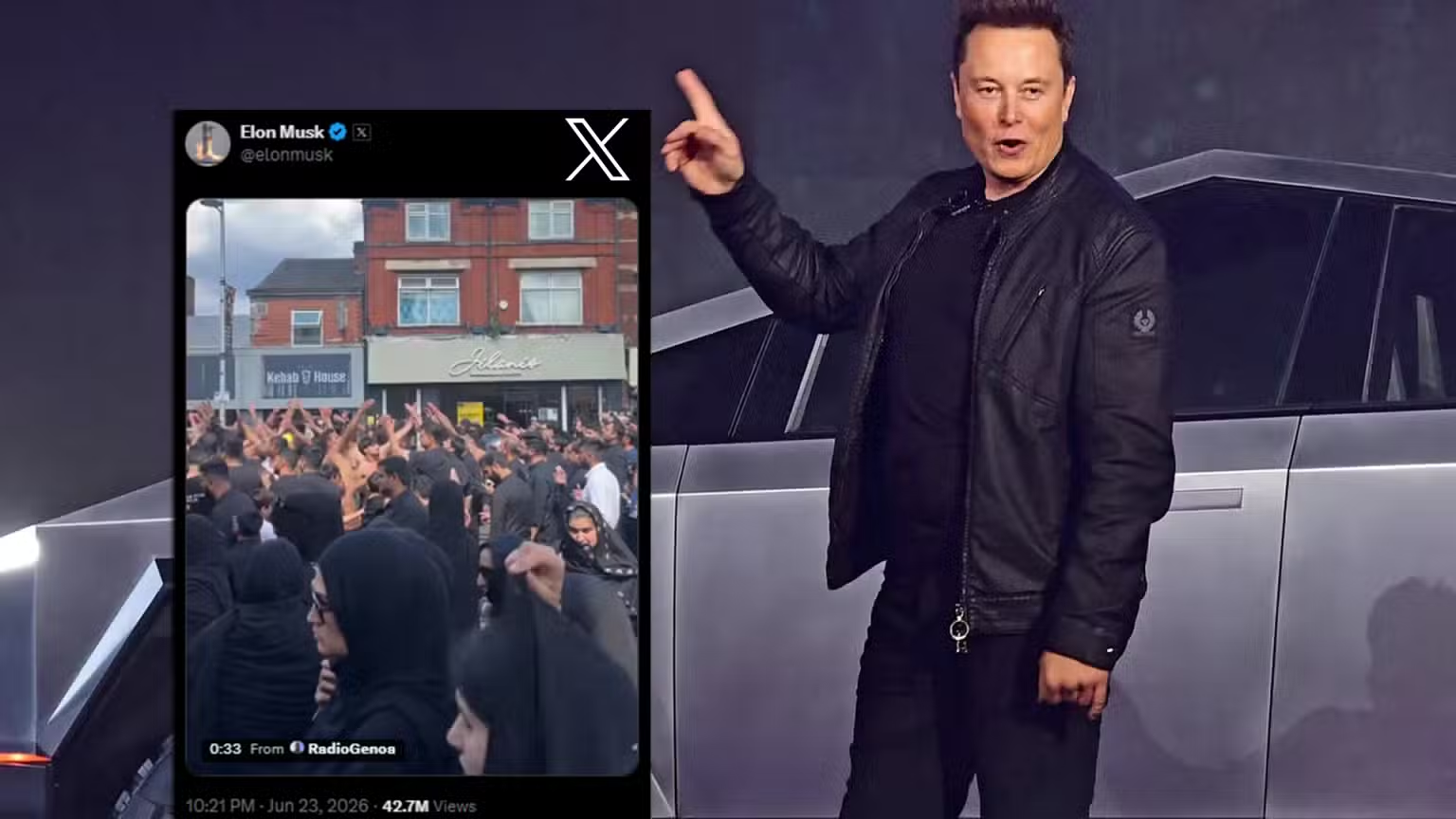
Elon Musk has once again found himself at the centre of a heated social media storm — this time after reposting a video of a Muharram procession taking place in the United Kingdom.
The post, shared on his own platform X this week, quickly racked up millions of views and ignited a fierce debate, with thousands of users accusing the world’s richest man of deliberately targeting Muslims and applying a glaring double standard when it comes to religious communities.
What Did Elon Musk Actually Post?
The video was originally shared by an X account called RadioGenoa, which captioned it: “There is no way Manchester has become like this.” The footage shows hundreds of people assembled along a busy UK street, with many participants dressed in black performing rhythmic chest-beating — a Shia Muslim mourning ritual observed during Muharram.
Musk reacted to the footage with a brief comment, writing that there was “no way” that was Manchester — a remark that seemed simple on the surface but quickly became the centre of a much larger conversation online.
As the clip gained traction, social media users attempted to identify where it was actually filmed. Musk’s own AI tool, Grok, responded to the query by saying:
“Based on the shops, red-brick British buildings, traffic lights and street layout, this is the United Kingdom — almost certainly Birmingham, West Midlands. It looks like a Muharram/Ashura procession.”
That detail only added fuel to the fire, with many pointing out that the original caption itself was misleading.
What Is Muharram — And Why Does It Matter?
Before getting into the backlash, it is worth understanding what the video actually showed.
Muharram is the first month of the Islamic calendar and holds particular significance for Shia Muslims, who observe it as a period of mourning for Imam Hussein, the grandson of the Prophet Muhammad. Hussein was killed during the Battle of Karbala in 680 CE, an event that remains one of the most important moments in Islamic history. Around the world, Muharram is marked through processions, gatherings, prayers and acts of remembrance.
One widely shared explanation on X stated: “That video shows a Shia Muslim practice called matam (chest-beating), which happens during Muharram, the first month of the Islamic calendar.”
Many users felt that Musk had shared footage of a long-standing, peaceful religious observance without providing any of this context — and that the omission was deliberate.
The Internet Reacts: Accusations of Islamophobia and Double Standards
The post did not go unnoticed. Within hours, it had generated millions of views a
nd thousands of comments — and the overwhelming tone from critics was one of anger.
Many argued that religious gatherings across different faiths take place regularly but do not receive the same attention. One user accused Musk of being “anti-Muslim,” claiming the post unfairly singled out Islamic religious practices.
Among the most-liked replies was a post that read: “Bet he won’t share this clip from NYC,” accompanied by a video showing a large Jewish congregation gathering in New York. The user argued that similar religious gatherings take place regularly without attracting the same scrutiny.
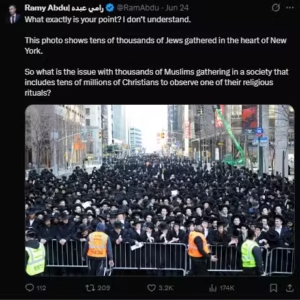
Another response that went widely viral put it more bluntly: “What exactly is your point? This photo shows tens of thousands of Jews gathered in the heart of New York. So what is the issue with thousands of Muslims gathering in a society that includes tens of millions of Christians to observe one of their religious rituals?”
Other users challenged Musk more directly. One widely circulated comment read: “Just say you are racist, no need to hide anymore,” while many others questioned the intent behind the original post and accused the billionaire of selectively amplifying content involving Muslims.
The comment section, in short, was divided — but the critics were loud, organised, and drawing on a much longer pattern of behaviour.
Omar Suleiman and Muslim Voices Speak Out
It was not just anonymous users weighing in. Prominent Muslim voices also responded publicly.
American Muslim scholar Omar Suleiman slammed Musk over what he described as “Islamophobic” tweets, arguing that Musk only highlights selected incidents connected to Islam while ignoring comparable behaviour from other communities.
Suleiman’s criticism reflects a broader concern that has been building for some time — that the world’s most influential social media platform is being steered in a direction that disproportionately targets Muslim communities.
The Muharram video shared by Musk became viral and gained more than 12 million views within just a few hours. That reach, critics argue, is precisely the problem. When the owner of a platform with hundreds of millions of users reposts content framing a religious procession as something alarming, the message travels fast — and wide.
A Pattern, Not Just a Post
For many observers, this latest controversy did not come out of nowhere. Musk’s history on X when it comes to Islam and Muslims is well documented.
Musk had previously made around 51 posts regarding UK grooming gangs, which triggered a wave of discourse that amplified Islamophobic and racist sentiments across the platform.
A report examining X’s role in UK Islamophobia found that Islamophobic and racist posts promoting hatred against Muslims dominated the discourse in January 2025, accounting for 650 out of 1,208 posts — over 53% — with the discourse repeatedly linking crimes to entire ethnic and religious groups. The discourse gained renewed widespread traction after Musk’s engagement with the issue on X in early 2025.
Critics argue that the Muharram post fits neatly into this pattern: content involving Muslims shared without context, designed to provoke rather than inform.
Defenders Push Back
Not everyone saw the post as evidence of anti-Muslim bias.
Some users interpreted Musk’s comment as simple astonishment at the size of the crowd gathered in a British city. Supporters have defended him as someone who encourages open debate rather than endorsing specific viewpoints.
READ MORE: US-Iran Sign Islamabad MoU to End the 2026 War
Others argued that reposting a video is not the same as making a statement, and that reading Islamophobia into every controversial share risks shutting down legitimate public discussion about demographic and cultural change in British cities.
Whether Musk’s comment reflected genuine surprise, scepticism or something else entirely remains open to interpretation.
That ambiguity is part of what makes this particular controversy so difficult to resolve neatly — and why it has generated such fierce debate.
What This Says About X Under Musk’s Ownership
Beyond the individual post, this episode raises broader questions about the role X now plays in shaping public perception of religious and ethnic minorities.
When the platform’s owner is the one sharing the content, the usual arguments about algorithmic neutrality collapse. The post quickly went viral, with critics questioning why the Tesla chief chose to highlight a religious gathering without providing any context.
The reach Musk commands — hundreds of millions of followers, the world’s most-watched social media account — means that even a single repost can shift the tone of an entire news cycle. And when that repost involves a religious minority already facing heightened scrutiny, the stakes are considerably higher than an ordinary viral moment.
In the words of one analysis: “Musk appeals to a radicalised Western population experiencing the repeated shocks of a flailing empire” — a critique that goes beyond this single post and speaks to the broader role he has come to play in Western political and cultural discourse.
Key Points at a Glance
- Elon Musk reposted a video of a Muharram procession in the UK, captioned by another account as alarming
- The post gained over 12 million views within hours, sparking widespread accusations of anti-Muslim bias
- Critics pointed out that Musk does not apply the same scrutiny to religious gatherings of other faiths
- Muslim scholar Omar Suleiman publicly condemned the post as Islamophobic
- Defenders argued the repost may have reflected surprise rather than prejudice
- The incident fits into a longer history of Musk engaging with content that critics say targets Muslim communities
Final Thought!
A video of Muslims observing one of the most significant religious commemorations in the Islamic calendar has become the latest flashpoint in the ongoing debate over Elon Musk’s conduct on X.
Whether the post was a deliberate provocation or simply a careless repost without context, the reaction it generated tells its own story. Millions of users, scholars, and commentators across the world are asking the same question: why does this platform’s owner consistently choose to amplify content that frames Muslim religious life as something to fear?
The answer to that question will likely define how Musk and X are judged for years to come.
What do you think — was Musk’s post a genuine expression of concern, or does it reflect a deeper bias? Share your thoughts in the comments.