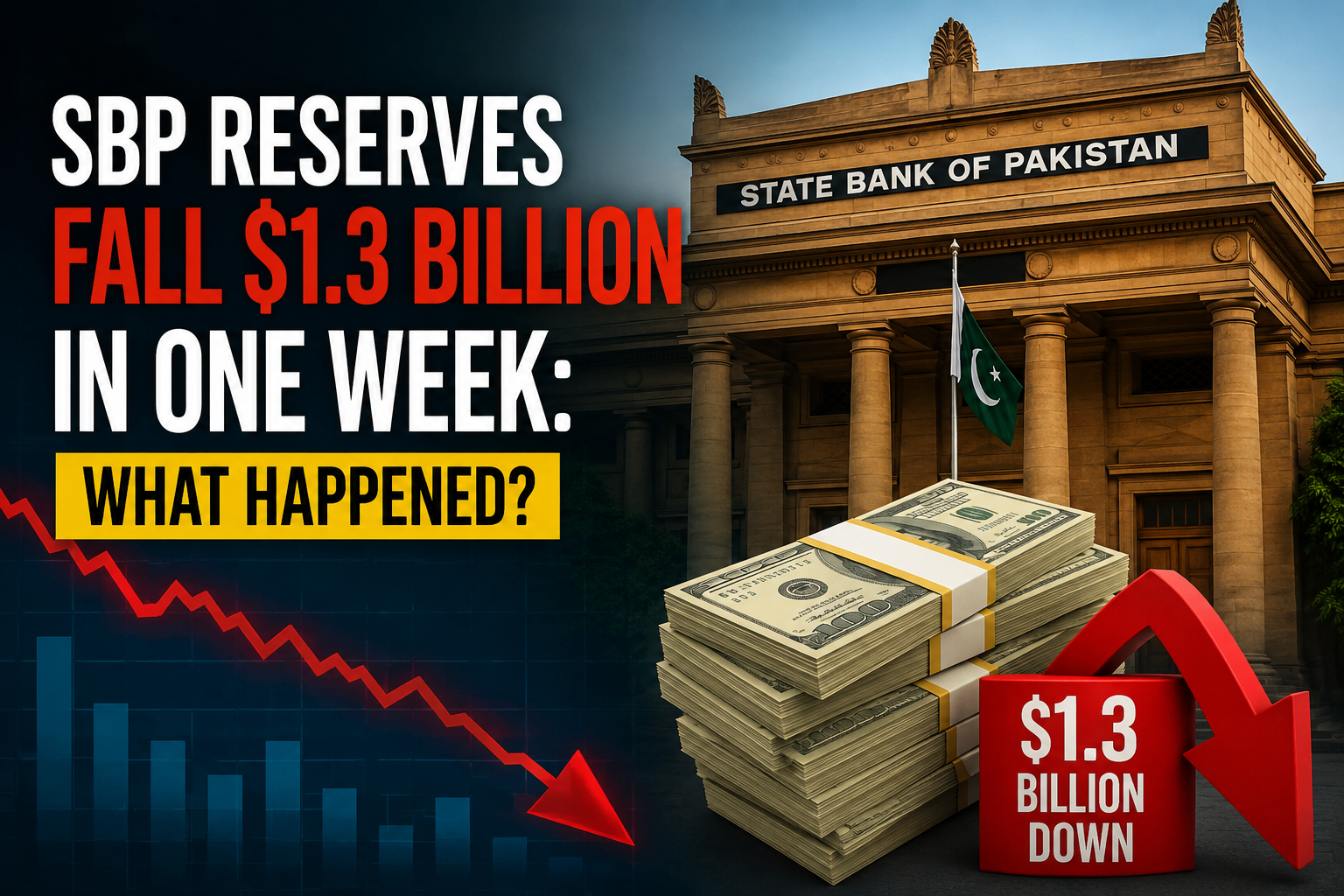
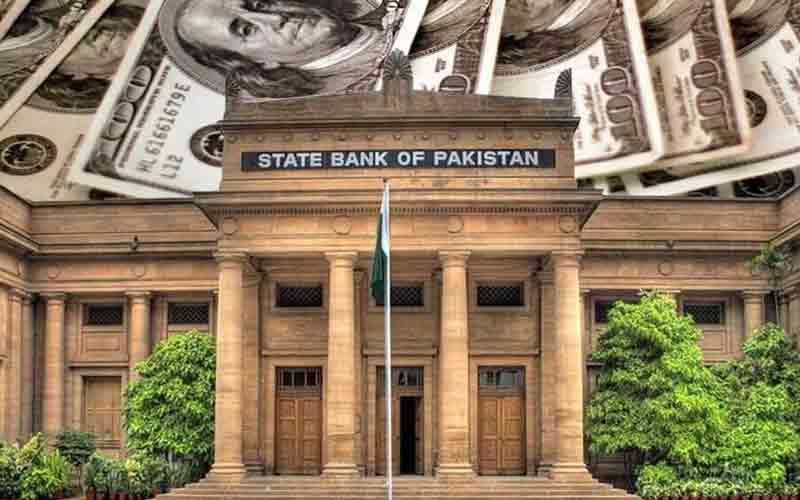
Foreign exchange reserves held by the State Bank of Pakistan (SBP) fell by $1.305 billion during the week ended June 19, 2026, mainly due to external debt repayments, the central bank said on Monday.
The SBP said its foreign exchange reserves declined by $1.305 billion to $15.916 billion during the week ended June 19, from $17.221 billion a week earlier. The fall was steep, visible, and entirely predictable — yet it still rattled markets. It was the largest single-week decline Pakistan’s central bank had seen in years, and it arrived at one of the most pressured moments for the country’s external finances.
The cause was straightforward. Pakistan repaid a $1.3 billion Eurobond maturing on April 8, 2026, in full and on schedule, as part of its routine external debt management, confirmed Advisor to the Finance Minister Khurram Schehzad. The country also met $126.125 million in coupon obligations on other Eurobond issuances.
So yes — Pakistan honoured its commitment to international bond markets. But it did so while simultaneously bracing for an even larger debt obligation looming just weeks away.
The Numbers Behind the Drop

A week earlier, the State Bank’s reserves had stood at $16.40 billion, bringing total foreign currency deposits to $21.895 billion. After the Eurobond repayment, Pakistan’s total liquid foreign exchange reserves stood at $20.52 billion, including $15.08 billion held by the SBP and $5.45 billion by commercial banks.
Market analysts noted that the decline reflected a weekly drop of $1.32 billion in SBP-held reserves. According to estimates by Topline Securities, the current reserves provide import cover of approximately 3.08 months, down from 3.35 months in the previous week.
Three months of import cover is the minimum threshold most economists regard as safe. Pakistan was right on the edge.
The UAE Debt Hanging Overhead
The Eurobond repayment was just the opening act. Pakistan also faced a $3.5 billion repayment to the United Arab Emirates this month, which put further strain on its foreign exchange reserves.
The combination of obligations — $1.4 billion in Eurobond principal and coupons, plus $3.5 billion owed to Abu Dhabi — meant Pakistan was staring at nearly $5 billion in external debt outflows within a single month. For a country with reserves hovering around $15 billion, that is not a minor liquidity event. It is a stress test.
Saudi Arabia Steps In
Islamabad had clearly anticipated the crunch. Even as the Eurobond repayment data hit the wires on April 16, the SBP simultaneously announced a critical inflow.
“The State Bank of Pakistan has received funds of $2 billion from the Ministry of Finance, Kingdom of Saudi Arabia in the value date of April 15, 2026,” the State Bank said in a social media post.
READ MORE: FBR Freezes and Recovers Rs. 3 Crore From Taxpayer’s Account
The timing was deliberate. Finance Minister Muhammad Aurangzeb confirmed that Saudi Arabia had committed $3 billion in additional deposits, bringing total Saudi deposits to $8 billion. He further stated that the existing $5 billion Saudi deposit would no longer remain subject to the earlier annual rollover arrangement and would instead be extended for three years.
Topline Research CEO Mohammed Sohail commented that the fresh $2 billion Saudi deposits would help in repaying the UAE debt without any major impact on Pakistan’s currency and forex reserves.
Analyst Warnings: Friendly Loans Are Not a Fix
Not everyone was reassured. Dr. Khaqan Najeeb, a former finance ministry adviser, characterised the Saudi funds as a “liquidity-supporting, non-market buffer.” He cautioned that while it helps cover external financing needs, it is a debt-creating deposit and does not represent a structural improvement in Pakistan’s balance of payments.
Another analyst cautioned that as a liability-creating inflow, Saudi support underscores Pakistan’s growing external dependence and may carry geopolitical sensitivities, particularly given the country’s delicate balancing role in regional tensions.
The pattern is familiar. Pakistan plugs one gap with borrowed money, then uses the next borrowed tranche to repay the last. The cycle is not unique to Pakistan — but it is one that the IMF has repeatedly flagged.
Where Reserves Stand in the Bigger Picture
SBP reserves stood at $11.7 billion on January 3, 2025, rising to $15.915 billion by the end of December — an increase of $4.2 billion across calendar year 2025. However, reserves grew by only $1.4 billion in the second half of the year, signalling a slowdown in accumulation.
SBP reserves had briefly touched $16.382 billion on April 3, 2026 — the highest level since FY21. That peak proved short-lived. The Eurobond repayment and UAE obligations quickly reversed the gains.
The government’s official target is to reach around $18 billion in SBP-held reserves by the end of FY26 — roughly equivalent to 3.3 months of import cover. Finance Minister Aurangzeb reiterated the commitment to achieving that target, in line with Pakistan’s obligations to markets and under the IMF-supported programme.
It is an ambitious target given the scale of outflows Pakistan absorbed in April alone.
IMF Tranche Provides Some Relief
Stability returned in May. Pakistan received inflows of $1.3 billion from the IMF on May 12, 2026, comprising SDR 760 million under the Extended Fund Facility and SDR 154 million under the Resilience and Sustainability Facility, following the IMF Executive Board’s third review approval on May 8.
The country’s total liquid foreign exchange reserves stood at $21.293 billion as of April 30, 2026, with the SBP holding $15.851 billion.
So the reserve picture had partially recovered. But the April episode exposed a structural vulnerability that IMF tranches and Saudi deposits can temporarily mask — not permanently resolve.
What This Means Going Forward
Pakistan is not in crisis. Reserves remain above the three-month import cover floor, debt repayments are being met, and the IMF programme is on track. The rupee held relatively stable throughout the period.
But the $1.3 billion single-week decline is a reminder of how quickly buffers can erode when a cluster of maturities lands at once. Analysts broadly agree that sustainable stability will depend on Pakistan’s ability to strengthen its export base, attract productive investment, and maintain macroeconomic discipline — not on rolling deposits from friendly governments.
The Eurobond was repaid. The UAE was repaid. Saudi Arabia filled the gap. And the IMF approved another tranche. Pakistan cleared the April hurdle.
The question is whether the underlying balance of payments fundamentals are improving fast enough to eventually make those rescues unnecessary.
People Also Ask
Why did SBP reserves fall by $1.3 billion in one week?
The decline was driven by the SBP’s repayment of $1.426 billion against a Pakistan Sovereign Eurobond that matured on April 8, 2026, alongside coupon obligations on other bond issuances.
What were Pakistan’s total foreign exchange reserves after the drop?
As of April 10, 2026, Pakistan’s total liquid foreign exchange reserves stood at $20.52 billion — $15.08 billion held by the SBP and $5.45 billion by commercial banks.
Did Saudi Arabia help Pakistan after the reserve drop?
Yes. The SBP confirmed it received $2 billion from Saudi Arabia on April 15, 2026. Saudi Arabia also committed an additional $3 billion in deposits and extended its existing $5 billion facility for three years.
What is Pakistan’s IMF reserve target for FY26?
Pakistan aims to reach approximately $18 billion in SBP-held reserves by end of FY26, equivalent to around 3.3 months of import cover, as part of its obligations under the IMF-supported programme.
Did Pakistan also have to repay the UAE in April 2026?
Yes. During April 2026 alone, Pakistan repaid around $5 billion in external debt in total, including a Eurobond repayment and approximately $3.5 billion owed to the UAE.