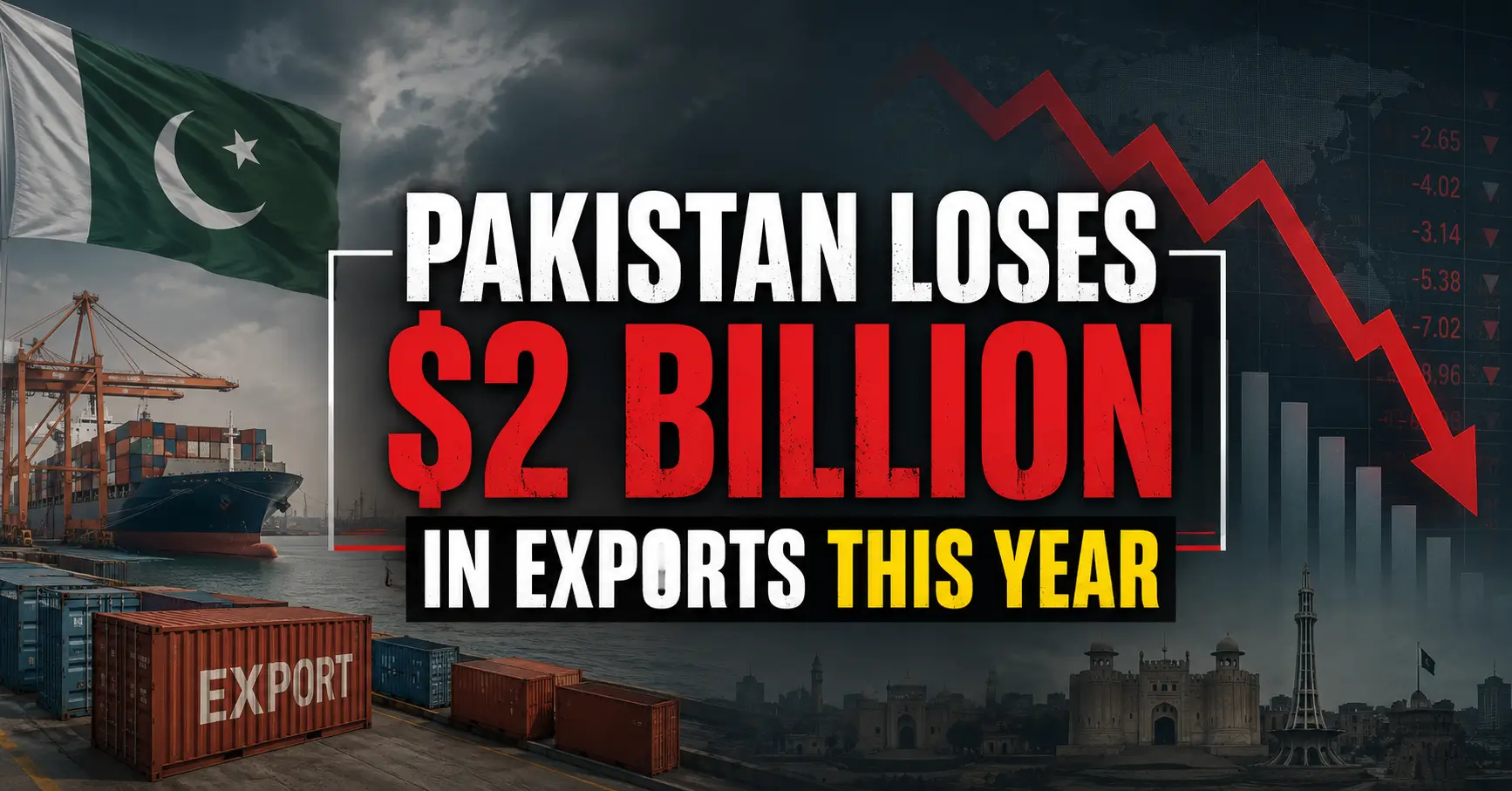

Pakistan’s export machine took a hard hit this year. Goods shipments fell by nearly $2 billion in the fiscal year that closed on June 30, and one crop is largely to blame: rice.
The numbers, drawn from provisional data released by the Pakistan Bureau of Statistics (PBS), tell a story of a country whose export base remains dangerously narrow — propped up by a handful of commodities and now increasingly rescued by a booming tech sector that most Pakistanis never see.
Goods Exports Shrink to $30 Billion

According to Pakistan Bureau of Statistics data, the country’s trade deficit widened to $39.47 billion in FY26, up 21.57 percent compared to the previous fiscal year, marking a four-year high. Brokerage house Topline Securities flagged the scale of the reversal, noting the shortfall had not been this wide in four years.
Goods exports alone declined by roughly 6 percent, slipping close to $2 billion to land near $30 billion for the year, per Topline’s reading of the PBS figures. That is a steep fall for an economy that has spent years trying to convince the IMF and its own citizens that exports, not borrowing, are the way out of its balance-of-payments trap.
The damage wasn’t evenly spread. In June 2026 alone, the trade deficit hit $4.53 billion, more than 57 percent higher than June 2025, and nearly 64 percent above the $2.76 billion recorded just one month earlier in May. Imports surged past $6.7 billion that month while export earnings actually dropped to around $2.24 billion — a gap widening in real time, not narrowing.
Rice Exports Fall Off a Cliff

The single biggest culprit is rice, and the numbers are brutal. National Assembly proceedings revealed that rice exports fell from $1.83 billion to $0.97 billion during July–December FY26, a drop of 46.7 percent, with quantities down 36.6 percent.
The reason isn’t mysterious. India lifted its Minimum Export Price restrictions on basmati and flooded the global market with cheaper supply. Indian basmati was selling around $900 per metric ton against Pakistan’s $1,050 to $1,275 range, gutting Pakistan’s competitiveness in price-sensitive Gulf markets like the UAE, the commerce minister told the Assembly.
By the seven-month mark of the fiscal year, the picture had barely improved. Rice export value fell 40.51 percent year-on-year to $1.305 billion, with volumes down nearly 33 percent to 2.439 million tonnes. Islamabad responded with a Rs15 billion subsidy package for rice exporters, but the relief came too late to reverse the year’s trajectory.
Rice wasn’t the only casualty. Broader agriculture and food exports fell sharply too, and cross-border trade with Afghanistan took a separate hit.
AKD Securities Director Research Muhammad Awais Ashraf pointed to the return of cheaper Indian rice combined with border closures with Afghanistan and Iran as key drivers of the food export slump.
The Torkham crossing, closed since October, choked off a trade route Pakistani exporters had long relied on.
Textiles Hold the Line, Barely

Not everything went backward. Textile and leather exports — Pakistan’s largest single export category — essentially flatlined rather than fell, edging up marginally to around $12.93 billion during July–February compared with $12.90 billion a year earlier.
Value-added textile products showed some improvement, but the sector never had enough momentum to offset the rice collapse elsewhere in the export basket.
Elsewhere, engineering goods exports rose nearly 6 percent on stronger shipments of machinery, transport equipment and auto parts, while cement exports edged higher too. These pockets of growth were real, but too small to move the national needle.
IT Sector Becomes Pakistan’s Quiet Export Engine
If there’s a bright spot in this year’s trade story, it’s technology. Services exports rose 18.38 percent in the first eight months of FY26 to $6.46 billion, up from $5.46 billion a year earlier, driven overwhelmingly by IT, telecommunications and computer services.
By May, cumulative IT export proceeds for the eleven-month period had reached $4.2 billion, running 21 percent ahead of the same period the year before.
READ MORE: Pakistan Cement Sales Soar by 7.2% in FY26
Government officials are now projecting full-year IT exports of $4.5 to $4.6 billion for FY26, compared with $3.8 billion the previous year — a jump officials attribute to freelancing platforms, software exports, and expanding outsourcing demand from Gulf clients.
This growth is why Pakistan’s overall export picture isn’t as grim as the goods numbers alone suggest. Combined goods and services exports are expected to close FY26 near $40.1 billion, barely below the $40.4 billion recorded in FY25 and still above the $38.5 billion posted in FY24. Services are effectively paying for rice’s mistakes.
What This Means Going Forward
The underlying vulnerability hasn’t gone away. Pakistan’s export base still leans heavily on a small set of commodities that can be upended by a single policy shift in a neighbouring country — as India’s basmati re-entry just proved.
Meanwhile, the State Bank of Pakistan’s Balance of Payments data, considered the more comprehensive measure of actual export inflows, is still awaited and could adjust the final tally once released.
Economists and trade analysts continue pointing to structural problems discretionary customs duties, an anti-export tariff bias, and reliance on a handful of border markets vulnerable to closure.
The National Tariff Policy has begun phasing out some of these distortions, and the World Bank has credited it as one of the largest single-year reductions in trade barriers among lower-middle-income countries.
But reforms take years to show up in export volumes, and investors are watching for policy continuity before committing capital.
For now, Pakistan’s export story in FY26 is really two stories: a commodity sector caught flat-footed by global price shifts, and a services sector — led by software engineers and freelancers — quietly picking up the slack.