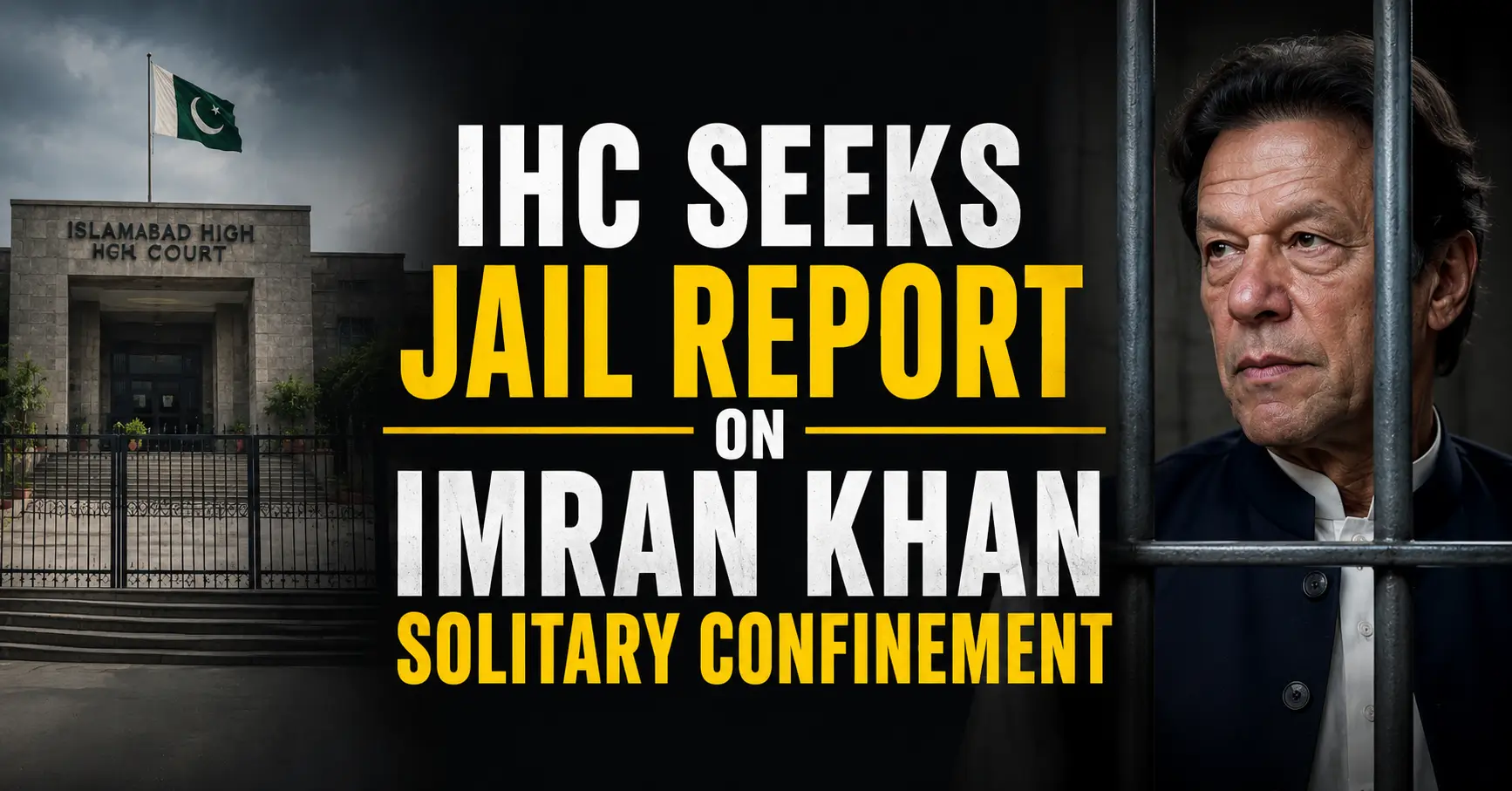

Islamabad’s High Court has run out of patience with vague denials. On Saturday, it told Adiala Jail to put its answers on paper.
Justice Khadim Hussain Soomro ordered the jail superintendent to file a detailed report addressing one specific question: has Imran Khan, and separately his wife Bushra Bibi, been kept in solitary confinement — and if so, under what legal authority, in what circumstances, and for how long.
It’s a narrow question. But it cuts to the heart of a dispute that has dragged through the IHC for weeks without resolution.
Petitions Filed by Family Members
The petitions weren’t brought by Khan or Bushra Bibi themselves. They came from Aleema Khan, the PTI founder’s sister, and Mubashra Khawar Maneka, Bushra Bibi’s daughter — both arguing that the couple’s treatment inside Adiala Jail violates prison rules and constitutional protections.
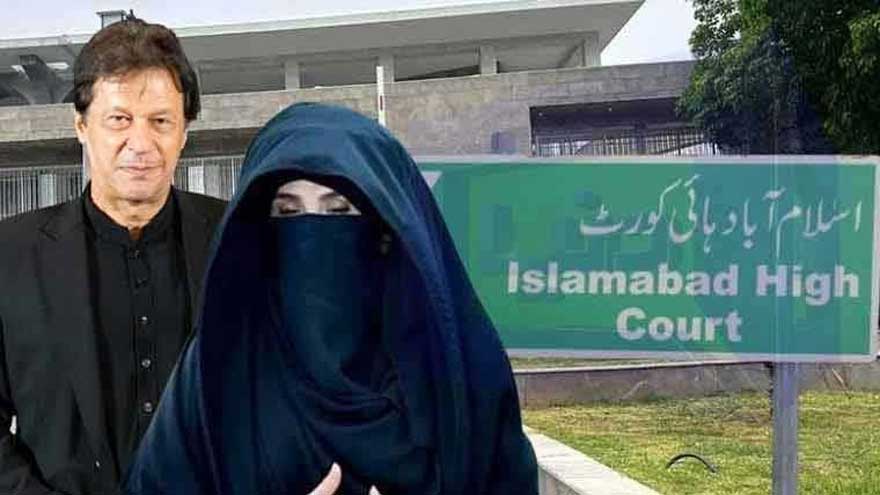
That distinction matters legally. NAB’s counsel, Rafi Maqsood, has repeatedly argued that neither Aleema nor Mubashra qualifies as an “aggrieved party” under the law, since neither is the direct petitioner in custody.
It’s a standing argument, not a denial on the merits — though Maqsood has also separately rejected the underlying allegation, insisting the couple’s custody is being managed strictly under rules applicable to convicted inmates.
READ MORE: PM Shehbaz Courts Turkish Investors in Istanbul Talks
Justice Soomro has said the maintainability question — whether these petitions can even proceed — will be decided only after the jail’s report comes in. Until then, the case sits in a kind of legal limbo: not dismissed, not admitted, just waiting on paperwork from Adiala.
What the Petitioners Allege
The claims themselves are specific and, if true, troubling.
Barrister Salman Safdar, representing both petitioners, told the court that Khan is being confined for roughly 22 hours a day, while Bushra Bibi is allegedly kept isolated around the clock — all 24 hours, every day.
Safdar said he was permitted to meet Khan following a court order, but has been denied access to Bushra Bibi for the past seven months. That’s a detail the court has not yet independently verified, but it’s one the petitioners have leaned on to argue that the isolation is both prolonged and, in Bushra Bibi’s case, effectively total.
Earlier arguments in the case also invoked international benchmarks — the UN’s Standard Minimum Rules for the Treatment of Prisoners, commonly known as the Nelson Mandela Rules — along with claims that Khan, now 74, has lost vision in one eye and that both he and Bushra Bibi have undergone eye surgeries while still allegedly held in isolation.
The Judge’s Own Reading of the Convictions

What’s given this case traction is something Justice Soomro said himself, not something the petitioners argued.
At an earlier hearing, the judge stated plainly that he had gone through both of the couple’s NAB conviction judgments and found no order authorizing solitary confinement as part of their sentence. In his words, convictions in NAB cases simply don’t carry solitary confinement as a punishment.
That observation doesn’t settle whether solitary confinement is actually happening. But it does establish that if it is happening, it isn’t something the courts sentenced them to — meaning any such treatment would need a separate legal justification, which is exactly what the judge is now asking the jail to produce.
Background: A Long Legal Trail
Khan has been in custody since August 2023, following his removal from office in April 2022 through a no-confidence vote. Since then, he’s faced a string of cases spanning corruption, terrorism, and other charges.
Most recently relevant here is the Toshakhana-II case, in which Khan and Bushra Bibi were sentenced on December 20, 2025, to 17 years each over allegations they unlawfully retained a Bulgari jewelry set gifted during an official visit to Saudi Arabia.
Separately, in January last year, an Islamabad accountability court had sentenced Khan to 14 years and Bushra Bibi to seven years in the Al-Qadir Trust reference — the £190 million case involving allegations that the couple received billions of rupees and land from a private property developer in exchange for legalising a UK-returned settlement.
The IHC is currently also hearing appeals seeking suspension of those sentences, running in parallel to the solitary confinement matter.
Why This Case Matters Beyond the Courtroom
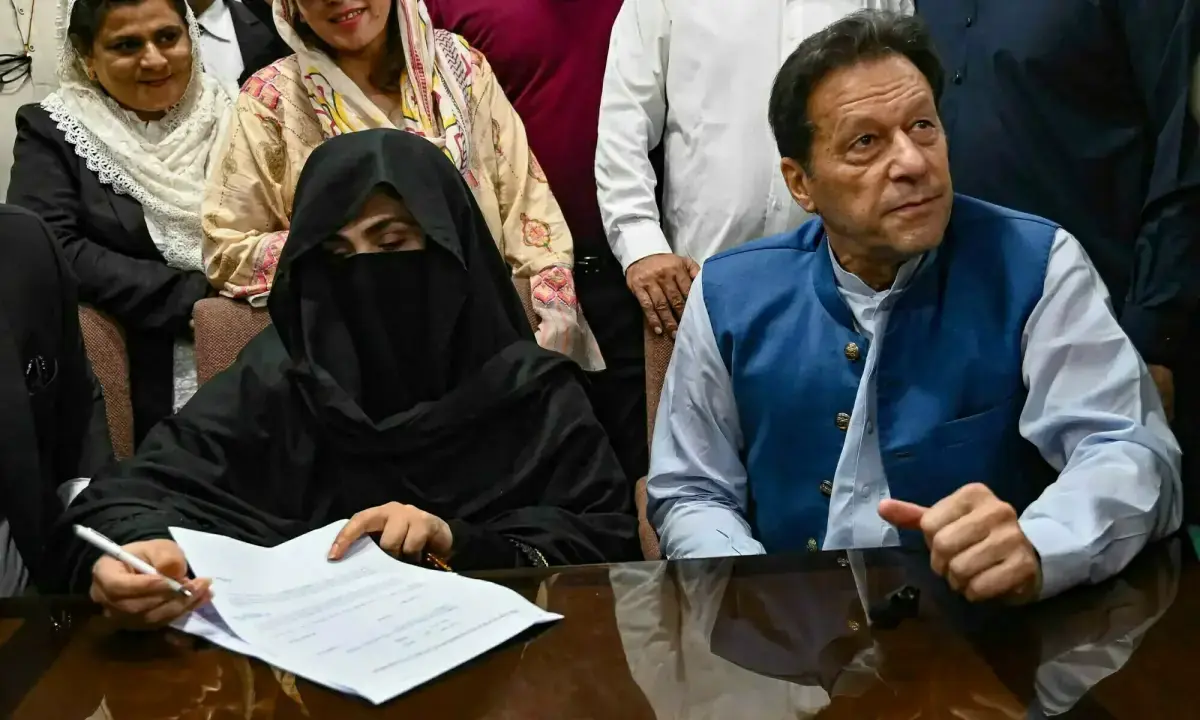
Cases like this rarely stay confined to legal technicalities. Khan remains Pakistan’s most polarising political figure, and any finding — either confirming or debunking claims of prolonged isolation — will land squarely in an already charged political environment.
For NAB and the state, a clean report showing standard prison procedure would undercut a narrative that’s fuelled protests and international attention. For Khan’s family and PTI, documented evidence of unauthorised isolation would hand them a powerful legal and political weapon.
Either way, the next month hinges on what Adiala Jail actually puts on paper — and whether that report matches what’s already been said in open court.
What the Court Wants Next
Beyond the confinement question, Justice Soomro has also asked for a separate report on the general facilities being provided to the former prime minister and his wife inside the jail — food, medical access, visitation, and living conditions more broadly.
He’s directed the Inspector General of Prisons and the jail superintendent to ensure that properly briefed representatives — officials who actually know the facts of the case, not just its paperwork — appear at the next hearing.