
A three-year experiment in grassroots gender equality just closed its books — and the numbers are hard to ignore.
The EWG Project wrapped up in Islamabad this week, with organisers claiming it reached over one million people across six Pakistani districts. Whether that scale translates into lasting change is the question policymakers now face.
EWG Project Concludes Three-Year Run in Pakistan

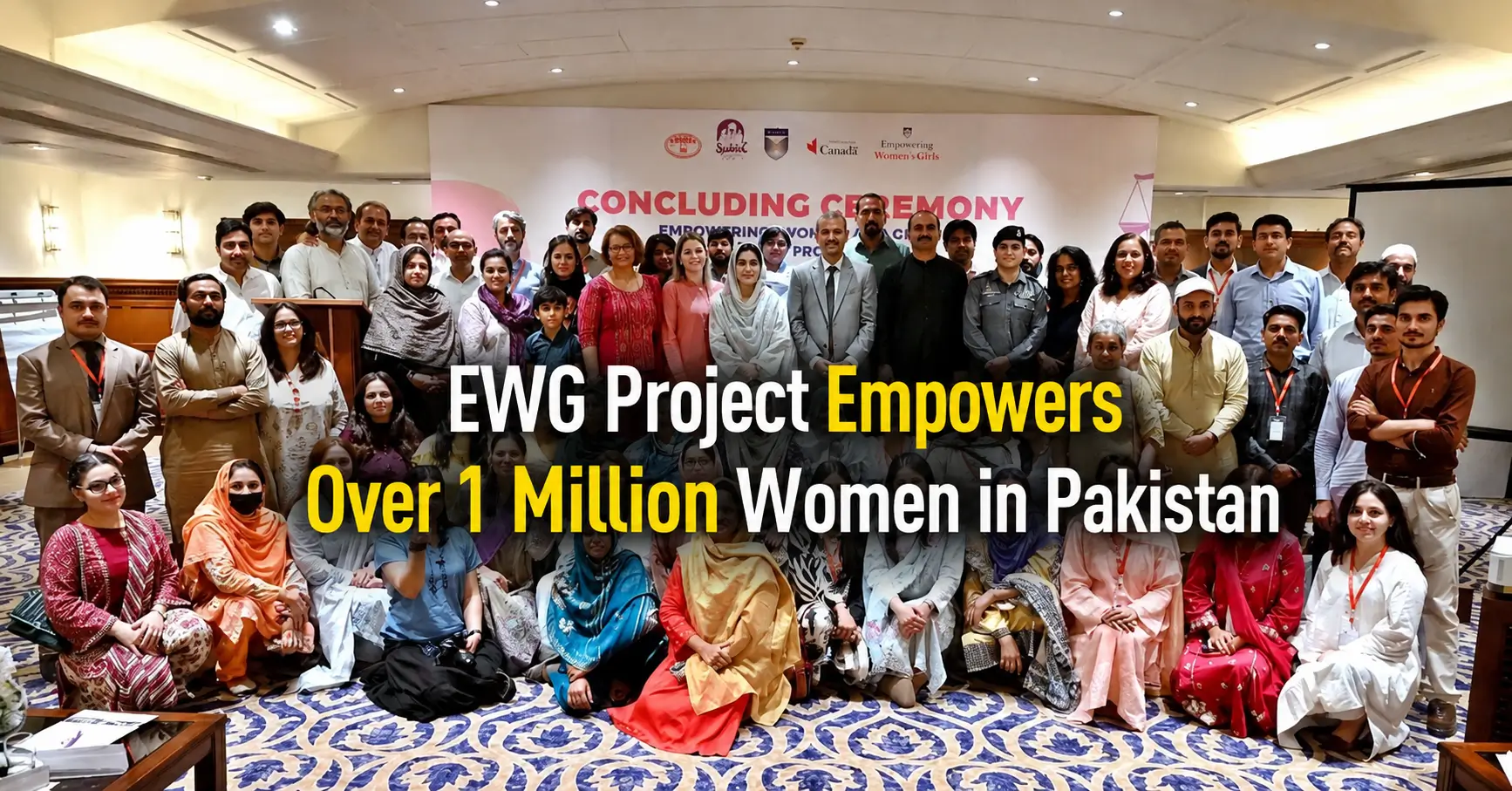
The Empowering Women & Girls Project was launched in March 2024 by SPARC, the Commonwealth of Learning, and Bedari, backed financially by Global Affairs Canada. Its completion ceremony this week drew government officials, diplomats, and community beneficiaries to Islamabad.
The project targeted six districts — Khushab, Bhakkar, Multan, Peshawar, Rawalpindi, and Islamabad — focusing on education access, vocational training, and gender-based violence prevention. It ran parallel to sister programs in Malawi, Mozambique, Bangladesh, and Sri Lanka under COL’s Commonwealth-wide mandate.
Key Numbers Behind the Empowering Women & Girls Project

Program Manager Sabeen Almas laid out the project’s core metrics at the closing ceremony, and they form the backbone of its claimed success. The EWG reported reach figures that outstrip most comparable NGO initiatives in the region.
According to SPARC’s own figures shared at the event:
- Over 10,000 girls and boys reintegrated into formal education or Open Schooling pathways
- More than 77,000 women and girls trained in vocational and labour-market skills
- Over 465,000 women and girls engaged through human rights and gender equality awareness sessions
- More than one million people reached through public campaigns on women’s rights and education
These figures were self-reported by SPARC and have not yet been independently audited by a third party.
Government and International Partners React
Engineer Gul Asghar Khan Baghoor, Parliamentary Secretary for the Ministry of Communication, commended the significant achievements of the project, highlighting its tangible and lasting impact across the districts where it was implemented. He praised the collaborative efforts of the project partners in expanding access to education, strengthening livelihoods, and advancing gender equality at the community level.
Dr. Shazia Sobia Aslam Soomro went further, appreciating the creativity, resilience, and entrepreneurial potential shown by women beneficiaries at the project’s exhibition showcase, and pledged to arrange a similar display at Parliament House for wider visibility.
Canada Reaffirms Its Commitment

Sasha Oliveira, representing Global Affairs Canada, noted that the partnership between Global Affairs Canada, COL, SPARC, and Bedari had contributed to expanding educational opportunities, strengthening livelihoods, and advancing the rights of women and girls in Pakistan. She emphasized that sustainable development is driven by empowering local organizations to lead community-based solutions.
Frances Ferreira of the Commonwealth of Learning, who has overseen the initiative from its 2024 launch, reflected that the project was driven by a shared commitment to advancing the rights, education, and economic empowerment of women and girls — language that has remained consistent across her public statements since the project began.
SPARC and Bedari’s Community-Driven Model
SPARC Executive Director Asiya Arif Khan framed the EWG Project as proof of concept for partnership-based development work. She emphasized that the project’s success reflects the power of strong partnerships and collective action in addressing barriers to equality.
Bedari’s Anbreen Ajaib echoed that framing, noting that the project’s success is a testament to the shared commitment of partners toward advancing opportunities for women and girls, and pointed to community-level buy-in as the model’s real differentiator.
- National Assembly member Huma Akhtar Chughtai attended and spoke on grassroots progress
- AIOU’s Dr. Zahid Majeed addressed education pathway integration
- District Task Force members and shelter home representatives from Multan also participated
The project’s Bhakkar component, run in coordination with local police and district administration, had already shown measurable results earlier in the program — including improved willingness among women to report rights violations through a dedicated police focal-person system.
What Comes Next for Gender Equality Programming in Pakistan
The harder question is sustainability. Canadian funding for this specific cycle has ended, and the Empowering Women & Girls Project’s long-term legacy now depends on whether its training models get absorbed into government systems.
National Commission on the Status of Women representative Noureen Bano Lehri pushed exactly this point, stressing that successful project models need integration into national policy frameworks — not just a one-off closing ceremony — if the gains for over a million women and girls are to outlast the funding cycle.