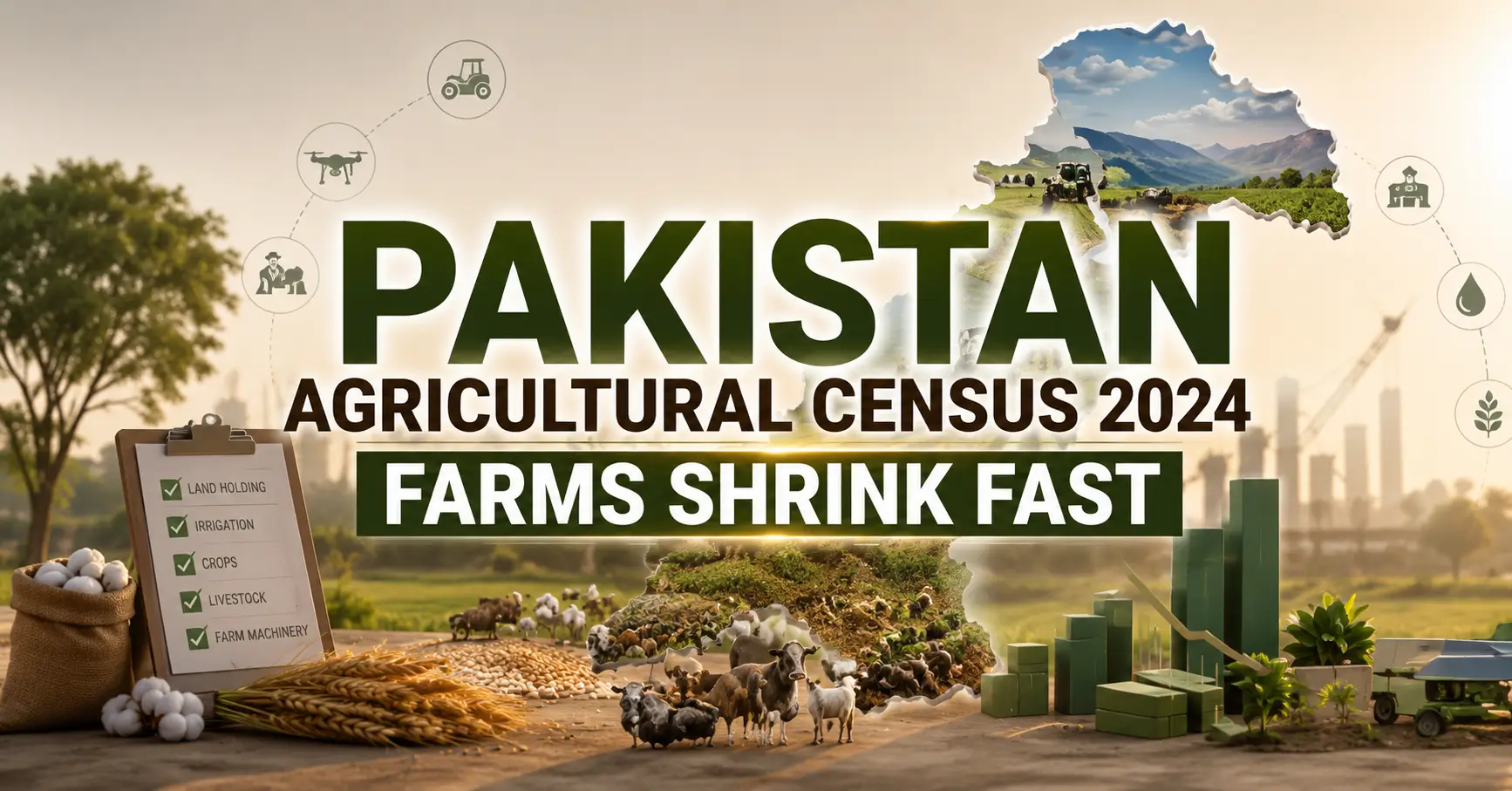
Pakistan just got its first real look at its farmland in fourteen years — and the picture is messier than officials expected. Farms are multiplying. Fields are splintering into smaller and smaller pieces. Livestock has more than doubled. And underground, a quiet solar revolution has reshaped how the country waters its crops.
This is the story the Pakistan Agricultural Census 2024 tells, and it’s the first time the exercise has been run as a single, fully digital operation, merging what used to be three separate counts — agriculture, livestock, and machinery — into one.
Pakistan’s First Fully Digital Agricultural Census

Planning Minister Ahsan Iqbal formally launched the results, calling the exercise a foundation for evidence-based policy after what he described as decades of reliance on outdated statistics. Chief Statistician Dr Naeem uz Zafar said the effort used real-time GIS mapping and geo-tagging to modernise how the Pakistan Bureau of Statistics collects field data.
It replaces a system where enumerators once visited the same households three separate times over a decade. This time, agriculture, livestock, and machinery data were captured together, cutting cost and duplication while giving policymakers a single, unified dataset to work from.
Farms Are Multiplying — But Getting Smaller
The headline number is stark: the count of agricultural holdings has jumped by roughly a third since the last census in 2010, while the land underneath them has barely grown. That mismatch has squeezed the average holding down toward roughly five acres, from well over six acres just over a decade ago.
- Farm households rose from 8.3 million in 2010 to a range of 11.10–11.7 million in 2024
- Cultivated area expanded from 42.6 million acres to 52.8 million acres
- Average farm size fell from 6.4 acres to between 5.1 and 5.3 acres
The gap between the low and high figures traces back to how the data was released — initial headline numbers came out at the August 2025 launch, with more granular breakdowns following later. Either way, the direction is unmistakable: more farmers, smaller plots.
Why Land Fragmentation Is Getting Worse

Splitting land within a single holding into scattered, disconnected parcels is now the norm rather than the exception. Nearly half the country’s farms are fragmented in this way, and the average fragmented farm is broken into far more pieces than it was in 2010.
Balochistan has it worst, with fragmented holdings splintered into roughly a dozen separate parcels on average, followed by Punjab, then Khyber Pakhtunkhwa. SDPI researcher Dr Abid Suleri linked Punjab’s pattern to generational land division: “Land that was already modest in size has been repeatedly subdivided through inheritance.”
Small Holdings Dominate, Big Owners Still Control the Rest
Ownership in Pakistan remains sharply unequal despite the sea of small farms. Roughly 97 percent of farmers own less than 12.5 acres, according to Express Tribune’s read of the data — yet a tiny elite still holds a disproportionate share of total land.
- Just 16,958 landlords own more than 100 acres, controlling about 6.2 percent of farmland
- Their average holding runs to 215 acres
- In Sindh, only 0.3 percent of farms control 15 percent of the province’s farmland
Sindh and Balochistan show far more land concentration than Punjab or KP, where repeated inheritance splits have pushed ownership toward smaller, more numerous holdings.
Ownership Is Shifting Away From Tenant Farming

Owner-operated farms now dominate the landscape, while pure tenant farming has fallen sharply. Leasing arrangements have also overtaken traditional sharecropping as the preferred way tenants access land, reflecting a broader move toward formal, contractual farming relationships.
Interestingly, the land that remains under tenant cultivation is worked more intensively than owner-run farms, based on cropping intensity figures in the release — a detail that complicates any simple story about which model is more productive.
Livestock Numbers Cross a Quarter Billion
Pakistan’s animal population has exploded since the last livestock count in 2006, rising to 251.3 million at an annual growth rate of 3.18 percent. Goats lead the national herd, followed closely by cattle, buffaloes, and sheep, with milk animal numbers more than doubling over the same period.
Punjab dominates cattle, buffalo, and goat numbers, while Balochistan holds the largest share of the country’s sheep and camels — a split that tracks closely with each province’s climate and grazing conditions.
Machinery Is Growing, But Farmers Are Renting, Not Buying
Tractor ownership has grown sharply since the last machinery census in 2004, with Punjab holding the overwhelming majority of the national fleet. But ownership tells only part of the story — for several implement categories, rented units now outnumber those farmers actually own.
READ MORE: pakistan Loses $2 Billion in Exports this Year
That pattern points to a practical reality: on holdings this small and this fragmented, buying heavy equipment rarely makes financial sense. Renting by the hour has become the default path to mechanisation.
Solar Power Has Quietly Taken Over Irrigation
Perhaps the sharpest shift in the entire dataset sits underground. Tubewells and lift pumps have nearly doubled since 2004, and solar power — which barely registered two decades ago — now runs the majority of them, edging out diesel as fuel costs climbed.
Balochistan, where groundwater stress is most severe, has seen its tubewell count rise several-fold, a sign that farmers there are chasing water at increasing depth and cost.
Cotton’s Long Decline Shows Up in Hard Numbers

Wheat still dominates Pakistan’s cropped area, and maize posted the fastest growth among major crops. Cotton, once the country’s flagship cash crop, tells a different story — area under cultivation has fallen sharply, with different releases putting the drop between roughly 29 and 45 percent depending on the measurement period used.
Whatever the exact figure, the trend confirms years of anecdotal reporting: Pakistan’s cotton belt is shrinking, and other crops are filling the space it leaves behind.
Not Everyone Is Convinced the Numbers Add Up
Not every analyst is taking the census at face value. Business Recorder’s research desk flagged that some of the release’s growth figures — a 42 percent jump in farm numbers, a sharp swing in irrigated land — sit uneasily against historical trend lines and ground realities in several districts, arguing that “a poorly executed census is worse than no census at all.”
That skepticism doesn’t erase the value of the exercise. But for a country that hasn’t updated this data in fourteen years, some caution before treating every figure as gospel seems warranted.
What This Means for Pakistan’s Farmers
Smaller, more fragmented holdings mean higher costs per acre, more time lost moving between scattered plots, and less room for the kind of mechanisation that could raise yields. At the same time, the shift toward solar irrigation and rented machinery shows farmers adapting in real time to constraints policymakers are only now measuring properly.
The real test isn’t the census itself — it’s whether Islamabad and the provinces turn these numbers into targeted credit schemes, consolidation incentives, and irrigation support before the next count rolls around.