
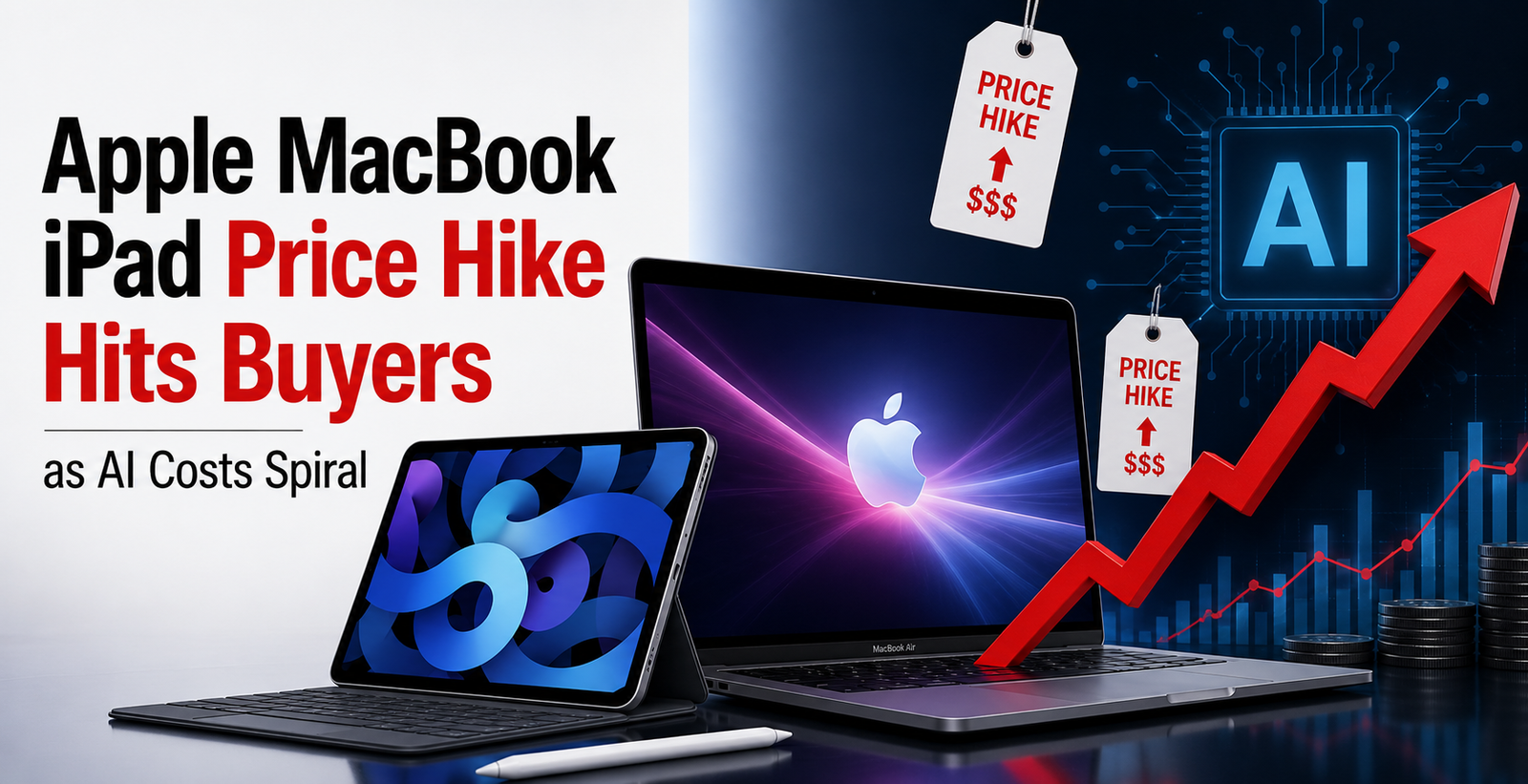

Apple MacBook iPad Price Hike Hits Buyers as AI Costs Spiral
Apple has done something it almost never does. On Thursday, 25 June 2026, the company quietly took its website offline for a short window — and when it came back up, the prices were higher. Not on new products. On devices already sitting in people’s shopping carts.
Apple raised the prices of its Macs and iPads, citing soaring costs of memory and storage chips driven by the artificial intelligence boom. The move shocked the market, caught many buyers off guard, and put a very public number on what the AI revolution is actually costing ordinary consumers.
How Much More Will You Pay?
The increases are not small adjustments. Apple increased prices on some laptop and tablet models by $200 or more. The base model MacBook Pro now costs $1,999, up from $1,699. The MacBook Neo — Apple’s entry-level laptop — now costs $699, a $100 increase from when it was introduced in March. The iPad Air went up $150 to $749, while the iPad Pro jumped $200 to $1,199.
Across Apple’s US website, price increases range from $30 to $300. The Apple TV streaming device has also risen, from $130 to $200.
These are not the gradual, almost-invisible price shifts Apple typically buries inside a product refresh. These are mid-cycle increases on devices already on sale, which almost never happens. The message is clear: even Apple, with all its supply chain muscle, has reached its limit.
Why Is This Happening? Blame the AI Arms Race
To understand why your next MacBook costs more, you need to look at what is happening inside AI data centres thousands of miles away.
The rapid buildout of AI data centres has sent the cost of memory chips and RAM skyrocketing, as the components are found in nearly all electronic devices, with the chips undergoing quarterly price increases of at least 50% since late 2025.
Industry tracker TrendForce estimates that prices of dynamic random access memory (DRAM) — used in smartphones, personal computers, and other devices — rose by as much as 98% during the first quarter of 2026. It projects prices to increase by a further 58% to 63% in the current quarter.
In simple terms: the same chips that go into your MacBook are the chips that Nvidia and other AI hardware makers need to power massive data centres. And right now, those data centres are winning the battle for supply.
Apple’s shares fell more than 6% on the day — their worst performance since April 2025. Investors know what this means. When a company as tightly managed as Apple cannot absorb a cost, that cost is enormous.
Apple’s Own Words: “We Have Never Seen This Before”
Apple is not usually a company that explains itself at length. So when it does, it is worth paying attention.
“The consumer electronics industry is facing an unprecedented challenge,” Apple said in a statement. “The rapid expansion of AI data centres has created an extraordinary surge in demand for memory and storage. We have never seen a component price increase this much, this quickly.”
Apple said it had shielded customers from increases thus far, but had now reached a point where it could no longer do so.
The company left the door open to further price increases, saying it had “reached a point where we need to begin raising prices on a number of products.”
That language — “begin raising prices” — suggests this announcement may not be the last one.
Tim Cook Had Warned This Was Coming
For those following Apple closely, Thursday’s announcement was not entirely a surprise. Tim Cook told The Wall Street Journal last week that Apple could no longer fully shield customers from the spike in component costs tied to the AI boom.
READ MORE: Google Gemini Shockingly Turns $100 Painting Into Rs. 7 Crore
The price hikes are the first concrete change stemming from Cook’s repeated warnings about rising costs. His successor will now inherit the fallout. John Ternus is set to succeed Cook as CEO on September 1, just days before the new generation of iPhones is unveiled. That launch will likely be the next major test of how consumers respond to a world where AI demand has permanently altered device pricing.
Who Is Winning From This?
While buyers lose out, memory chip manufacturers are having a very good year.
Chipmaker Micron just reported quarterly revenue more than quadrupling, with the memory crunch showing up directly in its financials. Its peers Samsung and SK Hynix are riding the same wave. For them, AI demand combined with tight supply is the best pricing environment in years.
Micron said this week it has secured $22 billion in long-term customer commitments for memory supplies, reflecting continued demand from companies investing in AI infrastructure.
It Is Not Just Apple
The Apple MacBook iPad price hike is part of a much wider pattern. Consumer electronics companies across the board are passing on higher component costs.
Microsoft announced that Xbox prices will go up by $100 to $150 per console, and that it would be discontinuing its more expensive $800 model. In a blog post, Xbox CEO Asha Sharma and chief content officer Matt Booty wrote “we are in a hardware component crisis,” and warned that the company expects another significant price increase in component parts this year — more than five times what it paid for them just two years ago.
Video game console makers, PC manufacturers, and smartphone brands are all navigating the same squeeze. This is not a single company’s problem. It is a structural shift in how tech hardware is priced.
What This Means for the PC and Smartphone Market
The knock-on effects are already being felt across the broader tech industry.
Research firm IDC estimates that global smartphone shipments could decline by nearly 14% this year, while the PC market could contract by 11.3% as higher component costs weigh on demand.
Higher prices mean fewer people buying. That is the economic reality Apple and the rest of the industry now face. The question is whether consumers will delay upgrades, switch to cheaper alternatives, or simply absorb the cost.
For Apple specifically, higher prices may not be entirely unwelcome from a business perspective. IDC expects Apple’s average selling price to rise 12% this year. Fewer units at higher margins can, in some scenarios, still result in healthy revenue figures — at least in the short term.
AI Features Are Pushing Apple Towards More Memory Anyway
There is another dimension to this story that goes beyond the chip shortage. Apple’s own AI ambitions are pushing the company towards higher-memory devices regardless of external supply pressure.
IDC expects all new iPhone models to move to 12GB of RAM, as Apple looks to avoid selling new devices without access to the full suite of Apple Intelligence features. More advanced on-device AI features require more memory, and Apple’s new Siri experience will only work on newer hardware.
IDC estimates roughly 54% of iPhones shipped since 2022 will not support the full new Siri experience.
That gives Apple a ready-made narrative: you are not just paying more because chips are expensive. You are paying more because the devices are more capable. Whether buyers accept that framing is another matter entirely.
Key Price Changes at a Glance
Here is a quick summary of the main Apple MacBook iPad price hike figures announced on 25 June 2026:
US price hikes | New price | Old price | Price difference |
MacBook Neo | $699 | $599 | +$100 |
| MacBook Air | $1299 | $1099 | +$200 |
MacBook Pro | $1999 | $1699 | +$300 |
| Mac mini | $799 | $599 | +$200 |
iMac | $1499 | $1299 | +$200 |
| Mac Studio | $2499 | $1999 | +$500 |
iPad A16 | $449 | $349 | +$100 |
| iPad mini | $599 | $499 | +$100 |
| iPad Air | $749 | $599 | +$250 |
iPad Pro | $1199 | $999 | +$200 |
| HomePod | $349 | $299 | +$50 |
HomePod mini | $129 | $99 | +$30 |
| Apple TV | $199 | $129 | $70 |
UK price hikes | New price | Old price | Price difference |
MacBook Neo | £699 | £599 | +£100 |
| MacBook Air | £1299 | £1099 | +£200 |
MacBook Pro | £1999 | £1699 | +£300 |
| Mac mini | £799 | £699 | +£100 |
Mac Studio (M4 Max) | £2499 | £1999 | +£500 |
| Mac Studio (M3 Ultra) | £5,299 | £3,999 | +£1300 |
iPad Air | £749 | £599 | +£250 |
| iPad Pro | £1199 | £999 | +£200 |
What Happens Next?
Apple has signalled that more increases could follow. With DRAM prices projected to keep climbing through the rest of 2026, and with the AI data centre buildout showing no signs of slowing, the pressure on component costs is unlikely to ease any time soon.
Earlier this year, Apple had indicated that rising memory costs would begin affecting its business after existing inventory helped cushion the impact. The company has now confirmed those higher costs are being reflected in product pricing.
The September iPhone launch will be the next significant moment. If Apple holds prices on its flagship smartphone, it will raise questions about where it is absorbing the cost. If it raises them there too, the conversation around the Apple MacBook iPad price hike will look like the opening move in a longer, more uncomfortable chapter.
Final Thought!
What happened on Thursday was more than a pricing update. It was a signal. The AI race — fought largely in data centres by tech giants chasing the next breakthrough — is now landing directly in the pockets of everyday consumers buying laptops and tablets.
Apple did not want to do this. The company said so explicitly. But when memory chip prices nearly double in a single quarter, even the world’s most valuable company eventually runs out of room to absorb the blow.
If you were planning to buy a MacBook or iPad, you are now paying more than you would have a week ago. And depending on how the rest of 2026 plays out, you may be paying even more before the year is done.
Have you been affected by the Apple price increases? Share your thoughts in the comments below, or let us know which device you were planning to buy.