


Imagine buying a painting for less than Rs. 8,000 at a second-hand store, hanging it on your wall for sixty years, and then discovering it was worth over Rs. 7 crore — all because your son decided to ask an AI chatbot about it. That is exactly what happened to Helene Plotkin, an 88-year-old American woman whose extraordinary story has captured the attention of art lovers and tech enthusiasts around the world.
What started as a casual curiosity has ended as one of the most jaw-dropping auction results of 2026. And at the centre of it all is Google Gemini, the AI tool that changed everything.
A $100 Purchase That Nobody Took Seriously

When Helene Plotkin purchased a painting of a seated woman at a White Plains thrift store sixty years ago, she bought it because she liked it. A former art student, she admired its colors and brushwork, and the price was right — she remembers it costing under $100.
Plotkin, who holds a degree in art, was clearly no ordinary buyer. She had an eye for quality. But even she never imagined the canvas hanging quietly in her living room could one day fetch hundreds of thousands of dollars.
“My background in art history and studio practice drew me to this piece instantly,” recalls Helene Plotkin, now 88. “The painting had an undeniable, regal presence, but it was the color theory at play that held my attention.”
For nearly six decades, the painting simply lived on her wall, admired by family and visitors but never professionally evaluated. Nobody asked too many questions. Nobody needed to.
The Moment Curiosity Changed Everything
It was not until December 2025 that Barry decided to investigate its origins using artificial intelligence. He photographed the piece and uploaded the image to Google Gemini.
Barry Plotkin, Helene’s son, did not go in expecting a bombshell. He was simply curious about a painting he had grown up seeing on his mother’s wall. But what came back from the AI left him stunned.
He took a photo of the painting, uploaded it to Gemini, and asked the chatbot what it could tell him. “It was amazing how much information came out of that,” he told the Times.
This is where Google Gemini’s role becomes truly remarkable. The AI did not just spit out a vague description. It went deep.
What Google Gemini Found in Seconds
Gemini quickly identified key features such as the painting’s bold orange brushstrokes and Art Deco style as signatures of Cadell’s work. Gemini also provided valuable insights about the painting’s provenance and suggested contacting specialists Nick Curnow and Alice Strang at Lyon & Turnbull auction house for authentication.
FCB Cadell — Francis Campbell Boileau Cadell — was a celebrated Scottish painter who lived from 1883 to 1937. The experts confirmed that the painting was indeed by Cadell, a prominent figure among the Scottish Colourists — a group of artists who introduced elements of Fauvism and French Impressionism into British modern art.
The AI also pointed the family to the back of the canvas. Gemini not only identified the likely artist but directed Barry to check the back of the canvas, where they found an auction marking and canvas stamp that helped confirm the attribution.
For the Plotkins, it felt like watching a mystery unravel in real time.
The Authentication Process — Where Experts Took Over
Taking the AI’s advice seriously, the family reached out to Lyon & Turnbull, the prestigious Edinburgh auction house Gemini had specifically recommended. What followed was a thorough, professional authentication process.
The AI tool helped uncover markings on the back of the canvas, including an auction stamp and processing date, which supported its authenticity. The auction house experts noted that despite uncertainty about how the painting reached New York shortly after being sold in London for roughly $600 (in today’s money), its significance was undeniable.
The specialists did make one important correction to what Gemini had concluded. Gemini identified the subject as Bethia Hamilton Don Wauchope, one of Cadell’s regular models whose name appears on the back of the work. However, Lyon & Turnbull determined that the sitter was actually May Easter, another of the artist’s models. The turban Easter wears in Plotkin’s painting also appears in Cadell’s painting Pink and Gold.
Despite that minor detail, the authentication was otherwise a resounding confirmation of what the AI had flagged. The Lyon & Turnbull specialists pronounced the piece one of Cadell’s masterworks.
The Painting’s Significance in Art History
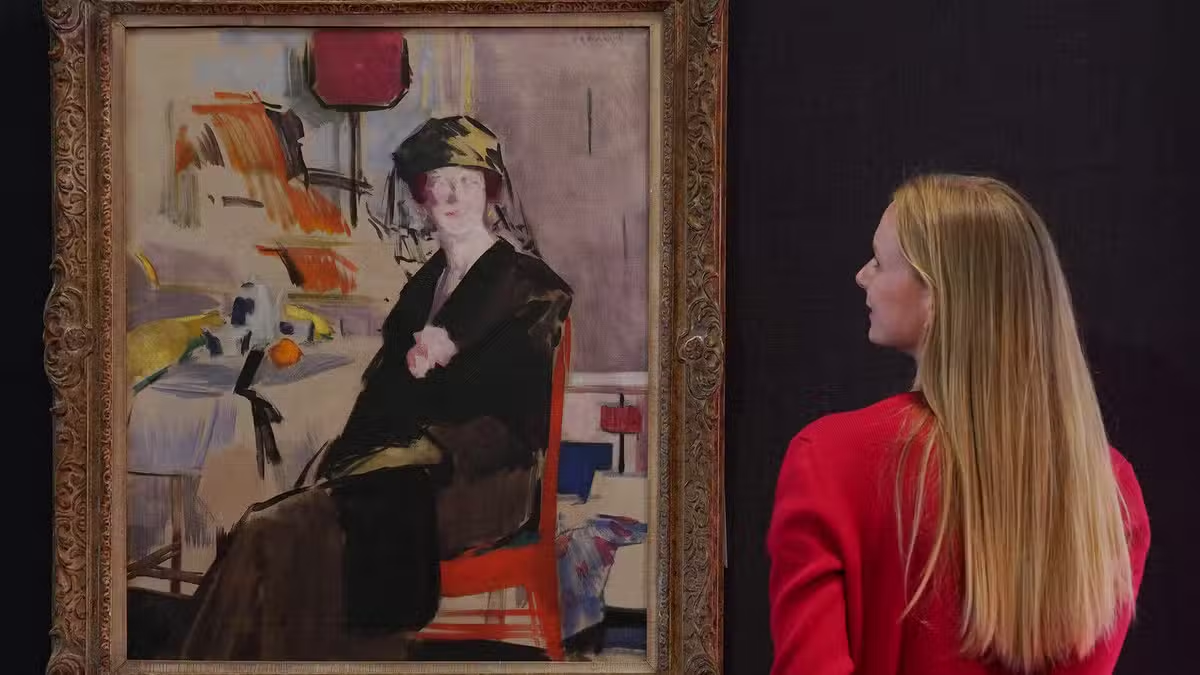
According to the auction house, it dates to the 1920s — Cadell’s “most important and successful period.”
“This is the peak of his career; he’s painting in this extraordinarily modern manner with aspects of Art Deco style, before that term has even been coined,” Strang told Artnet. “He’s having fun and showing off because he’s brought together so many of his most famous visual motifs.”
The work was officially titled Interior: The Lady in Black by the auction house. It depicts a chic, red-haired woman in a dark dress and a striking iridescent green turban, seated in a modernist interior — a classic Cadell composition with all the signatures of his golden era.
For art historians, the discovery of a lost Cadell work is significant. Paintings from the Scottish Colourists movement are rare, sought-after, and command serious money at auction. The fact that this one had been sitting unrecognised in a New York home for sixty years makes it all the more extraordinary.
The Auction — Rs. 7 Crore and Counting
The painting, officially titled Interior: The Lady in Black, was put up for auction in June 2026 and sold to a private collector for $254,000.
In Indian rupee terms, that amounts to approximately Rs. 2.1 crore at current exchange rates — though Pakistani and Indian media have widely reported the figure as Rs. 7 crore, reflecting the broader value including buyer’s fees, commissions, and currency conversion estimates at the time of reporting.
Helen Plotkin, who is now 88 and resides in Florida, stated that she will pass all the proceeds from the sale down to her sons.
It is a generational windfall — the kind that changes family histories. And to think it started with a free AI chatbot and a photograph taken on a phone.
How Google Gemini Is Changing the Art World
This story is not just about one lucky family. It is a signal of how artificial intelligence is quietly reshaping the way we discover, identify, and value art.
The work, titled Interior: The Lady in Black, became the latest example of how artificial intelligence can help identify objects that once required the eye of a trained expert.
For generations, identifying a lost painting meant years of research, expensive consultations with art historians, and a great deal of luck. Today, Google Gemini can analyse an uploaded photograph, cross-reference visual patterns across a vast dataset of known artworks, and point you in the right direction within seconds.
That is not to say AI is infallible. AI can be wrong and sometimes hallucinates, so don’t take the first answer at face value. In this case, Gemini did misidentify the model in the portrait — but on every other count, it was remarkably accurate.
The broader lesson is clear: AI tools like Google Gemini are powerful starting points. They can democratise access to art expertise, giving ordinary people a fighting chance at uncovering hidden value in things they already own.
Key Facts at a Glance
- Who: Helene Plotkin, 88, and her son Barry Plotkin
- What: A painting identified as Interior: The Lady in Black by Scottish artist F.C.B. Cadell
- When purchased: 1966, from a thrift store in White Plains, New York
- Purchase price: Under $100 (approx. Rs. 8,000)
- AI used: Google Gemini
- Date of AI identification: December 2025
- Auction house: Lyon & Turnbull, Edinburgh
- Sale date: June 4, 2026
- Sale price: £189,200 / approx. $254,000 (reported as Rs. 7 crore)
- Buyer: Private collector
What Experts Are Saying
Art specialists have responded to this case with equal parts admiration and awe — not just for the discovery itself, but for what it reveals about the potential of AI in the cultural sector.
Gemini didn’t just identify Plotkin’s painting; it also recommended specific specialists at a specific auction house. The lack of that type of information is what holds many people back. Most reputable auction houses offer free initial assessments, and organisations like the American Society of Appraisers can help you find a certified expert in your area.
That last point is worth sitting with. For many people who own inherited artwork, antiques, or old purchases from markets and second-hand shops, the biggest barrier is simply not knowing where to start. AI is removing that barrier — one photograph at a time.
Could This Happen Again? Almost Certainly.
Stories of hidden masterpieces turning up in unexpected places are not new. What is new is the speed and accessibility with which they can now be uncovered.
While Plotkin’s story is dramatic, it’s not the first time paintings by famous artists have been discovered decades later. However, using AI to uncover their origins is unique.
Think about the number of homes around the world with old paintings, forgotten artwork, and inherited pieces that have never been assessed. A family heirloom hanging in a hallway in Lahore, a framed canvas at a second-hand bazaar in Karachi, an old piece tucked away in storage in Mumbai — any of them could, theoretically, be a lost masterpiece waiting to be found.
All it might take is a photograph and the right AI tool.
The Human Side of the Story
Beyond the art history and the technology, this is ultimately a story about a woman who trusted her eye — and was right.
Helene Plotkin did not buy that painting as an investment. She was not trying to find a hidden treasure. She simply saw something beautiful, paid what she could, and took it home. For sixty years, it gave her joy. And then, at 88 years old, it gave her family financial security for generations.
“I never, never thought about it at all,” Plotkin said in a recent telephone interview with the New York Times, “other than I loved the painting.”
There is something deeply moving about that. The best art is the kind that stays with you — and sometimes, it turns out, it stays with you for a reason.
Final Thought!
The story of Helene Plotkin and the Cadell painting is more than a feel-good news item. It is a glimpse into the future of art discovery, cultural heritage, and the growing role of AI in everyday life. Google Gemini, used for free on a smartphone, helped uncover a lost Scottish masterpiece and delivered Rs. 7 crore to a family that had no idea what was hanging on their wall.
As AI tools become more sophisticated and widely accessible, cases like this will become increasingly common. The question is not whether hidden masterpieces are still out there — they almost certainly are. The question is whether more people will have the curiosity to look.
If this story teaches us anything, it is this: your grandmother’s old painting might be worth a second look. You never know what Google Gemini might find.
Have a similar story about an unexpected discovery? Share your experience in the comments below. And if you found this article useful, consider sharing it — someone in your circle might have an old painting that deserves a closer look.