A single signature in Bhubaneswar just reshaped the map of global aluminium production.
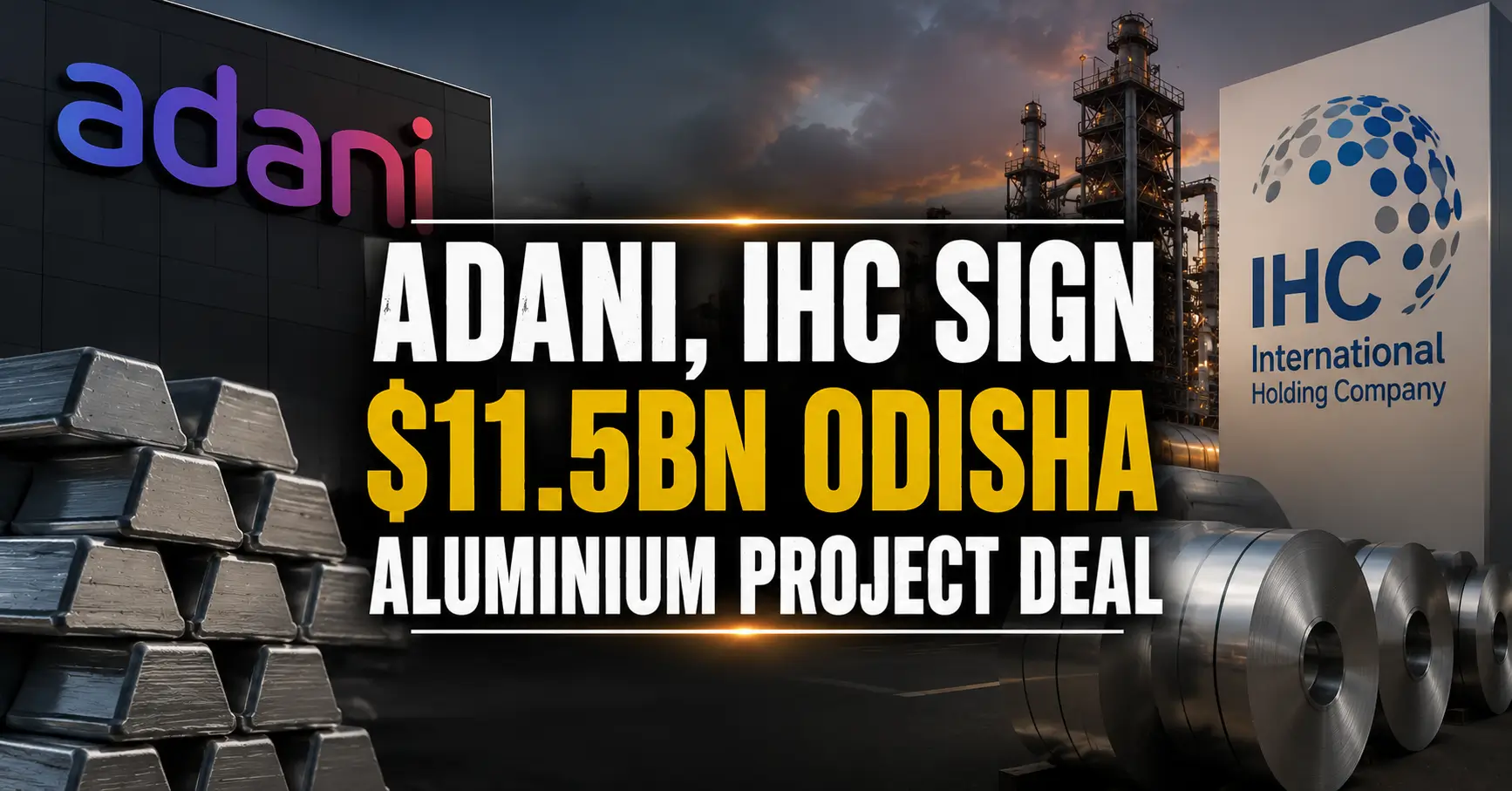
On Thursday, Gautam Adani’s flagship company and an Abu Dhabi state-backed investor put pen to paper on what officials are calling India’s largest-ever foreign direct investment in metallurgy — an $11.5 billion bet on a state most outsiders have never heard of.
The state is Odisha. And it’s about to become impossible to ignore.
The Deal: What Was Actually Signed

Adani Enterprises Limited (AEL) and International Resources Holding (IRH) — the natural resources arm of Abu Dhabi’s International Holding Company (IHC) — signed a memorandum of understanding with the Odisha state government to build an integrated, greenfield aluminium complex.
The deal was signed in the presence of Odisha Chief Minister Mohan Charan Majhi and Industries Minister Sampad Chandra Swain, along with senior government officials.
The structure is straightforward on paper, ambitious in scale. AEL and IHC will form a joint venture with equal 50:50 ownership to run the project.
What exactly are they building? The plan includes a 4-million-tonne-per-annum alumina refinery, a 2-million-tonne aluminium smelter, and 1 million tonnes of downstream manufacturing capacity. Add to that a captive power plant large enough to run it all — the project also includes a 4,000-megawatt captive power plant.
This isn’t a modest expansion of existing capacity. Industry estimates suggest the plant could lift India’s total aluminium capacity by nearly 50 per cent.
Jobs, Money, and Where the Plants Will Actually Sit

Numbers this large invite skepticism, so it’s worth pinning down the specifics.
The project is projected to create 53,500 jobs. Reports on the ground add texture to that figure — construction and operations phases will both draw heavily on local labour, though the split between the two hasn’t been finalised publicly by either company.
The investment will roll out in two phases: roughly ₹66,000 crore for Phase I and ₹44,000 crore for Phase II, financed through a mix of internal company resources and debt.
That’s not money committed overnight — Adani’s leadership expects 12 to 18 months just to clear milestones and regulatory approvals, with a further three and a half years needed before the project is fully operational.
Geography matters here too. Sources indicate the alumina refinery will be built in Rayagada, while the smelter will go up in Sundargarh — both districts sitting atop Odisha’s bauxite-rich terrain, the raw material aluminium is refined from.
Why Odisha, and Why Now
This isn’t Adani’s first foray into metals, but it’s a new metal for the group. This marks the conglomerate’s second major metals venture, following its copper smelter in Gujarat that began operations last year.
Odisha’s pitch to investors has been building for years, and this deal validates it. The state already anchors India’s bauxite reserves and refining capacity, giving it a natural head start over rival states chasing the same industrial dollars.
Speaking at the signing ceremony, Karan Adani, managing director of Adani Ports and Special Economic Zone, framed the project as more than a balance-sheet decision.
“With a proposed investment, this is among the most significant aluminium ecosystem investments anywhere in the world. But its true significance lies not only in the size of the investment. It lies in the depth of its impact,” he said. He added that the project brings together the full aluminium value chain in a single integrated ecosystem.
The Emirati side struck a similar note, tying the deal to a longer-running strategy rather than a one-off transaction. IHC chief executive Syed Basar Shueb said the investment follows the company’s approach of building long-term businesses in critical minerals that support industrial development, resilient supply chains, and the clean energy transition.
On the partnership itself, he was direct: “The partnership with Adani Enterprises will help develop a world-class integrated aluminium project capable of creating long-term economic value.”
Chief Minister Majhi, for his part, tied the announcement to the state’s own long-term development branding. He said the MoU marks Odisha’s entry into the global aluminium supply chain, calling it “an important step towards Samruddha Odisha 2036 and our contribution to Viksit Bharat 2047.”
A Widening UAE-Adani Relationship

This deal doesn’t exist in isolation. It’s the latest link in a chain Adani and IHC have been building for a while now.
Earlier this year, IHC Group company ePointZero entered a joint venture with Adani Green Energy for renewable energy projects across India.
The aluminium deal extends that relationship into an entirely different sector — mining and metals — signalling that Abu Dhabi’s sovereign-linked capital sees India as more than a one-industry opportunity.
READ MORE: Apple MacBook iPad Price Hike Hits Buyers as AI Costs Spiral
IHC itself isn’t a small player looking to diversify on a whim. The group carries a market capitalisation of $233 billion and holds stakes in more than 1,300 subsidiaries spanning technology, infrastructure, financial services, and consumer sectors. When capital of that scale commits to a single Indian state, it tends to pull other investors along in its wake.
What Happens Next — and Why It Matters Beyond Odisha
An MoU is a statement of intent, not a shovel in the ground. Officials say the joint venture partners and the Odisha government will now move into the next phase: land acquisition, statutory approvals, and infrastructure planning.
That’s typically where big-ticket Indian industrial projects slow down or stall entirely, and this one will be watched closely for exactly that reason.
But the strategic logic behind the deal is bigger than any single project timeline. India remains the world’s second-largest aluminium producer yet still imports significant volumes to meet demand from infrastructure, power, transport, and renewable energy sectors — a gap New Delhi has openly said it wants to close through domestic capacity expansion.
If Odisha’s new complex comes online as planned, it will do more than add tonnage to India’s output tables. It will test whether Gulf capital and Indian industrial ambition can execute at the scale both sides are now promising in public.