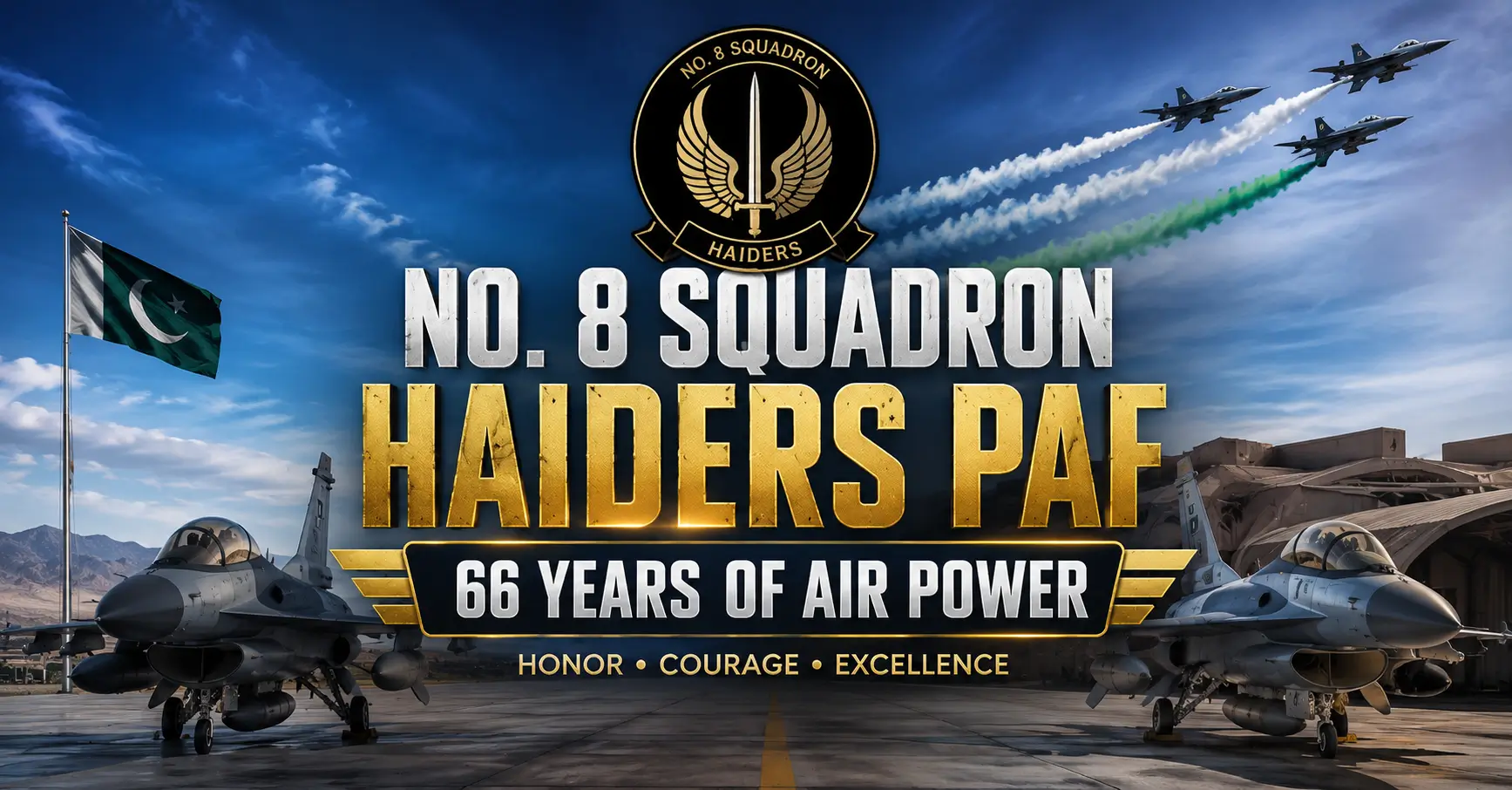

No 8 Squadron Haiders PAF was raised on 1 August 1960 at PAF Base Masroor, and this week the unit quietly crosses its 66th year in service. Few squadrons in South Asia carry a lineage this dense with firsts, comebacks, and combat history.
The squadron takes its name from Hazrat Ali (RA), known in Islamic tradition as “Haider” — a title associated with courage and battlefield resolve. That naming choice was never incidental; it set the tone for a unit built around offensive strike capability from day one.
From B-57 Bombers to a Historic World-First Formation

The Haiders began flying American-made Martin B-57 Canberra light bombers, acquired through the 1955 Pakistan-US mutual defence treaty. Records show the squadron initially operated roughly a dozen B-57B variants plus a single B-57C trainer, sourced from a disbanded USAF bombardment wing.
On 27 October 1964, the squadron achieved something no air force had done before: alongside No 7 Squadron, four B-57s executed the world’s first bomber formation loop, flying in diamond formation. It remains one of the more cited moments in Pakistan Air Force aviation history.
The 1965 War: No 8 Squadron Haiders PAF Under Fire
When war broke out in September 1965, the Haiders — then under No 31 Bomber Wing — were thrown into sustained combat operations. According to PAF historical accounts:
- The squadron flew 167 combat sorties across the conflict
- Nearly 600 tons of ordnance were dropped on Indian airbases
- Targets included Jamnagar, Adampur, Halwara, Pathankot, Srinagar and Ambala
- Strikes reportedly destroyed 16 Indian aircraft and damaged 17 more, a figure PAF accounts say was acknowledged by the Indian Air Force itself
These numbers appear consistently across PAF-linked sources, though independent, non-military verification of exact loss figures remains limited — a common caveat with wartime combat claims from any air force.
A Quiet Decade, Then Reactivation with Mirage-V Jets

The 1971 war found the Haiders largely inactive as a standalone unit. Post-1965 U.S. sanctions had degraded the B-57 fleet, and by 1968 the squadron was number-plated, its aircraft and pilots absorbed into No 7 Squadron.
The unit stayed dormant until 6 March 1982, when it was reformed and re-equipped with French-built Mirage-V PA2/3 fighters. That relaunch marked a shift from pure bombing to a broader tactical-attack role within PAF’s Southern Air Command structure.
Pioneering Maritime Support and Joint-Service Operations
No 8 Squadron became the first PAF unit formally tasked with Maritime Support Operations, working directly with the Pakistan Navy. This wasn’t a symbolic assignment.
- In September 1992, two Haider Mirage-Vs intercepted the Indian vessel INS Talwar after it entered Pakistani territorial waters, forcing it out
- In May 1995, Haider Mirages took part in exercise “Inspired Alert” with US Central Command, executing a simulated multi-directional attack meant to overload the defences of USS Abraham Lincoln
Both episodes are documented in PAF unit histories and cited across open-source military references, reinforcing the squadron’s reputation for joint-service coordination.
The JF-17 Thunder Block III Era

The squadron’s latest chapter began on 1 January 2023, when it was re-equipped with JF-17 Thunder Block III aircraft — a 4.5-generation, jointly developed Pakistan-China multirole platform. In December 2003, well before this transition, the unit had already earned PAF’s prestigious “Colour” honour for distinguished night operations.
What the Transformation Signals for PAF’s Modernization
The Block III rollout isn’t isolated to No 8 Squadron. No 16 Squadron “Black Panthers” received an early batch of the same aircraft, and PAF contingents have since flown Block III jets to exercises abroad, including Indus Shield Alpha in Azerbaijan in October 2025.
READ MORE: Pakistan Navy Deepens Belarus Defence Cooperation Grows in 2026
Taken together, these deployments point to a broader PAF strategy: consolidating an aging, mixed fleet into fewer, more capable 4.5-generation squadrons rather than spreading upgrades thin. No 8 Squadron’s inclusion in that pipeline places it among PAF’s frontline units going forward.
Why the Legacy of No 8 Squadron Haiders PAF Still Matters
Sixty-six years is a long institutional memory for any fighting unit. What stands out about the Haiders isn’t just longevity — it’s the pattern of reinvention: bomber squadron, disbanded unit, Mirage strike force, maritime specialist, now a Block III multirole squadron.
Officials have previously described the unit as a symbol of professionalism and combat readiness during past anniversary commemorations. Whether that framing holds up depends less on ceremony and more on operational record — something worth watching as PAF continues rolling out Block III aircraft across its squadrons.