

He Voted His Conscience. Trump Voted Him Out — And Cassidy Hit Back on His Way Out the Door
Five years after casting one of the most consequential votes of his Senate career, Bill Cassidy paid the political price in Louisiana’s Republican primary. But even in defeat, he refused to go quietly.
BATON ROUGE, La. — Bill Cassidy walked into Saturday night knowing the numbers probably weren’t going to fall his way. He had spent months crisscrossing Louisiana, touting flood recovery funding and bipartisan infrastructure wins, trying to convince Republican voters that a senator who actually delivers for his state is worth keeping around — regardless of one vote cast five years ago. But in Donald Trump’s Republican Party, that one vote was the only thing that mattered.
Cassidy failed to advance past the GOP primary in Louisiana’s Senate race on May 16, 2026 — knocked out by Trump-backed Rep. Julia Letlow and state Treasurer John Fleming, who will now face each other in a June 27 runoff. The result was swift and, to many in Washington, a signal: cross Trump, and the party will come for you, no matter how long it takes.
It was the first time Trump had successfully ousted a sitting senator from his own party in a primary — a milestone he had been chasing since 2021, when Cassidy became one of just seven Senate Republicans to vote to convict the then-former president on charges of inciting the January 6th Capitol riot.
The Vote That Started It All

When Cassidy cast that vote in February 2021, he did so with a short, direct statement that left no room for misinterpretation. “Our Constitution and our country is more important than any one person,” he said from the Senate floor. “I voted to convict President Trump because he is guilty.”
“Our Constitution and our country is more important than any one person.”
— Sen. Bill Cassidy, February 2021, explaining his impeachment vote
Louisiana’s Republican Party voted to censure him within days. Allies quietly urged him to apologize or soften his position. He did neither. And for the next five years, that vote followed him everywhere — at town halls, in campaign ads, and on Trump’s Truth Social page, where the president repeatedly labeled him a “disloyal disaster.”
What made Cassidy’s situation unusual — and ultimately tragic, depending on your politics — was that his actual Senate voting record barely deviated from the Trump line. He supported Trump’s legislative priorities, backed his nominees, and even played a key role in advancing Robert F. Kennedy Jr.’s confirmation as Health and Human Services Secretary, despite significant personal reservations about Kennedy’s stance on vaccines. None of it was enough.
Trump’s Campaign Against Cassidy: Personal and Relentless
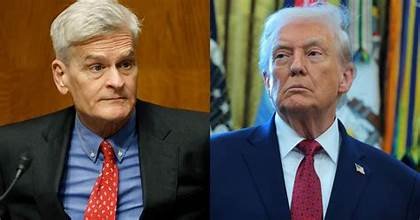
Trump’s opposition to Cassidy was never really about policy. It was about loyalty — the kind that Trump defines as unconditional. When he endorsed Julia Letlow, a congresswoman from northeastern Louisiana, he was sending a message to every Republican in Washington: votes have consequences, and so does independence.
- Cassidy became the first GOP senator to lose a primary renomination in nearly a decade.
- Trump-backed Rep. Julia Letlow and state Treasurer John Fleming advance to a June 27 runoff.
- Cassidy voted to convict Trump in the 2021 Senate impeachment trial — one of only seven Republican senators to do so.
- Cassidy rarely voted against Trump’s legislative agenda despite their personal tensions.
- Trump referred to Letlow and Fleming as “two great people” as voting opened Saturday morning.
- This was the first time Trump successfully defeated a sitting senator from his own party in a primary.
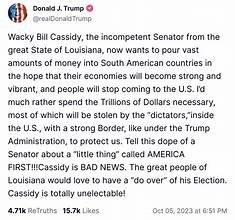
In the weeks leading up to the primary, Trump ramped up his attacks. He blasted Cassidy on Truth Social as someone who used Trump’s name and endorsement to win his 2020 Senate race, then “turned around and voted to impeach.” He later blamed Cassidy for the failed nomination of Casey Means as Surgeon General, accusing the senator of being an obstacle to his agenda.
Cassidy, for his part, pushed back quietly but consistently. He criticized Trump’s rhetoric on immigration as “dehumanizing.” He raised pointed questions about vaccine policy changes under Kennedy. He made clear, in his careful doctor-senator way, that he was not going to simply disappear and be quiet just because the president wanted him to.
Why Other Republicans Survived — and Why Cassidy Didn’t
One of the underappreciated realities of Trump’s campaign against Republicans who voted to impeach or convict him is how many of them simply chose not to run again. Senators like Pat Toomey and Richard Burr retired rather than face a Trump-fueled primary. Alaska Sen. Lisa Murkowski survived — but only because Alaska uses a nonpartisan primary system that gave her a structural advantage no one else had.
Cassidy chose a different path. He announced he was running for a third term and made clear he wouldn’t run from his record. That decision, admirable or politically reckless depending on your view, put him on a collision course with the most powerful force in Republican politics today.
In Defeat, Cassidy Delivered His Own Message
What happened after the results came in on Saturday night may have been the most politically interesting part of the whole story. Cassidy gathered his supporters at Boudreaux’s Caterers in Baton Rouge and delivered a concession speech that, without ever mentioning Trump’s name, made clear he was not done speaking his mind.
According to multiple reports from the event, Cassidy signaled that he intends to spend the remaining months of his Senate term being more openly critical of the administration — a lame-duck senator with nothing left to lose and a platform he’s not quite ready to give up. He had carried the weight of that 2021 impeachment vote for five years, and now, freed from the calculus of electoral survival, he appeared ready to speak more freely.
“When a man knows he’s going to be hanged in a fortnight, it concentrates his mind wonderfully.”
— Samuel Johnson, a sentiment that captures Cassidy’s post-primary posture
It’s a posture that could make Cassidy a genuine irritant to the White House in the months ahead. The Louisiana Senate seat won’t flip — it’s ruby-red territory, and whoever emerges from the Letlow-Fleming runoff will almost certainly win in November. But Cassidy’s voice, once muffled by the need to survive a primary, could now be louder than ever.
What This Means for the Rest of the GOP
The political ripple effects of Cassidy’s defeat are already being felt. The most immediate concern is in Texas, where Sen. John Cornyn — who has occasionally clashed with Trump — faces a May 26 runoff against Attorney General Ken Paxton. Trump has notably stayed out of that contest, but the Louisiana results will hang over it like a storm cloud.
Meanwhile, Trump wasted no time drawing a direct line between Cassidy and Kentucky Rep. Thomas Massie, another Republican he’s been trying to unseat. In a Truth Social post early Sunday morning, Trump declared that Massie is “an even bigger insult to our Nation” than Cassidy, reinforcing his endorsement of Massie’s primary challenger.
- June 27 runoff — Julia Letlow vs. John Fleming for the Republican Senate nomination in Louisiana.
- May 26 — Texas Senate runoff between John Cornyn and Ken Paxton, a race Trump has avoided entering.
- Thomas Massie primary — Trump is backing Ed Gallrein against the Kentucky congressman in Tuesday’s contest.
- Cassidy’s final months — Watch for potentially more outspoken criticism from the senator before his term ends.
The Price of Independence in Trump’s GOP
Political analysts have long debated whether Trump’s grip on the Republican Party would eventually loosen — whether voters would begin to value results over loyalty, experience over allegiance. Cassidy’s defeat suggests that moment, at least in Louisiana in 2026, has not yet arrived.
The irony is sharp. Cassidy supported much of Trump’s legislative agenda, championed major infrastructure investment that sent billions of federal dollars to Louisiana, and positioned himself as a practical, results-oriented senator. He was the kind of Republican that, in another era, would have been considered a party asset. But in today’s GOP, the era of the independent-minded Senate institutionalist feels increasingly distant.
Most of the other senators who voted to convict Trump in 2021 read the room and quietly exited. Cassidy chose to stay and fight. He lost. But in doing so, he also became something rare in modern American politics — a politician who said what he believed, faced the consequences openly, and refused to pretend it never happened.
That may not win primaries. But it’s worth noting.
Final Thought!
The Louisiana Senate primary delivered two clear messages on Saturday night. Trump’s message was aimed at every Republican in Washington who might be tempted to defy him: the political cost of independence in this party is real, and it is enforceable. He finally got the scalp he had been after since 2021.
Read More! Pakistan Brokers Gulf Calm as Trump
Cassidy’s message, delivered quietly from a ballroom in Baton Rouge, was aimed somewhere else entirely — perhaps at history, perhaps at the handful of colleagues still watching. In defeat, with nothing left to protect, he signaled he intends to spend his final months in the Senate saying exactly what he thinks. Bill Cassidy lost his primary. Whether he lost the argument is a different question entirely.
What do you think? Did voters in Louisiana make the right call? Does party loyalty or individual conscience matter more in today’s political climate? Let us know in the comments below.