


A legal watchdog has thrown a fresh challenge at the presidency — and this one comes with a paper trail attached.
The Judicial Activism Panel (JAP) has formally questioned how Muhammad Zafar-ul-Haq Hijazi landed the post of Federal Tax Ombudsman. Not through informal criticism. Through a constitutional information request addressed directly to President Asif Ali Zardari and the Ministry of Law and Justice.
The recommendation was made while disposing of implementation proceedings in a refund-related complaint.
During the hearing, the department informed the FTO that an amended assessment order under Section 122 of the Income Tax Ordinance had been passed after issuance of the Ombudsman’s recommendations.
The FTO clarified that the legality of the assessment order falls within the exclusive jurisdiction of the statutory appellate fora and, therefore, refrained from expressing any opinion on its merits.
Who’s Behind the Challenge
JAP Chairman Muhammad Azhar Siddique, an Advocate of the Supreme Court, drafted and dispatched a detailed questionnaire invoking Article 19-A of the Constitution — Pakistan’s right-to-information guarantee — along with the Right of Access to Information law.

This isn’t a symbolic gesture. Article 19-A carries legal weight, and public office holders are bound to respond to citizen requests filed under it, at least in principle.
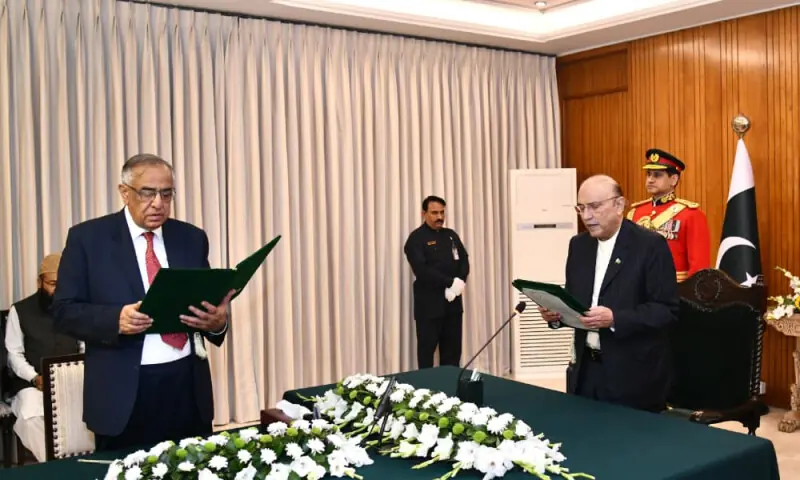
Hijazi’s own appointment is a matter of public record. He was sworn in as Pakistan’s FTO on 16 December 2025, taking the oath from President Zardari at Aiwan-e-Sadr.
He arrived at the post with a substantial résumé — Chairman of the Securities and Exchange Commission of Pakistan, Chairman of the Audit Oversight Board, and more than four decades in taxation, audit, and corporate regulation. On paper, a credible appointee.
But JAP isn’t disputing his credentials. It’s disputing the process.
Why the Selection Method Matters
The panel’s core argument centres on power, not personality. It contends that the Federal Tax Ombudsman wields authority on par with a Supreme Court judge — including contempt powers — which makes the office too consequential to fill through discretion alone.
According to JAP, a position of that weight demands an open, advertised, competitive process. Not a quiet nomination followed by a notification.
READ MORE: IHC Seeks Jail Report on Imran Khan Solitary Confinement After 7 Months
To back that position, the panel leaned on Supreme Court precedent. It cited the judgment in Constitutional Petition Nos. 1716-1724 of 2022, where the apex court described public appointments as a “sacred trust” that must be handled fairly, transparently, and without discrimination.
JAP’s logic here is straightforward: if that standard applies to honorary roles, a salaried statutory office should face even tighter scrutiny.
The panel didn’t stop at one ruling. It also referenced PLD 2024 SC 1276 and 2023 SCMR 1932, alongside judgments tied to the Sindh Public Service Commission and the Balochistan High Court — all cases where merit-based selection was treated as non-negotiable.
A Wider Legal Net

What sets this challenge apart is its reach beyond domestic case law. JAP’s questionnaire draws on comparative legal principles from India and the United Kingdom, positioning Pakistan’s appointment practices against international benchmarks.
It also invokes Pakistan’s treaty commitments — specifically the UN Convention Against Corruption (UNCAC) and the International Covenant on Civil and Political Rights (ICCPR). Both instruments touch on transparency and accountability in public administration, and JAP appears to be using them as external pressure points, not just domestic ones.
This layering of local jurisprudence with international obligation is a tactic increasingly common among Pakistan’s legal activist groups — it raises the reputational stakes for the state well beyond a single court petition.
What Information Is Being Sought
The questionnaire isn’t vague. JAP has asked for a specific set of documents, including:
- Certified copies of any public advertisement for the FTO post
- The total number of applications or nominations received
- A list of candidates who were considered
- The shortlisting criteria applied
- Minutes and details of any Search or Selection Committee
- The official summary and file notings that led to the appointment
- The appointment notification and oath of office
- Details of any conflict-of-interest screening mechanism
That’s a comprehensive paper trail — and its absence, or presence, will likely determine how this story develops.
The panel has given the President and the Law Secretary 10 days to respond. It has also asked that the entire appointment record be made public, not shared privately or selectively.
Broader Implications for Public Appointments
JAP’s demand isn’t only about one appointment. It closes with a wider request: that future appointments to senior statutory offices be conducted through open, advertised, competitive selection — as a standing practice, not a one-off concession.
That’s the real target here. Hijazi’s appointment is the trigger, but the underlying complaint is structural — a pattern, JAP suggests, of filling powerful government posts without public scrutiny of how candidates are chosen.
Whether the presidency responds within the stated timeline, and what it discloses if it does, will say a lot about how seriously Article 19-A requests are treated when they land at the highest levels of government.
Pakistan has no shortage of laws promising transparency. The test, as always, is whether those laws produce documents — or just more questions.