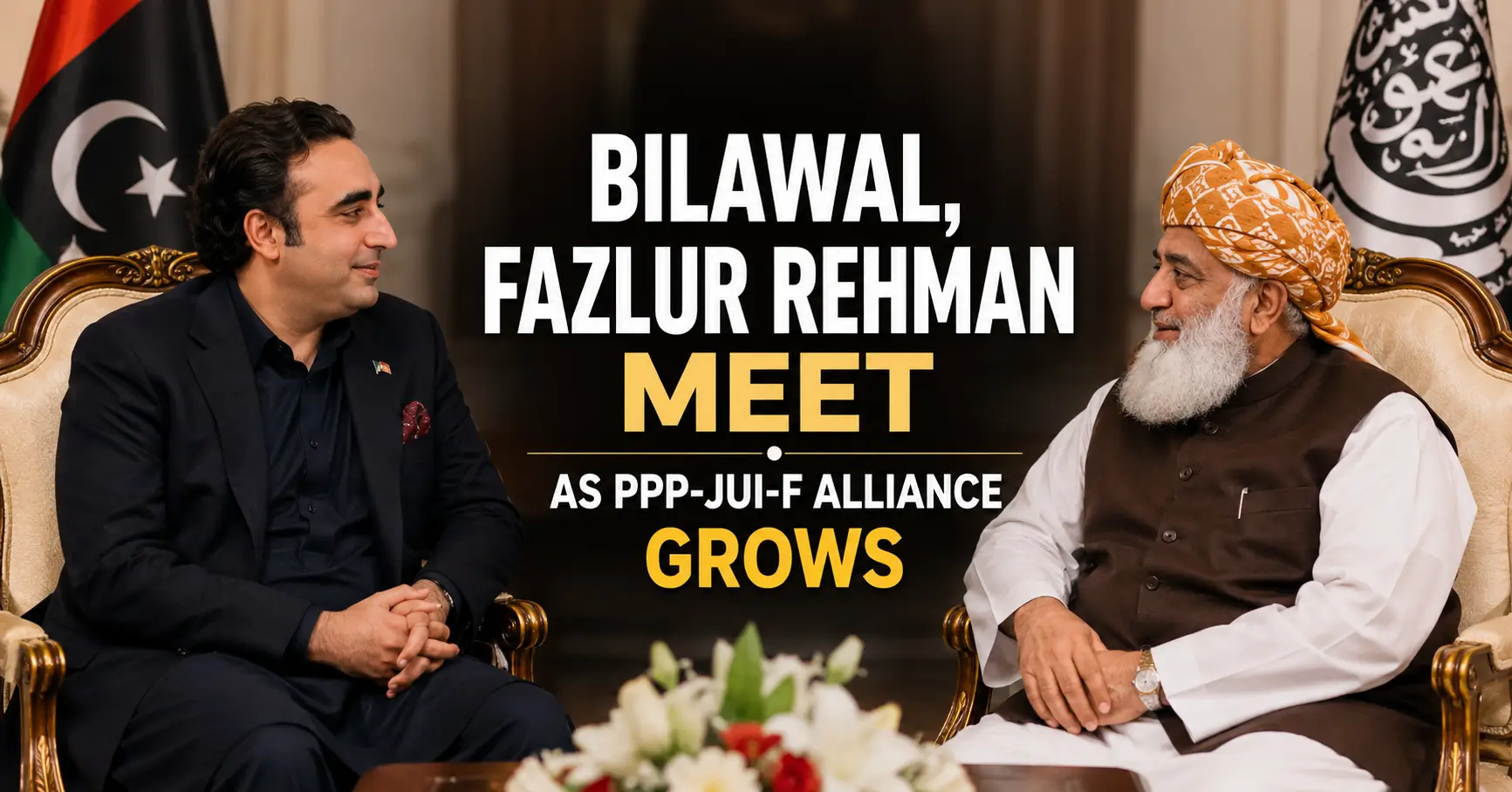

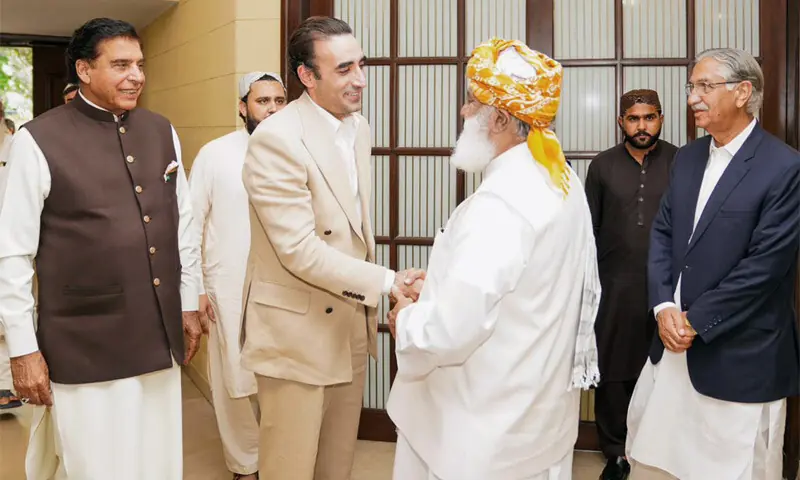
Islamabad’s political circuit had another quiet but consequential afternoon on Tuesday. PPP-JUI-F Chairman Bilawal Bhutto Zardari drove to Maulana Fazlur Rehman’s residence, sat down for a closed-door conversation, and left behind fresh speculation about where Pakistan’s two largest opposition-turned-coalition forces are headed next.
On paper, it was an ordinary courtesy call. In practice, it was the latest in a string of meetings between the two leaders that has steadily hardened into something resembling a working partnership.
What Happened at the Meeting
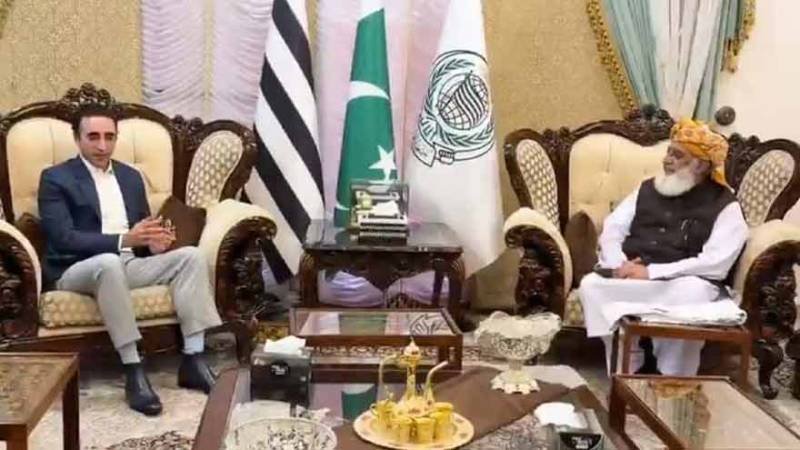
Bilawal arrived accompanied by former prime minister Raja Pervaiz Ashraf. On the JUI-F side, the host was joined by Engineer Ziaur Rehman and Maulana Asjad Mahmood. According to sources close to both camps, the two chairmen reviewed the prevailing political situation in the country and exchanged views on a range of issues of mutual interest — language both parties have used consistently to describe their recent run of consultations.
No formal statement followed the meeting, and neither side released a detailed readout. That has become typical of these PPP-JUI-F engagements: substantive in private, sparse in public.
A Pattern, Not a One-Off
This was not an isolated handshake. Bilawal and Fazlur Rehman have met repeatedly over recent months, each time circling similar themes — parliamentary cooperation, legislative strategy, and coordination on contested national issues. Earlier sit-downs touched on a proposed constitutional amendment, the stalled signing of the Madrasa Registration Bill, and the security and economic challenges facing the federal government.
What has changed is the backdrop. Tuesday’s meeting came just days after PPP and JUI-F formally translated their political chemistry into an electoral pact — something neither party had done in Azad Jammu and Kashmir before.
The AJK Alliance: The Real Story Behind the Meeting
The trigger for the renewed attention is an announcement made at a joint press conference in Islamabad, where PPP AJK President Chaudhry Muhammad Yasin and JUI-F AJK chief Maulana Saeed Yousaf unveiled a formal electoral alliance for the AJK Legislative Assembly elections scheduled for July 27.
Under the arrangement, the two parties will field joint candidates in two constituencies — LA-14 (Western Bagh/Dhirkot) and LA-23 (Sudhnoti/Pallandri). In return, PPP has pledged to back JUI-F’s nominees there, while JUI-F has directed its workers and candidates to support PPP nominees in every other constituency across the 53-member assembly.
Two sitting PPP nominees, Nabeela Ayub and Zobia Khurshid, are withdrawing their nomination papers in those seats to make way for the joint candidates, in line with the party’s internal decision.
READ MORE: Mushaal Mullick Strongly Condemns Fresh Chargesheet Against Yasin Malik
Yasin did not undersell the moment. “Today is a historic day in the politics of Azad Kashmir,” he told reporters at the press conference, framing the deal as the start of formal cooperation between the two parties in the region rather than a one-election arrangement.
He also credited Bilawal and Fazlur Rehman personally for facilitating the understanding, and reaffirmed that PPP would continue raising the Kashmir issue at national and international forums.
Maulana Saeed Yousaf, for his part, called it the first formal electoral alliance between JUI-F and PPP anywhere in Azad Kashmir’s history, and instructed JUI-F candidates who had already filed papers in other constituencies to withdraw and fall in line with the agreement.
Senior Minister Mian Abdul Waheed described the pact as a reflection of the political maturity and mutual understanding of both leaderships — a line that has since been echoed across multiple briefings by party officials.
Why It Matters Beyond Kashmir
AJK’s 53-seat assembly has never been a straightforward two- or three-party contest. Smaller alliances often decide the margin between forming a government and sitting in opposition.
By pooling resources in two competitive constituencies and backing each other broadly elsewhere, PPP and JUI-F are betting that combined vote banks will outperform fragmented ones.
For PPP, which has long struggled to consolidate a single dominant bloc in AJK, the tie-up with JUI-F’s organised religious-political network offers ground-level reach the party doesn’t always have on its own.
For JUI-F, formal cooperation with PPP extends a relationship that has already shaped legislative votes in Islamabad — and gives the party a foothold in a region where its presence has historically been thinner than in Khyber Pakhtunkhwa or Balochistan.
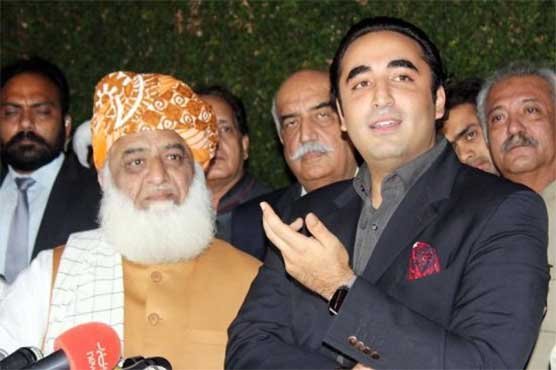
Political observers in Islamabad see Tuesday’s meeting as confirmation that the AJK pact isn’t a standalone transaction. It sits inside a broader pattern of PPP-JUI-F coordination on legislation, parliamentary votes, and now, electoral arithmetic — raising the question of whether this cooperation eventually extends to national-level alliances beyond Kashmir.
Neither party has confirmed that ambition publicly. But the frequency of these meetings, and the speed with which the AJK alliance moved from informal talk to signed-and-sealed candidate withdrawals, suggests both camps are comfortable testing the limits of the relationship.
What Comes Next
PPP has already announced its first batch of 35 candidates for the AJK polls, with senior leader Chaudhry Yasin himself contesting from two seats — LA-10 Kotli-III and LA-12 Kotli-V (Charhoi).
A second phase of candidate announcements is expected in the coming days, and both parties are reportedly assigning campaign responsibilities at the tehsil level to firm up ground operations before July 27.
Whether Tuesday’s meeting produces further joint moves — beyond AJK — remains to be seen.
But for now, the optics are clear: Bilawal and Fazlur Rehman are choosing to be seen together, often, and at a moment when their parties are translating goodwill into actual seat-sharing on paper.