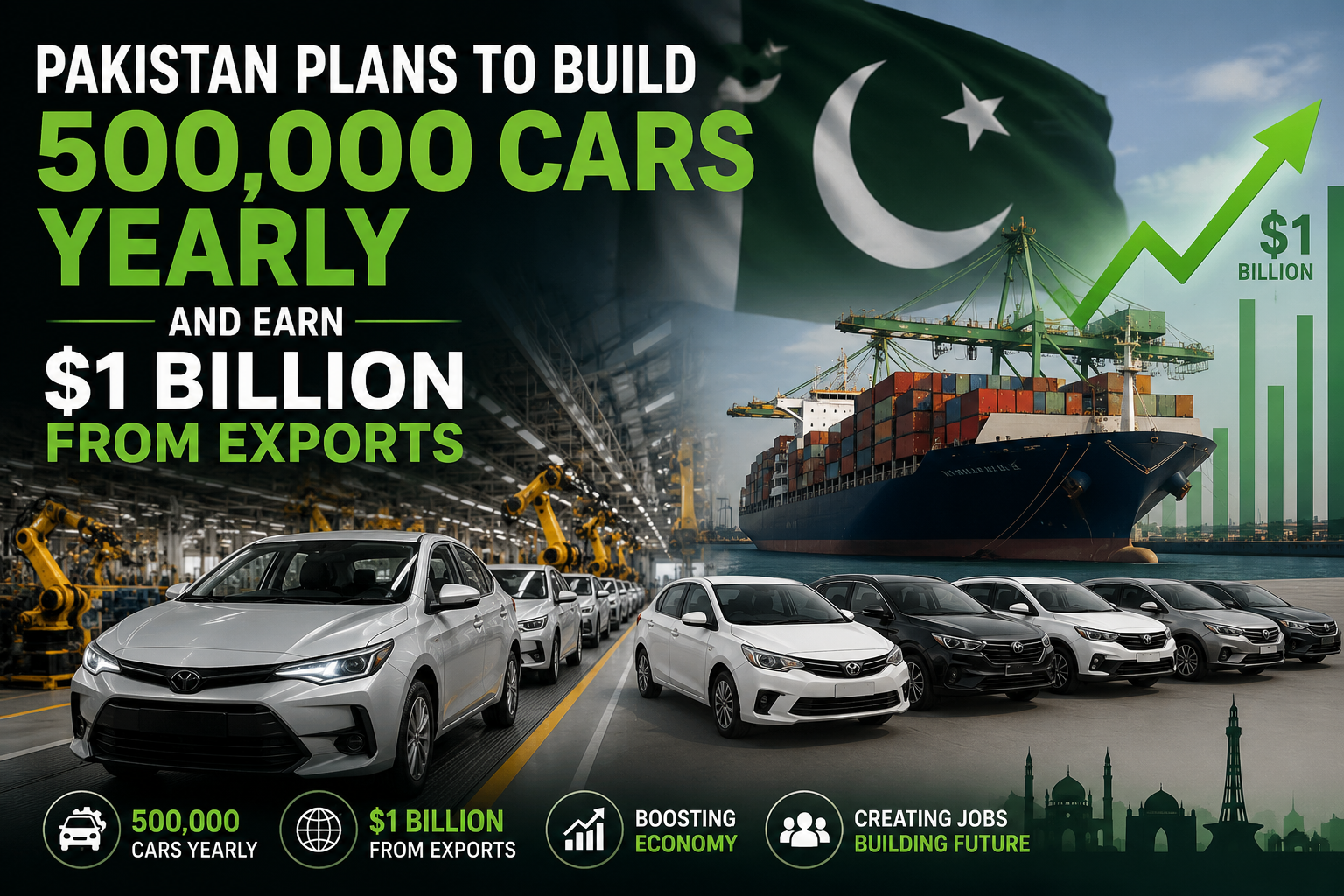
Pakistan federal government has unveiled one of its most ambitious automotive roadmaps in years. Under the draft Auto Policy 2026–31, Islamabad is targeting annual local production of over 500,000 vehicles and $1 billion in automotive exports — a sweeping turnaround plan for a sector that hit rock bottom just a few years ago.
If approved and properly implemented, this policy could fundamentally reshape how Pakistan makes, sells, and eventually exports cars.
From Rock Bottom to 500,000 Units — The Target Explained
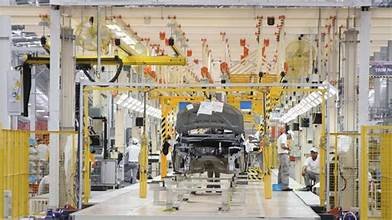
The numbers tell a stark story. Pakistan’s auto sector, which was producing close to 300,000 units in FY2022, collapsed to a jaw-dropping 56,000 units in FY2022-23 — one of the worst downturns the industry has ever seen. High interest rates, currency depreciation, import restrictions, and squeezed household incomes all contributed to the crash.
Now, the government wants to reverse that entirely.
The draft Automobiles and Auto Parts Manufacturing Policy 2026–31 sets a target of over 500,000 vehicles per year by 2031. That means more than tripling current output within five years — a goal that is ambitious by any measure, and one that would require sustained investment, policy consistency, and genuine demand-side recovery.
The $1 Billion Export Dream
Beyond domestic production, the government has set its sights on earning US$1 billion through automotive exports — a figure that would mark a historic first for Pakistan’s car industry.
To put that in perspective, Pakistan currently exports roughly $300 million in automotive goods annually — mostly to Afghanistan, the UAE, and a few African markets. Hitting $1 billion would require not just more cars, but cars that actually meet international standards and can compete on price in global markets.
Critics have pointed out that this is easier said than done. Pakistan’s auto exports have consistently missed targets under previous policies, and the country’s manufacturers are still heavily reliant on imported components — with average localization rates for passenger cars sitting around 58 percent.
Still, the policy signals a clear intent: Pakistan wants to stop being a purely inward-looking auto market and start competing globally.
Electric Vehicles at the Heart of the New Policy
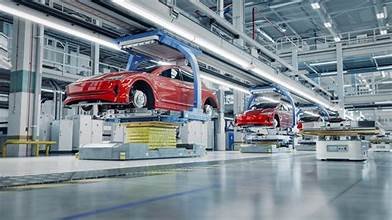
Perhaps the most forward-looking element of the draft policy is its strong push on New Energy Vehicles (NEVs).
Under the framework, the government wants 30 percent of all new vehicle sales to be electric or hybrid by 2031. That is an aggressive target for a country where EV adoption is still in very early stages and charging infrastructure remains thin.
To support that shift, authorities plan to establish 3,000 EV charging stations nationwide — covering major cities, highways, and eventually smaller towns. Right now, Pakistan has fewer than 100 public chargers, mostly concentrated in Lahore, Karachi, and Islamabad. The gap between where things are and where the government wants them to be is significant.
On the incentives side, NEVs would be exempt from Federal Excise Duty, Capital Value Tax, and Withholding Tax for the duration of the policy. Hybrid vehicles would attract only half the standard sales tax rate — 9 percent instead of 18 percent. These are meaningful concessions that could shift consumer behavior over time.
Farm Mechanization Gets a Mention Too
The policy doesn’t just cover passenger cars. The government has also targeted 100,000 agricultural vehicles per year to improve farm mechanization and productivity across the country.
For a largely agrarian economy like Pakistan’s, where outdated farming equipment remains a barrier to productivity, this is a noteworthy inclusion — though it remains to be seen how seriously it will be pursued in practice.
Tariff Reforms and the IMF Connection
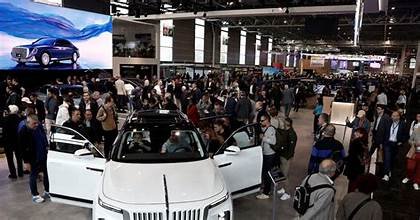
The new auto policy is not happening in a vacuum. It forms part of Pakistan’s broader reform commitments under the IMF’s $7 billion Extended Fund Facility.
The government has already submitted the draft to the IMF for review ahead of cabinet approval. Under the proposed framework, vehicle import tariffs would be gradually lowered — from a weighted average of 10.6 percent today to around 7.4 percent by 2030, with a broader goal of getting to 6 percent by the end of the decade.
For consumers, this could eventually mean more competition and a wider choice of vehicles. For local assemblers, it’s a clear warning: the era of relying on high import walls to stay afloat is ending. The government wants manufacturers to compete on merit — on quality, price, and technology — rather than leaning on protective tariffs.
Additionally, Special Regulatory Orders (SROs) — long criticized for creating confusion and eroding investor confidence — are expected to be phased out by 2030 and replaced with a cleaner, tariff-based system aligned with the National Tariff Policy 2025–30.
Consumer Protections Also in the Frame
Interestingly, the draft policy also addresses some of the long-standing frustrations of ordinary car buyers.
- Booking prices would be locked at the time of confirmation. Automakers could only adjust for statutory taxes — not arbitrary price hikes.
- If delivery exceeds 30 days, consumers would be entitled to compensation at KIBOR plus 3%.
- OEM dealerships would be capped at a maximum 20 percent markup over the manufacturer’s purchase price for spare parts.
- Automakers would also need to report bookings exceeding a 60-day hold period to the Engineering Development Board monthly.
These are changes that buyers have been asking for years. Whether enforcement will match the promise is another matter entirely — Pakistan has a track record of strong policy language followed by weak implementation.
Can Pakistan Actually Pull This Off?
Honest analysis requires acknowledging the scale of the challenge.
Pakistan’s auto sector currently sells around 150,000 vehicles per year. The recognized production capacity is roughly 418,000 units annually — but actual utilization runs well below that. Getting to 500,000 units of real output means not just building factories, but actually generating the demand and financing conditions that put buyers in showrooms.
Used car imports have also been rising fast — jumping from 7.5 percent of the market in 2020–23 to 20 percent in 2025 — eating into the potential customer base for locally assembled vehicles.
On exports, the challenges are even steeper. Global automotive markets are intensely competitive. Pakistani cars face high logistics costs, foreign import duties, currency volatility, and a brand recognition problem. Honda recently became the first local manufacturer to export a batch of cars to Japan — just forty units. That’s a start, but the road to $1 billion is long.
That said, there are genuine reasons for cautious optimism. The policy framework is more comprehensive than previous attempts. The IMF alignment means there’s external pressure to follow through. And the global shift toward electric vehicles opens a window — if Pakistan can produce affordable EVs for regional markets in Africa and South Asia, there’s a real niche to be filled.
What Happens Next?
The Motor Vehicle Development Act has already been submitted to parliament and is expected to secure National Assembly approval before the end of June 2026. The policy itself is slated to take effect from July 1, 2026, if cabinet approval comes through.
In the meantime, the auto industry — manufacturers, parts suppliers, dealers, and buyers alike — will be watching closely.
Final Thought!
Pakistan’s Auto Policy 2026–31 is genuinely ambitious. Targeting 500,000 locally produced cars per year and $1 billion in exports would be transformational for an industry that spent the last few years in crisis mode. The inclusion of EV targets, consumer protections, and tariff reforms adds real substance to what could have been just another policy document.
Whether the ambition translates into reality will depend on something Pakistan has historically struggled to deliver: consistent implementation, investor confidence, and policy continuity across political cycles.
The blueprint is there. Now comes the hard part.
Have thoughts on Pakistan’s new auto policy? Drop a comment below or share this article with others following the country’s automotive sector.