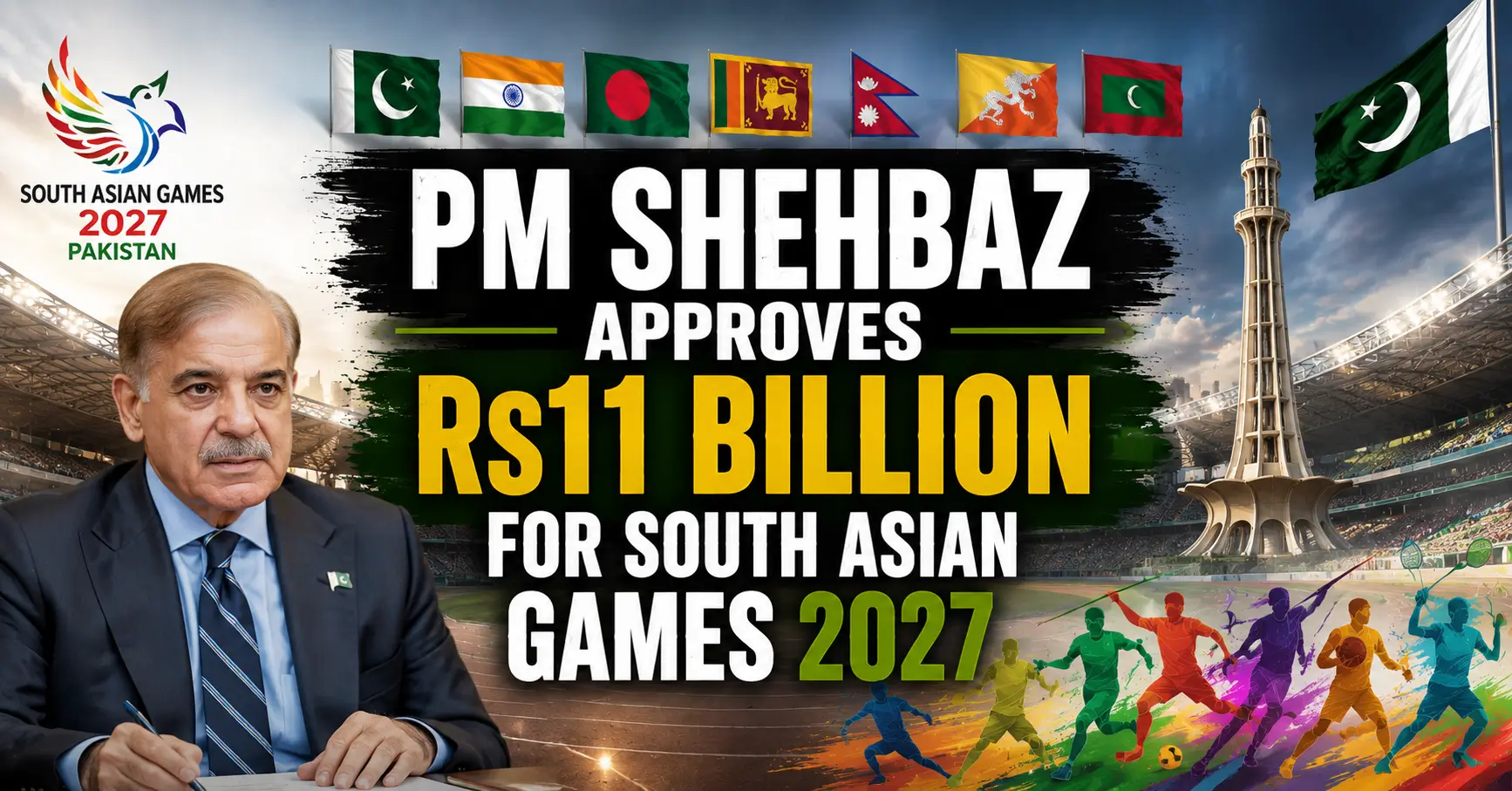

For a Games that has been postponed four times since it was first awarded to Pakistan, Rs 11 billion is either a serious commitment or a very expensive promise. This week, Prime Minister Shehbaz Sharif signed off on that figure for the 14th South Asian Games, scheduled for March 2027.
Sources familiar with the decision say the prime minister has told authorities to begin preparations immediately. The money won’t land in one transfer. It will be released in phases, tied to stadium upgrades, logistics, ceremonies and the administrative machinery needed to run a multi-nation sporting event.
A Games With a Long, Troubled Timeline

To understand why this funding matters, it helps to look at how long Pakistan has been trying to make this event happen.
The South Asian Olympic Council awarded Pakistan hosting rights back in December 2019. The original target was 2021. Covid-19 pushed it to 2023, then 2024, then January 2026. In November 2025, the council deferred it again, this time to March 2027, citing insufficient preparation and a lack of preliminary registrations.
That history explains the urgency behind this latest approval. A Games Secretariat will now be established in Islamabad specifically to coordinate preparations — a deliberate echo of the 2004 edition, which officials still regard as Pakistan’s best-organised international sporting event.
That earlier success came partly because the Secretariat was stood up two years ahead of the opening ceremony. Planners are trying to replicate that lead time now, even if the runway is shorter than they’d like.
Where the Money Is Actually Going

Officials had floated a budget north of Rs 5 billion as recently as April this year, with the Ministry of Inter-Provincial Coordination working alongside the Pakistan Olympic Association to finalise numbers. That figure has since more than doubled.
The bulk of spending is expected to go toward venue upgrades, sports equipment — including specialised gear that isn’t manufactured domestically and must be imported — and the opening and closing ceremonies, which alone were projected to cost over Rs 1.5 billion under the earlier budget draft.
Islamabad is set to carry the heaviest load, hosting roughly 80 percent of the disciplines at venues including Jinnah Sports Stadium. Lahore and Faisalabad round out the host-city list, with officials describing all three as fully operational ahead of the competition.
The Scale of What’s Coming
More than 3,500 athletes from eight countries are expected to compete across 27 disciplines. That includes athletics, aquatics, badminton, boxing, cricket, kabaddi, squash, wrestling, and a long list of other sports — with India and Afghanistan expected to send some of the largest contingents.
READ MORE: PCB Signs Deal to Build Saudi Arabia Cricket Stadium
Afghanistan’s presence is itself notable. The country had stepped away from the Games after the 2019 edition to focus on Central Asian competitions under the Olympic Council of Asia umbrella. Its return to the South Asian roster, alongside India, adds diplomatic weight to an event that already carries plenty.
Security Is Not an Afterthought

With athletes and officials from eight nations converging on Pakistani cities, security planning has become as central to preparations as the stadiums themselves.
The local organising committee is working on Games Villages built around strict protective protocols for visiting delegations.
Given the recent history of regional tension — including the brief but serious military confrontation between Pakistan and India earlier this year — that security framework will be watched closely, both by participating nations and by broadcasters planning coverage.
Why Pakistan Is Betting Big on This

Officials are framing the Games as more than a sporting calendar entry. It’s being pitched as a showcase moment — proof that Pakistan can host a large-scale regional event competently, safely, and on schedule, after a run of postponements that did little for its credibility on that front.
The opening ceremony in Lahore is expected to be the single biggest draw, with organisers anticipating strong viewership across South Asia.
For a region where sport regularly cuts through political noise — think of the goodwill generated when javelin throwers Arshad Nadeem of Pakistan and Neeraj Chopra of India shared the spotlight at the Paris Olympics — a well-run Games could do quiet diplomatic work that formal channels struggle to achieve.
There’s also a development angle. Officials describe the event as a platform for emerging athletes across the region, not just established stars. That framing matters for smaller delegations from countries like Bhutan and the Maldives, for whom a home-region event offers rare international exposure.
The Real Test Starts Now
Money alone hasn strategy. Pakistan has approved Games budgets before — a modest Rs 2 billion was earmarked back in 2019 — only to watch dates slip year after year.
What’s different this time, at least on paper, is the phased funding model, the earlier Secretariat setup, and a firm March 2027 date that the South Asian Olympic Council has already tied to a compliance deadline.
Whether Rs 11 billion converts into finished stadiums, secured venues and smooth logistics — or becomes another entry in a long list of delayed promises — will depend on how quickly the phased funds actually reach the ground.