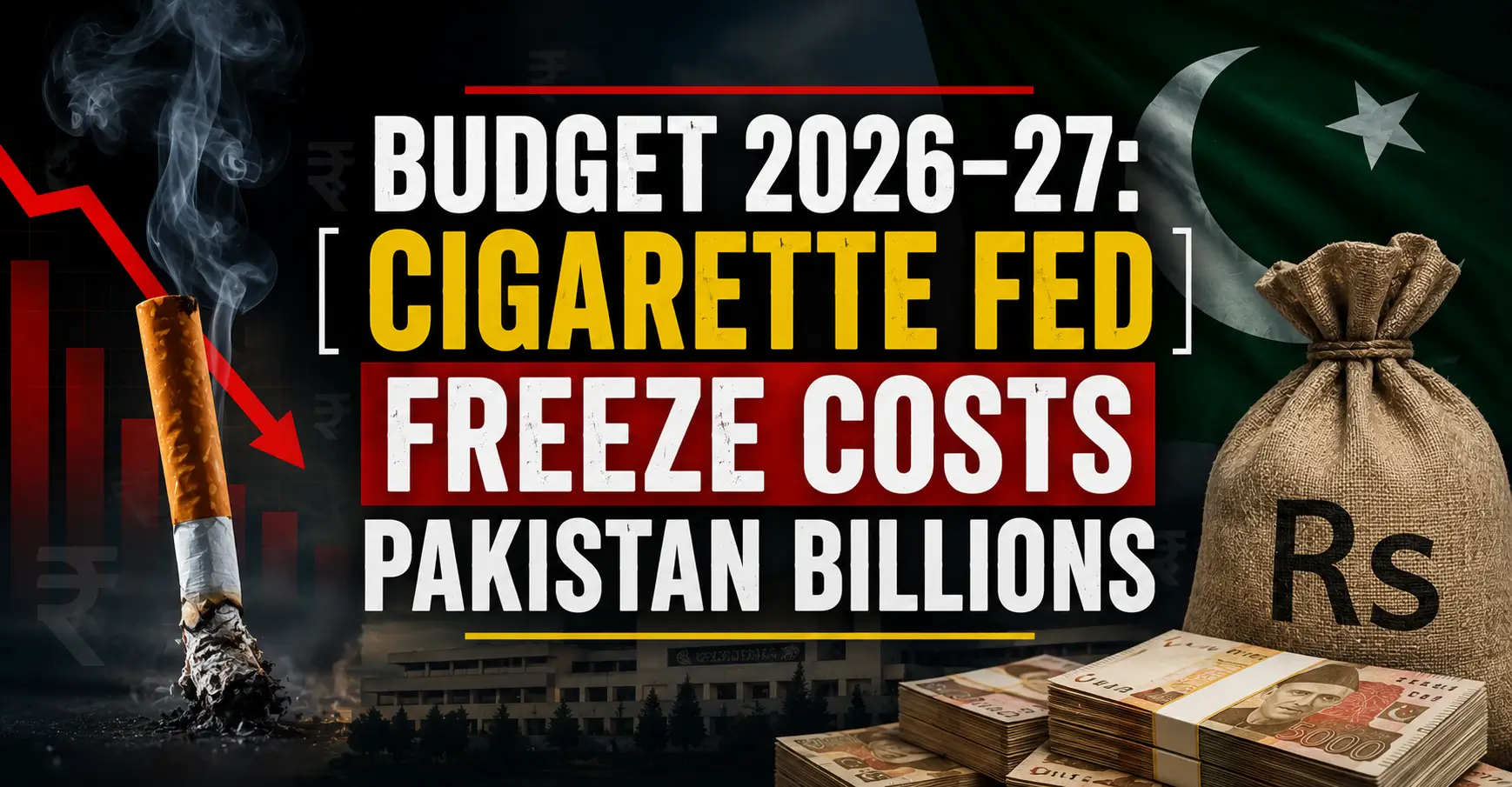

Pakistan just left Rs51 billion on the table. And public health experts say the real cost is measured in lives, not rupees.
The Federal Budget 2026–27, unveiled by the government in Islamabad on a Rs18.771 trillion outlay, kept the Federal Excise Duty on cigarettes frozen for a third consecutive year.
For anti-tobacco campaigners who had spent months building the case for reform, the silence in the budget speech spoke louder than any announcement would have.
A Proposal That Didn’t Make the Cut

The Society for the Protection of the Rights of the Child (SPARC) had pushed hard for this budget cycle. Working alongside the Social Policy and Development Centre, the organisation released a detailed tobacco fact sheet earlier this year, laying out exactly what a tax hike could achieve.
READ MORE: ICAP Raised for Trainee Chartered Accountants in Pakistan in 2026
Dr. Khalil Ahmad, Program Manager at SPARC, said the government’s failure to raise cigarette duties meant walking away from an estimated Rs. 51 billion in additional annual revenue. That figure came from a specific ask: a Federal Excise Duty increase of Rs. 35 per pack on economy brands and Rs. 21 per pack on premium brands.
The projected payoff wasn’t limited to the treasury. SPARC’s modelling suggested the increase could have stopped roughly 369,000 young people from ever picking up a cigarette, cut the total number of smokers by 271,000, and saved close to 279,000 lives — split between 185,000 youth and 95,000 adults.
None of it happened.
Frozen Since 2023, and Getting Cheaper
Here’s the part that should worry policymakers more than the missed revenue. Federal Excise Duty rates on cigarettes have not moved since February 2023. In a country where inflation has chipped away at purchasing power across the board, a flat tax rate has an odd side effect: cigarettes get relatively cheaper every year.
Dr. Ahmad pointed out that this stagnation has already eroded the real value of tobacco taxes, pushing down the tax share embedded in retail cigarette prices. Low-cost brands, the ones that tend to hook younger and lower-income smokers first, have become more accessible as a result.
Pakistan’s pricing already stood out regionally even before this budget. A pack of 20 cigarettes costs roughly Int$3.46 in the country, against Int$6.32 across the Eastern Mediterranean region and Int$10.91 in South-East Asia — making Pakistani cigarettes among the cheapest in either comparison group. That gap isn’t closing under the current policy; it’s widening.
The Human Toll Behind the Numbers
Tobacco use kills more than 192,000 Pakistanis every year. That works out to roughly 526 deaths a day, driven mostly by cardiovascular disease, cancer, and other smoking-linked conditions.
Dr. Ahmad framed the missed FED increase as a lost chance to interrupt that pattern at its source: youth initiation. “Higher taxes are among the most effective measures to prevent smoking initiation among children and youth,” he said, adding that global evidence consistently shows price increases discourage smoking in younger age groups more than almost any other intervention.
The Math Doesn’t Add Up for the Treasury Either

Beyond public health, there’s a straightforward fiscal argument that seems to have gone unheeded. The economic burden of smoking-related disease in Pakistan hit an estimated Rs. 1,835 billion in 2024–25 — roughly 1.6 percent of GDP. Tobacco tax collection over the same period stood at just Rs. 266 billion.
Do the arithmetic and the country is spending nearly seven rupees on tobacco-linked healthcare for every rupee it collects in tobacco tax.
That imbalance existed before this budget and remains unchanged now that the FED freeze has been extended for another fiscal year.
What the Budget Did Change
The Federal Budget 2026–27 wasn’t silent on tobacco altogether. Officials raised the Federal Excise Duty on e-liquids used in electronic cigarettes from Rs. 10,000 to Rs. 16,500 per kilogram, while removing the previous 65 percent retail price cap on those products. It’s a targeted move on vaping, but it leaves the far larger conventional cigarette market untouched.
That contrast hasn’t gone unnoticed among public health advocates, who argue that addressing one nicotine delivery product while ignoring the dominant one undercuts the coherence of the government’s tobacco control strategy.
Where This Leaves Pakistan’s Tobacco Control Commitments
Pakistan is a signatory to the World Health Organization’s Framework Convention on Tobacco Control, and its MPOWER strategy explicitly identifies tobacco taxation as one of the most effective tools available to governments trying to curb consumption.
Dr. Ahmad noted that the decision to leave FED untouched sits uneasily against those international commitments, undermining efforts to protect future generations from tobacco dependence.
SPARC’s argument was never that taxation alone solves Pakistan’s tobacco problem. Illicit trade, for instance, is estimated to account for roughly 33 to 34 percent of total cigarette consumption in the country — a factor that complicates any simple tax-and-consumption relationship.
But the organisation maintains that a calibrated, inflation-indexed increase, paired with a push toward a more unified tax tier structure, would have narrowed the price gap between economy and premium brands without handing illicit traders an opening.
The Road Ahead
With this budget cycle closed, the next opportunity for reform sits a year away. Whether that gap gets used to build a stronger case — or whether cigarette taxation simply drifts for a fourth straight year — will shape both public health outcomes and revenue collection heading into Budget 2027–28.
For now, the numbers stand as a marker of what didn’t happen: Rs. 51 billion uncollected, hundreds of thousands of preventable smoking cases left unaddressed, and a pricing gap with the rest of the region that keeps growing.