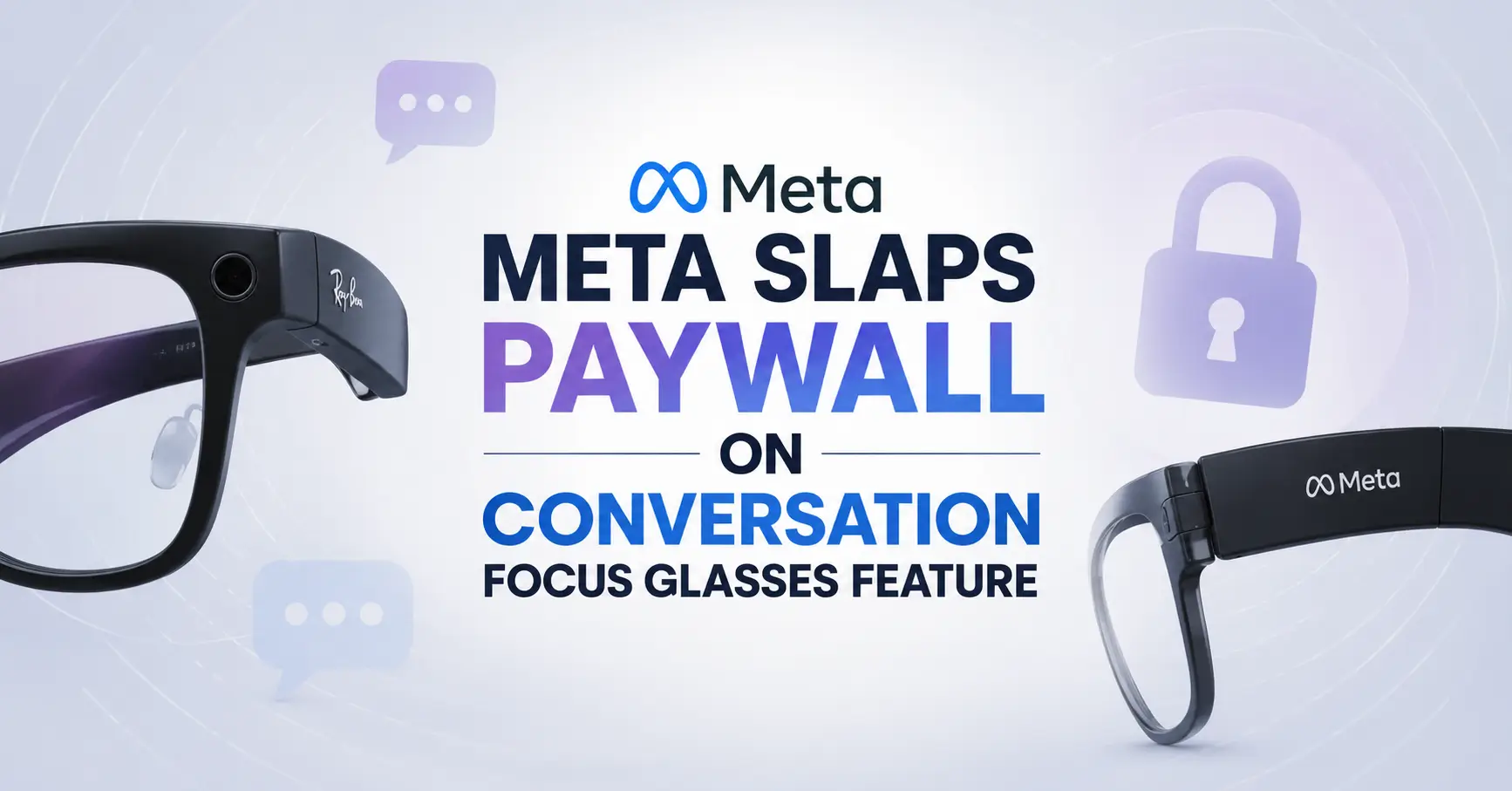

Meta has quietly rolled out usage caps on Conversation Focus, the hearing-assist tool built into its AI smart glasses. Users without a subscription can access Conversation Focus for three hours per month, while a Meta One Premium subscription costing $19.99 per month increases the allowance to 15 hours. Unused time does not carry over to the following month.
Spread across thirty days, the free tier works out to about six minutes per day. The paid tier doesn’t fare much better — fifteen hours a month comes to roughly thirty minutes a day, still not much breathing room for anyone who wears the glasses regularly in noisy settings.
What Conversation Focus Actually Does

The feature isn’t a novelty add-on. It uses the glasses’ microphones and open-ear speakers to amplify the voice of the person directly in front of the wearer, cutting through crowd noise, traffic, or restaurant chatter. Meta first pushed it out as a software update in December of last year, positioning it as one of the standout capabilities of the AI glasses line.
The tool relies on beamforming microphones and spatial audio processing, and users can adjust amplification levels directly through the glasses or a connected app. It is distinct from Meta’s conversational AI assistant it doesn’t hold context across a long chat or let a wearer ask follow-up questions without repeating themselves.
No Servers, No Data — So Why the Limit?
This is where the backlash sharpens. Conversation Focus does not touch Meta’s servers at all. Reporters at The Verge tested it with Wi-Fi off, cellular off, and the phone in airplane mode and it kept working.
That detail undercuts Meta’s usual justification for rate limits. Rate limits typically make sense for cloud-dependent AI tools, where a company pays for server capacity and bandwidth per request, so usage caps help recover real operating costs. Conversation Focus runs entirely on the hardware a customer already owns.
Meta hasn’t offered much clarity on the mechanics. When The Verge asked the company to explain the move, and whether other on-device features could face similar caps in the future, Meta did not respond.
Meta’s Position

Meta frames this as usage management, not a paywall. According to the company’s help documentation, Meta One is currently in limited testing and isn’t available everywhere yet, which means some owners may not have noticed any change at all so far.
READ MORE: HMD Vibe 2 5G Launched: Unisoc Chip, 6000mAh Battery at Just $115
When pressed for comment, Meta said the limit “currently” applies only to Conversation Focus — language that implies other AI features could be rate-limited down the line.
The company maintains that core features, including the voice assistant, live translation and visual questions, remain available without a Meta One Premium subscription, and that the paid tier is aimed at heavier users who want extra headroom plus faster support access.
Why This Lands Hardest for Accessibility Users

The sharpest criticism isn’t about convenience — it’s about who relies on this feature daily. Conversation Focus is used regularly by people with minor hearing difficulties, for whom it functions less like a novelty and more like a practical daily accommodation.
For that group, a six-minute free allowance isn’t a mild inconvenience; it’s a functional limit on hearing well in public.
Commentators have been blunt about the optics. The new subscription plans and limits are being described as bizarre — Meta is restricting and charging for what amounts to an accessibility feature that doesn’t rely on AI server processing, even as other flashier features escape the same treatment.
The Bigger Business Story
The timing matters. Meta laid off roughly 10 percent of its workforce — around 8,000 employees — to help offset mounting AI infrastructure costs, according to reporting cited by The Verge.
The company also cut entry prices on newer glasses models by $80 after dropping the Ray-Ban name, narrowing margins while expanding its addressable market.
Building a recurring subscription layer on top of hardware customers have already paid for looks, to many observers, like a logical response to that financial squeeze.
The hardware economics only add to the frustration. Ray-Ban Meta glasses originally started at $299, while the second-generation version launched at $379. Buyers paid full price upfront, with Conversation Focus arriving later as a bonus capability rather than a disclosed trial.
What Happens Next
Nobody outside Meta knows if this holds. If rival smart glasses from Google or Apple launch without aggressive usage caps, Meta may face pressure to walk this back.
But if the wider industry moves toward subscription-gated AI hardware features, consumers could be left with fewer alternatives.
For now, Meta’s support page doesn’t let users check how much of their monthly Conversation Focus allowance they have left — so many owners won’t know they’ve hit the wall until the feature simply stops working.
Would you pay a monthly fee to keep using a feature built into hardware you already own — or does this cross a line for you?