
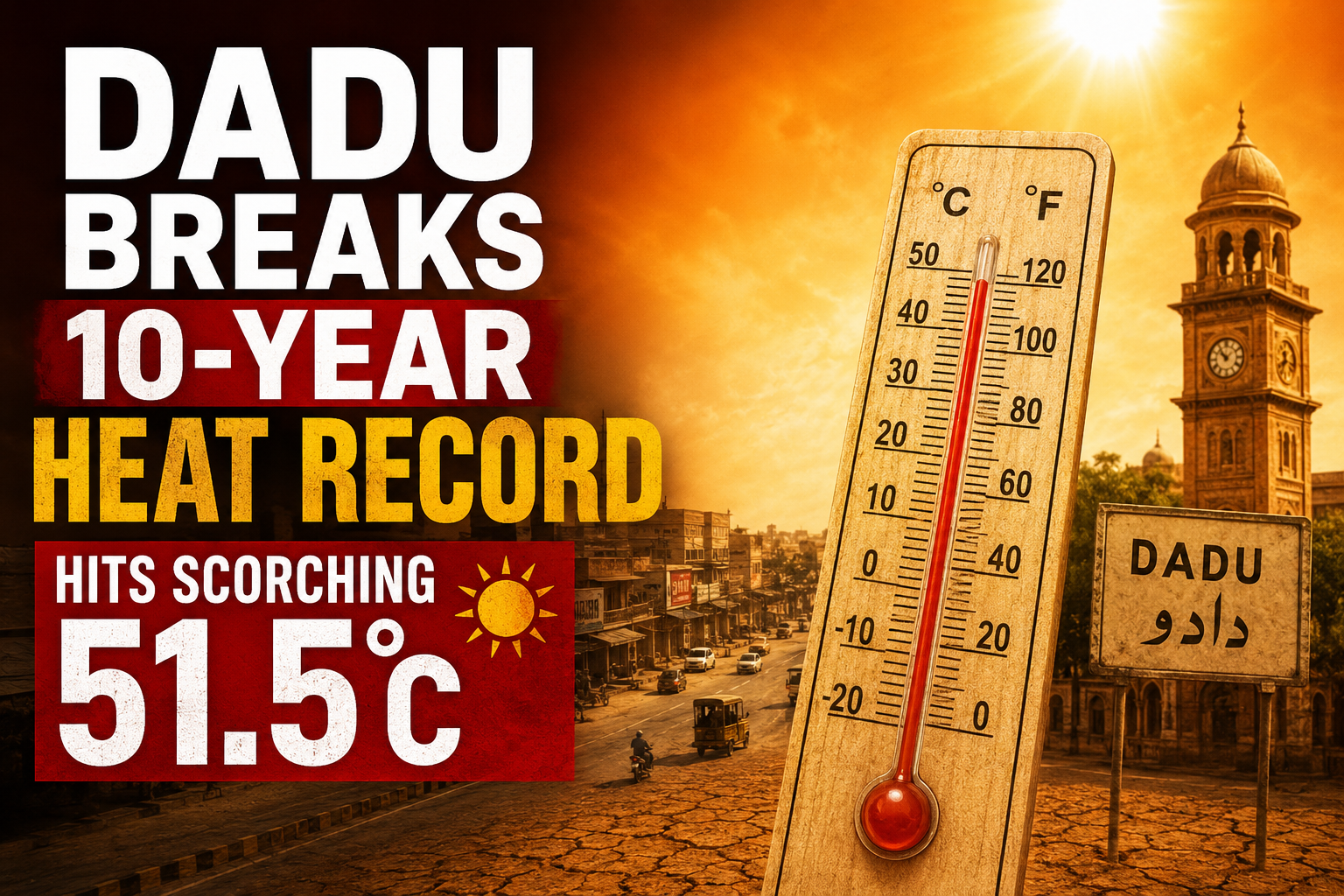
Dadu Shatters Decade-Old Heat Record, Hits Scorching 51.5°C
Pakistan’s interior Sindh city of Dadu has broken its own 10-year temperature record after the mercury surged to a blistering 51.5°C on Thursday, May 29, 2026 — a reading so extreme it sent shockwaves through an already heat-exhausted nation. The Pakistan Meteorological Department (PMD) officially confirmed the new high, marking it as the hottest day Dadu has seen in over a decade. Authorities have renewed urgent calls for residents to stay indoors as a relentless heatwave continues to hammer southern Pakistan.
What the Numbers Actually Mean
When the PMD released Thursday’s data, the figure was hard to ignore. The previous record for Dadu stood at 51.4°C, set on May 18, 2016 — a number that had held for exactly ten years. This new peak didn’t just tie that record; it surpassed it.
More alarming is how far above normal this reading actually is. According to PMD data, Thursday’s temperature was 4.5°C higher than Dadu’s typical May average. That’s not just a hot day — that’s a city cooking well beyond what its residents, its infrastructure, and its healthcare system are built to handle.
To put things in perspective for those unfamiliar with interior Sindh: this is a region that already deals with some of the harshest summer heat on the planet. Even for Dadu, 51.5°C is extraordinary.
Larkana and Jacobabad Not Far Behind
Dadu wasn’t alone in bearing the brunt of this heatwave. The PMD confirmed that both Larkana and Jacobabad registered 50.5°C on the same day — temperatures that would themselves be considered record-level events in most parts of the world.
These three cities, all located in interior Sindh, form a triangle of extreme heat that has been a recurring flashpoint during Pakistan’s summer seasons. Jacobabad, in particular, has long been cited by climate scientists as one of the hottest inhabited places on Earth. The fact that it recorded 50.5°C during what is technically still the pre-monsoon season speaks to how early and how intensely this year’s heat has set in.
Temperatures in the region are expected to remain between 47°C and 50°C in the coming days, with several more districts — including Sukkur, Shikarpur, Qambar Shahdadkot, and Shaheed Benazirabad — under similar warnings.
A Heatwave That Has Been Building for Weeks
This didn’t happen overnight. Pakistan has been living under severe heatwave conditions for several weeks now, and the situation has been deteriorating steadily. The PMD had already warned at the start of the month that temperatures during the Eidul Azha holidays would remain 5°C to 7°C above normal across most of the country.
Repeated heatwave advisories have been issued across Sindh, Balochistan, and parts of southern Punjab. Citizens have been urged — again and again — to avoid going outside during peak afternoon hours, drink plenty of water, and watch out for signs of heatstroke.
The pattern is becoming familiar, and that familiarity is itself a problem. Each year, communities in southern Pakistan have to mobilise around the same warnings, the same health risks, and the same strain on public services. But the numbers keep creeping higher.
What the Met Office Is Saying
The Pakistan Meteorological Department has been issuing detailed daily forecasts as the situation develops. For Friday, the PMD forecast hot and dry weather continuing across most of the country, with particular severity expected in:
- Khyber Pakhtunkhwa (interior districts)
- Sindh (especially upper and central areas)
- Central and southern Balochistan
There is some limited relief in the forecast — isolated rain, windstorms, and thunderstorms are possible in parts of Azad Jammu and Kashmir, northeastern Punjab, and the Potohar region during evening and night hours. But for interior Sindh and surrounding areas, there is no meaningful rain in sight.
The PMD also flagged this month that El Niño conditions are likely to develop during the 2026 monsoon season across South Asia, alongside above-normal temperatures. This raises serious concerns about whether the monsoon — which typically provides relief in July and August — will arrive on time or at its usual intensity.
The Bigger Climate Picture

Pakistan’s heatwave crisis doesn’t exist in isolation. The United Nations and the World Meteorological Organisation (WMO) issued a stark warning recently: global average temperatures are likely to remain at or near record levels not just this year, but for the next four years.
According to the WMO, there is a 75% chance that the 2026–2030 five-year average temperature will exceed the critical 1.5°C threshold above pre-industrial levels. That’s the same threshold that world leaders agreed needed to be avoided under the Paris Agreement. The window for meeting that target is closing fast.
For Pakistan specifically, the situation is compounded by geography, poverty, and infrastructure gaps. The country contributes less than 1% of global greenhouse gas emissions, yet consistently ranks among the nations most vulnerable to climate-driven disasters — from floods to droughts to heatwaves exactly like this one.
The 2015 Karachi heatwave killed over 1,300 people. The 2024 heat event across Sindh resulted in more than 568 deaths. Each time, the numbers remind us that extreme heat is not an inconvenience — it is a public health emergency.
Health Risks at These Temperatures

At 51.5°C, the human body has almost no natural ability to cool itself down through sweating alone. Heat exhaustion can set in within minutes of outdoor exposure, and heatstroke — which can be fatal — can follow quickly.
Vulnerable groups face the highest risk:
- Elderly individuals, who have reduced ability to regulate body temperature
- Children, especially those in homes without air conditioning or reliable electricity
- Outdoor workers — farmers, construction workers, daily wage labourers — who cannot simply choose to stay indoors
- People with pre-existing conditions such as heart disease, kidney problems, or diabetes
Doctors and public health officials have repeatedly urged people to stay hydrated, wear loose light clothing, avoid direct sun from 11am to 4pm, and seek immediate medical attention if they or someone nearby shows signs of confusion, loss of consciousness, or excessive sweating followed by dry skin.
Power Outages Make Things Worse
One factor that consistently makes Pakistani heatwaves deadlier than they need to be is the electricity situation. When temperatures spike this high, demand for fans and air conditioners surges — often overloading the grid and triggering the load-shedding that cuts power for hours at a time.
This creates a brutal irony: the moment people most need electricity, they are most likely to lose it. For families in lower-income households without backup generators or stable power supply, these hours without a fan in 51-degree heat can be dangerous.
Local administrations in Sindh have been under pressure to manage the situation, but with the current scale of the heatwave, resources are being stretched thin.
What Comes Next
Looking ahead, the PMD’s forecasts point to continued extreme heat through the first week of June across interior Sindh and Balochistan. The arrival of pre-monsoon moisture — which can bring some humidity relief — is still some weeks away.
For a city like Dadu, which has now broken its own record, every additional day of this heat is a test of endurance. The question for authorities, health workers, and climate planners is not just how to get through this heatwave — but how Pakistan prepares for summers that are projected to get hotter still.
As the WMO’s data makes clear, what feels like an extreme outlier today may simply be the new normal in a few years.
Final Thought!
Dadu’s 51.5°C reading on May 29, 2026 is more than just a weather statistic — it is a signal. It tells us that the records set a decade ago are no longer safe. It tells us that southern Pakistan is entering its hottest summers on record. And it tells us that the combination of rising global temperatures, possible El Niño disruption to the monsoon, and existing infrastructure vulnerabilities makes this an urgent, ongoing crisis — not a one-day headline.
Authorities have urged citizens to take every precaution. The PMD will continue to issue daily updates. And for millions of people across interior Sindh, the only option right now is to wait out the heat — and hope for rain.
Have thoughts on Pakistan’s climate crisis or this year’s heatwave? Share this article and join the conversation.