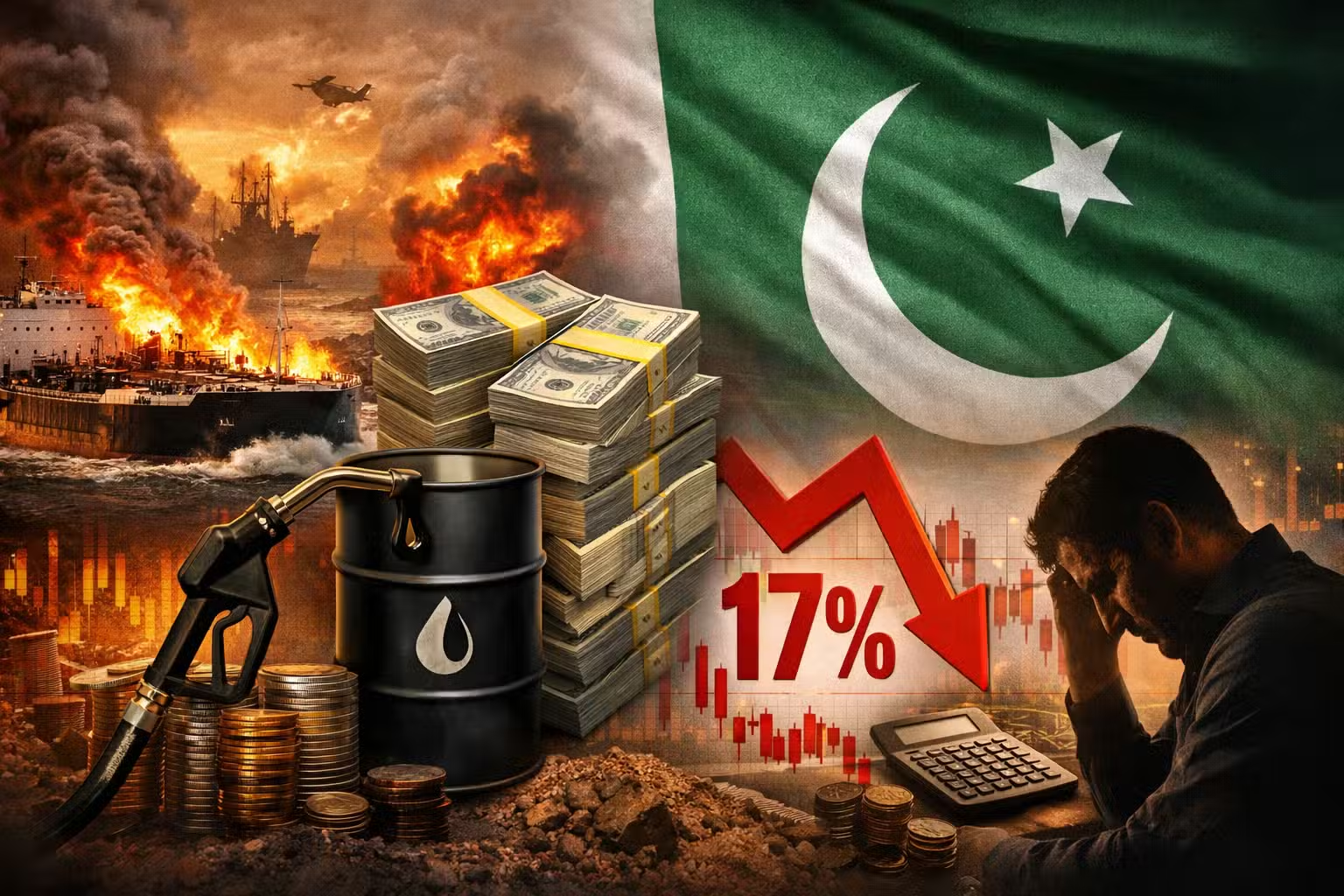
Pakistan’s equity market suffered a massive blow on Monday as the Pakistan Stock Exchange (PSX) witnessed a dramatic sell-off, wiping out last week’s gains and pushing the benchmark index below the critical 168,000 level.
The KSE-100 Index plunged 5,478 points (3.16%) to close at 167,691 points after intense selling pressure across major sectors.
The crash was triggered by profit-taking, economic uncertainty, and declining investor confidence, with heavy losses recorded in index-heavy stocks and widespread market participation in the downturn.
PSX Records Sharp Decline in Monday Trading
The latest PSX market crash marks one of the steepest single-day declines in recent months, reversing strong gains recorded in the previous trading week.
During early trading hours, the market experienced even sharper losses. The main index briefly dropped by 6,283 points (3.63%), falling to an intraday low of 166,886 points before recovering slightly by the session’s close.
Market analysts described the session as highly volatile, with strong selling momentum dominating throughout the day. The sharp decline reflects fragile investor sentiment amid economic and political uncertainties affecting Pakistan’s financial markets.
Trading Activity and Market Participation
Despite the steep fall, trading activity remained strong, indicating widespread investor participation in the sell-off.
Key trading statistics from Monday’s session:
- Total shares traded: 204.7 million
- Total value of traded shares: Rs. 20.6 billion
- Total companies traded: 567
- Companies recording gains: 42
- Companies recording losses: 389
- Unchanged stocks: 136
The data shows that the overwhelming majority of stocks ended in negative territory, highlighting the broad-based nature of the market decline.
Experts say such widespread losses usually signal strong bearish sentiment and declining confidence among both institutional and retail investors.
Index-Heavy Stocks Drag Market Lower
The benchmark index suffered major losses due to declines in heavyweight companies, which collectively pulled the market down by nearly 1,797 points.
Major laggards included:
- Fauji Fertilizer Company (FFC)
- Lucky Cement (LUCK)
- Engro Holdings (ENGROH)
- National Bank of Pakistan (NBP)
- Habib Bank Limited (HBL)
These index-heavy constituents carry significant weight in the benchmark index. Their sharp declines amplified the market’s downward momentum and accelerated the overall crash.
Banking, cement, and industrial sectors faced intense selling pressure, reflecting investor concerns about economic stability and corporate earnings.
Top Volume Leaders in the Market
Trading volumes remained concentrated in several stocks, with K-Electric leading the volumes chart.
Most Active Stocks
|
Company |
Price (Rs.) | High | Low | Change | Volume |
| K-Electric (KEL) | 7.66 | 8.14 | 7.57 | -0.37 |
36,062,769 |
|
WorldCall Telecom (WTL) |
1.32 | 1.43 | 1.29 | -0.06 | 33,673,161 |
| Bank of Punjab (BOP) | 30.19 | 33.20 | 29.74 | -2.85 |
26,673,106 |
|
First National Equities (FNEL) |
1.34 | 1.40 | 1.20 | +0.08 | 24,647,531 |
| TSBLR1 | 0.43 | 0.55 | 0.41 | -0.09 |
18,550,384 |
|
Pakistan Telecommunication Company |
57.10 | 61.20 | 55.70 | -2.12 | 17,077,810 |
| Pakistan International Bulk Terminal | 17.49 | 18.95 | 17.35 | -1.19 |
13,317,615 |
High trading volumes indicate strong investor reaction and increased market participation during the crash.
Why Did the Market Crash?
Economic Uncertainty
Economic concerns remain a major driver of market volatility. Investors are worried about inflation, rising interest rates, and Pakistan’s external financing challenges.
The State Bank of Pakistan’s tight monetary stance has raised borrowing costs, reducing corporate profitability and discouraging equity investment.
Profit-Taking Activity
After recent market gains, institutional investors engaged in profit-taking, triggering a chain reaction of selling. Once the market began falling, panic selling accelerated the decline.
Political and Policy Concerns
Political uncertainty and concerns over policy direction have further weakened investor confidence. Markets typically react negatively to uncertainty regarding economic reforms and governance stability.
Investor Sentiment and Market Psychology
The fall below the psychological barrier of 168,000 points intensified selling pressure. Analysts say such levels often trigger automated sell orders and panic-driven decisions by retail investors.
Brokerage firms reported heightened trading activity as investors rushed to limit losses. Market sentiment remained strongly bearish throughout the session.
Financial experts emphasize that investor psychology plays a crucial role in market performance. Negative sentiment can amplify small declines into major crashes.
Global Market Influence
Pakistan’s stock market is closely linked to global financial trends. Recent volatility in international markets, driven by interest rate concerns and geopolitical tensions, has affected emerging markets worldwide.
Foreign investors typically reduce exposure to riskier markets during periods of global uncertainty, contributing to selling pressure in Pakistan’s equities market.
Is This a Temporary Correction or a Warning Sign?
Market experts remain divided over the implications of the latest crash.
Some analysts believe the decline represents a healthy market correction following rapid gains. Periodic corrections help stabilize markets and prevent asset bubbles.
However, others warn that continued economic challenges could prolong volatility if investor confidence is not restored.
Expert Expectations
- Short-term volatility likely to continue
- Economic stability needed for recovery
- Policy clarity may restore investor confidence
- Long-term outlook depends on macroeconomic indicators
Impact on Pakistan’s Financial Outlook
The PSX downturn reflects broader concerns about Pakistan’s economic trajectory. A declining stock market can affect business confidence, investment flows, and overall economic sentiment.
Sharp market fluctuations may also influence foreign investment decisions, which play a crucial role in Pakistan’s economic growth.
Financial experts stress the importance of stable economic policies and consistent reforms to strengthen investor trust and market performance.
What Investors Should Do During Market Volatility
The PSX market crash highlights the risks associated with equity investments during uncertain economic conditions.
Experts recommend:
- Avoid panic selling during market declines
- Maintain diversified investment portfolios
- Focus on long-term investment strategies
- Monitor economic and policy developments
Market corrections often create opportunities for long-term investors seeking undervalued stocks.
Possible Market Recovery Outlook
Despite the sharp decline, analysts believe recovery remains possible if economic and political conditions improve.
Factors that could support market recovery include:
- Improved macroeconomic stability
- Consistent government policies
- Reduced inflation pressures
- Increased foreign investment
- Strong corporate earnings
Market performance in the coming weeks will depend heavily on policy decisions and investor sentiment.
Final Thought!
The dramatic fall at the Pakistan Stock Exchange underscores growing concerns about economic stability, investor confidence, and market volatility. The 5,478-point drop in the benchmark index and widespread losses across major sectors highlight the fragile state of Pakistan’s equity market.
While some analysts view the decline as a temporary correction, continued economic and political uncertainty could sustain market pressure. The coming weeks will be crucial in determining whether the market stabilizes or faces further declines.
For investors and policymakers alike, the latest market crash serves as a reminder of the importance of economic stability, policy clarity, and long-term financial confidence. Market participants will now closely watch future developments shaping Pakistan’s financial landscape.