
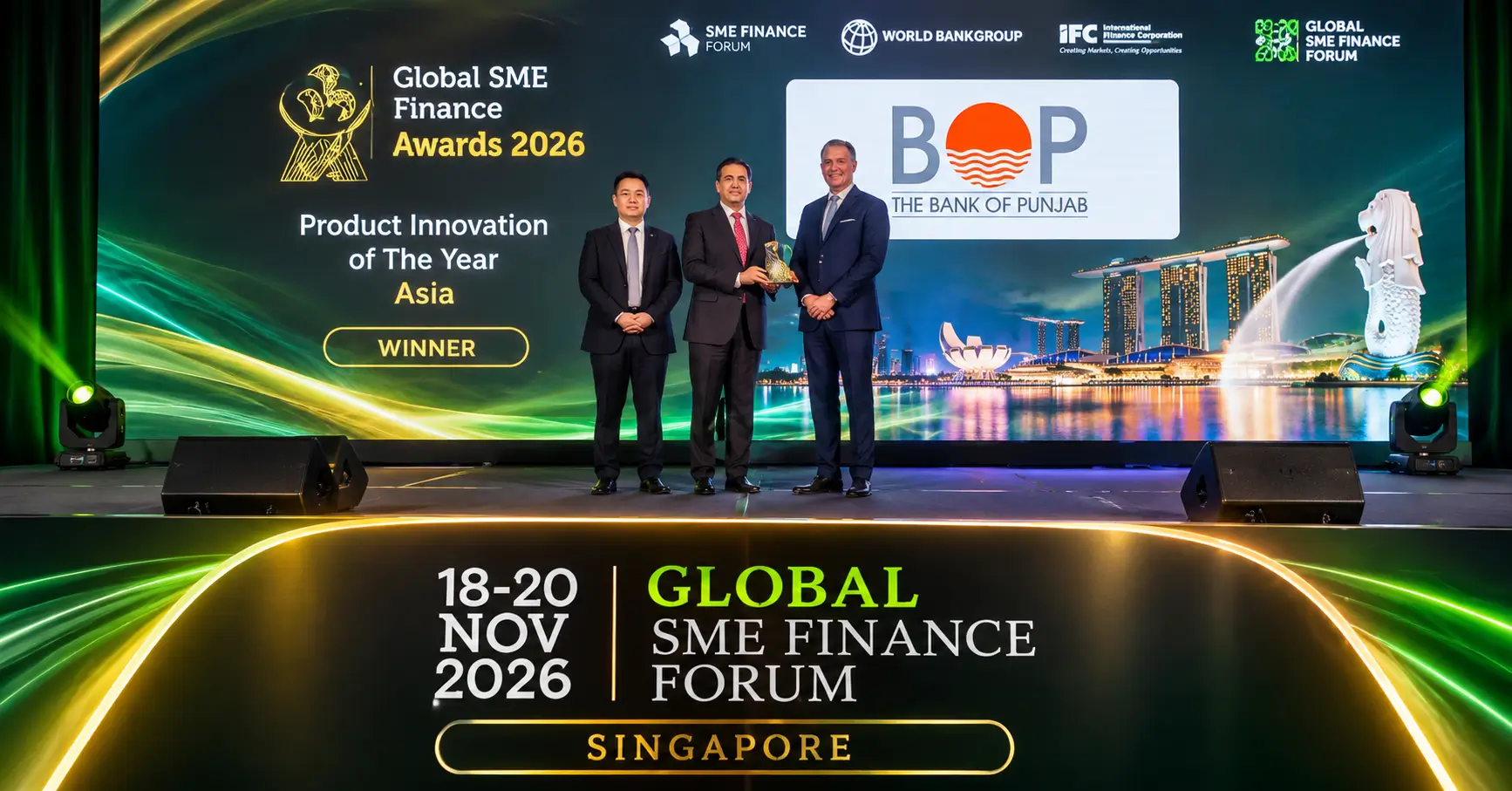

The Bank of Punjab SME Finance Award has brought international recognition to Pakistan’s banking sector after the provincial lender secured the Product Innovation of the Year distinction at the 9th Global SME Finance Awards 2026 in Singapore. The recognition highlights its expanding role in financing small businesses.
Announced on November 19, the award was presented during the Singapore FinTech Festival. The achievement comes as Pakistan pushes financial institutions to extend credit to smaller enterprises, improve access to formal banking and support businesses seeking sustainable growth.
Why the Bank of Punjab’s SME Finance Award Matters

The recognition places Pakistan’s SME financing efforts on an international platform. Small and medium-sized enterprises are important contributors to employment, production and exports, yet many continue to struggle with limited financing options and traditional bank lending requirements.
For the Bank of Punjab, the distinction reflects its reported expansion in SME lending and efforts to reach businesses previously underserved by conventional banking. However, the award itself does not establish whether borrowers have achieved lasting improvements in productivity, profitability or employment.
What the Global SME Finance Awards Recognise
The 9th Global SME Finance Awards were hosted by the SME Finance Forum alongside the Singapore FinTech Festival 2026. The awards recognise financial institutions and initiatives working to improve financing opportunities for small and medium-sized enterprises across different markets.
READ MORE: LIIBS 2026: Pakistan’s Bold 9th Summit Framework Revealed
The 2026 programme included four main categories: SME Financier of the Year, Product Innovation of the Year, Sustainable SME Financier of the Year and Best Financier for Women Entrepreneurs. Federal Finance Minister Senator Muhammad Aurangzeb attended the ceremony.
Understanding the Product Innovation of the Year Category

The Product Innovation category recognises financial products and services designed to address the financing needs of SMEs. Its purpose is to highlight solutions that improve access to credit and make financial services more useful for smaller businesses.
The bank’s recognition was associated with its SME lending approach, borrower outreach and financial inclusion efforts. Its announcement describes the distinction as Product Innovation of the Year – Asia, while the government’s announcement uses the broader official category title.
Bank of Punjab’s SME Financing Growth

The bank reported substantial growth in its small-business lending operations. According to figures accompanying its award announcement, BOP serves approximately 153,000 SME borrowers, representing around 48% of the country’s banking industry SME borrower base.
It also reported 397% growth in SME borrowers, compared with industry growth of 73%. The figures suggest an expansion in formal credit outreach, although the underlying calculations and reporting methodology have not been independently audited for this report.
Borrower Numbers and Financing Portfolio
The bank’s announcement also reported an SME financing portfolio of Rs230 billion, equivalent to approximately 25% of outstanding SME financing across the banking industry. It said the portfolio had grown by 146% since December 2024.
Another reported figure is Rs164 billion disbursed to new borrowers since December 2024. These numbers indicate the scale of BOP’s stated lending expansion, but disbursements should not be confused with outstanding loans or repayments.
Figures attributed to the Bank of Punjab’s award announcement
| Performance indicator | Reported figure |
|---|---|
| SME borrowers | 153,000 |
Share of industry SME borrowers | 48% |
| Growth in SME borrowers | 397% |
Industry borrower growth | 73% |
| New borrowers added | Over 122,000 |
SME financing portfolio | Rs230 billion |
| Portfolio growth since December 2024 | 146% |
Share of industry financing | Approximately 25% |
| Financing disbursed to new borrowers | Rs164 billion |
How BOP Is Expanding Access to Business Loans
BOP attributes its SME financing growth to changes in credit assessment, cash-flow-based lending, digitalisation and simplified financing processes. These approaches can help businesses that lack extensive collateral or conventional financial documentation seek formal banking facilities.
Traditional lending often relies heavily on property guarantees, established credit histories and documented financial statements. Alternative assessments can consider business cash flows and repayment capacity, potentially allowing smaller enterprises to access financing that conventional lending models might otherwise restrict.
Cash-Flow-Based Lending and Digital Finance
Cash-flow-based lending evaluates a business’s ability to generate sufficient income to repay borrowed money. Rather than relying exclusively on fixed assets, lenders can consider transaction records, operating revenue and other relevant financial information.
Digital banking can also reduce application barriers, improve record management and make financing processes more accessible. However, these methods require reliable data, appropriate risk controls and responsible lending practices to protect both borrowers and financial institutions.
Asaan Karobar Programme and SME Development
The Punjab government’s Asaan Karobar Programme is another part of the bank’s reported SME financing expansion. The initiative reflects cooperation between provincial authorities and financial institutions to improve access to business financing and encourage entrepreneurship.
BOP’s announcement credited the provincial government’s approach and its banking partnership with supporting the programme. Nevertheless, the long-term effectiveness of such initiatives depends on transparent eligibility requirements, timely loan processing, responsible disbursement and measurable business outcomes.
What the Award Means for Pakistan’s Banking Sector
The award comes amid broader government efforts to increase SME financing. At the Global SME Finance Forum in Singapore, Finance Minister Muhammad Aurangzeb highlighted the sector’s contribution to Pakistan’s economy and outlined a target of Rs2 trillion in SME financing by June 2028.
According to the government’s November 18 statement, SMEs account for approximately 90% of businesses, 40% of GDP, 20% of exports and 78% of non-farm employment. These figures underline why improving business credit access remains an economic priority.
Challenges Facing Small Businesses in Pakistan
Despite growing lending figures, access to affordable financing remains a significant challenge for smaller enterprises. Businesses with limited documentation, irregular income, insufficient collateral or weak financial records may struggle to satisfy conventional banking requirements.
The government has acknowledged the need to expand lending beyond established businesses. During a November 5 financing review, officials emphasised reaching smaller and export-oriented enterprises, highlighting that increasing the number of businesses accessing formal credit remains a priority.
SMEConnect and the Future of Business Financing
The State Bank of Pakistan introduced SMEConnect, a centralised financing portal that became operational for applications on November 1, 2026. The platform connects businesses with banks and development finance institutions through a digital application process.
The initiative aims to improve transparency, simplify applications and allow businesses to track financing requests. It could complement banks’ digital lending efforts, although effective implementation will depend on accessibility, processing efficiency and support for applicants with limited digital literacy.
The government’s broader financing targets also indicate the scale of the challenge:
Increase SME financing to Rs2 trillion by June 2028.
Raise SME financing’s share of private-sector credit from 9.9% to 13%.
Expand access to formal lending for smaller and export-oriented businesses.
Improve digital applications, financial records and monitoring of bank responses.
Can International Recognition Translate Into Sustainable SME Growth?
Winning an international award is an important achievement, but its wider economic value will depend on what happens after financing reaches businesses. Borrowers need affordable credit, predictable repayment conditions and sufficient working capital to maintain operations and expand production.
For Pakistan, the bigger test is whether banking innovation can reach businesses outside established commercial networks, including smaller enterprises and women-led ventures. Greater access to finance must ultimately translate into sustainable businesses, employment opportunities and stronger economic participation.