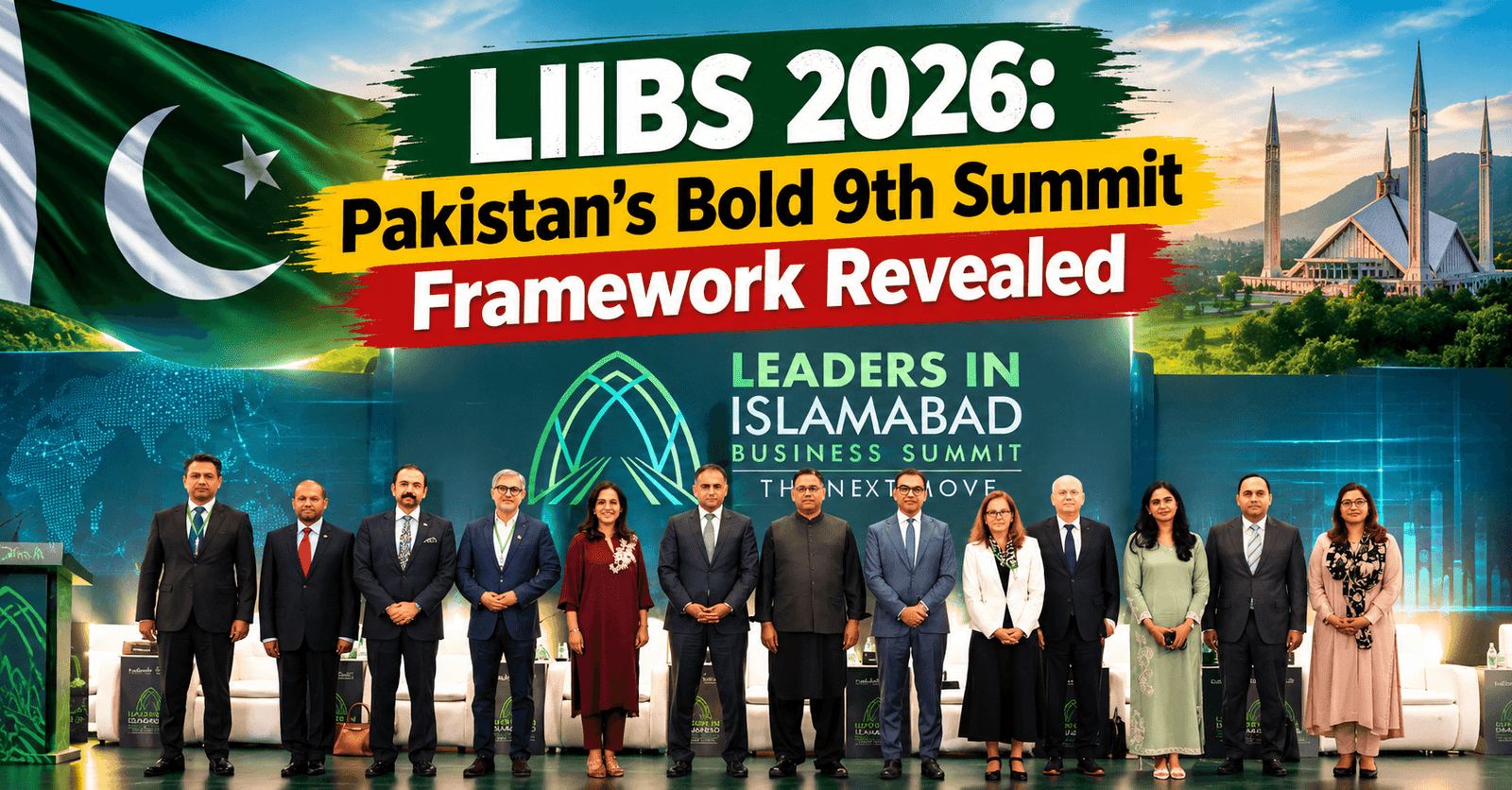

LIIBS 2026 Concludes with Framework on “The Next Move” for Economy, Technology, and Global Positioning
Islamabad — LIIBS 2026 wrapped up this week with something rarer than another round of ministerial speeches: a specific argument about what Pakistan should do next, and who should do it.
The 9th edition of the Leaders in Islamabad Business Summit, themed “The Next Move,” brought federal ministers, global institutional heads and Pakistan’s top corporate executives into one room on September 17. The pitch was simple — stop debating uncertainty, start acting on it.
What Happened at LIIBS 2026 in Islamabad

LIIBS 2026 closed with policymakers and business leaders committing to convert Pakistan’s economic potential into something durable. Senator Muhammad Aurangzeb, Muhammad Ali, Bilal Azhar Kayani, Anwar-ul-Haq Kakar and Dr. Musadik Malik anchored the closing arguments.
The summit ran across six thematic sessions before the closing address, moving from geopolitics and geoeconomics through AI and digital transformation to capital, finance and Pakistan’s “moment of choice.” Each session fed into the same closing question: what’s the actual next move.
Aurangzeb’s GDP Claim, Checked Against the Data
Finance Minister Muhammad Aurangzeb told the summit Pakistan logged “about 3.7% GDP growth last fiscal year,” with large-scale manufacturing recovering and remittances and IT exports propping up the external account.
The number needs context. Provisional estimates from the Pakistan Bureau of Statistics put FY25 real GDP growth closer to 2.7%, and the State Bank’s own FY25 target range was 2.5–3.5%. A 3.7% figure lines up more closely with later revised or forward-looking estimates than with the original provisional print — a gap worth flagging rather than repeating uncritically.
- PBS provisional FY25 growth: ~2.7%
- SBP’s original FY25 target range: 2.5%–3.5%
- SBP Governor’s later revised/forward guidance: growth “exceeding 3.7%,” moving toward ~3.75% in FY26
Muhammad Ali: Pakistan Must Create Technology, Not Just Consume It
Muhammad Ali, Federal Minister and Adviser to the Prime Minister on Privatisation, pushed the summit toward a sharper framing. “Pakistan cannot just be a consumer of technology; we need to be the creator,” he said, calling for productive businesses that can compete globally.
He tied that ambition to workforce basics — stronger education, equal participation, and skills extended into manufacturing and defence. His closing line was blunt: cities that are productive, not just congested, and young people equipped for the economy that’s actually coming.
Bilal Azhar Kayani on Structural Reform and Fiscal Discipline

Bilal Azhar Kayani, Minister of State for Finance and Railways, made the case for governance over grand strategy. “We need structural reforms with better governance,” he said, pointing to the recurring cycle of unchecked spending followed by IMF bailouts.
He credited last year’s reduction in super taxes to private-sector coordination and flagged financing support for agriculture and SMEs, alongside reforms at bodies like SMEDA. Export growth, in his framing, isn’t optional — it’s the only durable way out of the borrowing cycle.
Kakar’s Closing Message: Security Isn’t the Whole Story
Senator Anwar-ul-Haq Kakar, Pakistan’s caretaker Prime Minister from 2023–24, pushed back on a familiar excuse. Security challenges are real, he said, but “the deeper question is structural” — other countries facing serious violence have still built large export economies.
His point cuts against a common instinct in Pakistani economic commentary: blaming weak growth on terrorism rather than on the underlying constraints. LIIBS 2026‘s closing session leaned into that reframing rather than away from it.
Musadik Malik on Elite Capture and Merit-Based Policy
Dr. Musadik Malik, Federal Minister for Climate Change and Environmental Coordination, went furthest on continuity. “Policies based on elite capture always result in exploitation,” he said, calling for a level playing field built on skills and merit.
READ MORE: Mobil™ & HASCOL Partnership Reshapes Pakistan’s Lubricants 2026
He singled out universities as an example — let capable students build things without institutional hurdles, he argued. Breaking elite capture, in his telling, isn’t a one-summit fix; it’s a standing project.
Inside the Six Sessions of LIIBS 2026
Before the ministerial closing, global institutional leaders and industry executives worked through a packed six-session agenda.
| Session | Focus |
|---|---|
| Inaugural | Ministerial keynotes, reading the moment |
| Geopolitics, Geoeconomics & Pakistan | Investment confidence, climate resilience |
| Business, Technology & Competitive Landscape | Adapting faster, unlocking new markets |
| AI, Digital Transformation & Economic Value | Productivity, business models, competitive edge |
| Capital, Finance & Confidence Economy | Mobilizing domestic and international capital |
| Closing: Pakistan’s Moment of Choice | Political, business and strategic perspectives |
Speakers ranged from IFC’s Simon Andrews and UNDP’s Dr. Samuel Rizk to Telenor Group’s Irfan Wahab Khan and S&P Global Pakistan’s Mujeeb Zahur — a lineup weighted toward finance, telecom and development institutions rather than a single sector.
From “Navigating the Unknown” to “The Next Move”

The theme shift matters more than it looks. LIIBS 2025 ran under “Navigating the Unknown,” co-hosted by Nutshell Group and Unity Foods with the Overseas Investors Chamber of Commerce as a strategic partner.
LIIBS 2026 dropped the uncertainty framing entirely and was hosted solely by Nutshell Group, with Coca-Cola Pakistan, ACCA, S&P Global and Systems Limited among its named partners. The organizers are betting Pakistan has moved from crisis management to something closer to execution.
What LIIBS 2026 Means for Pakistan’s Next Steps
Strip away the panel titles, and LIIBS 2026 left behind a fairly specific checklist: verified, sustainable growth over consumption-led numbers; governance reform ahead of new borrowing; and merit-based policy that survives changes in government.
That checklist becomes policy or stays a summit takeaway depends on decisions well outside the conference hall — the next budget cycle, the next IMF review, the next set of LSM numbers. Pakistan’s actual “next move” will show up in those, not in a hotel ballroom in Islamabad.