
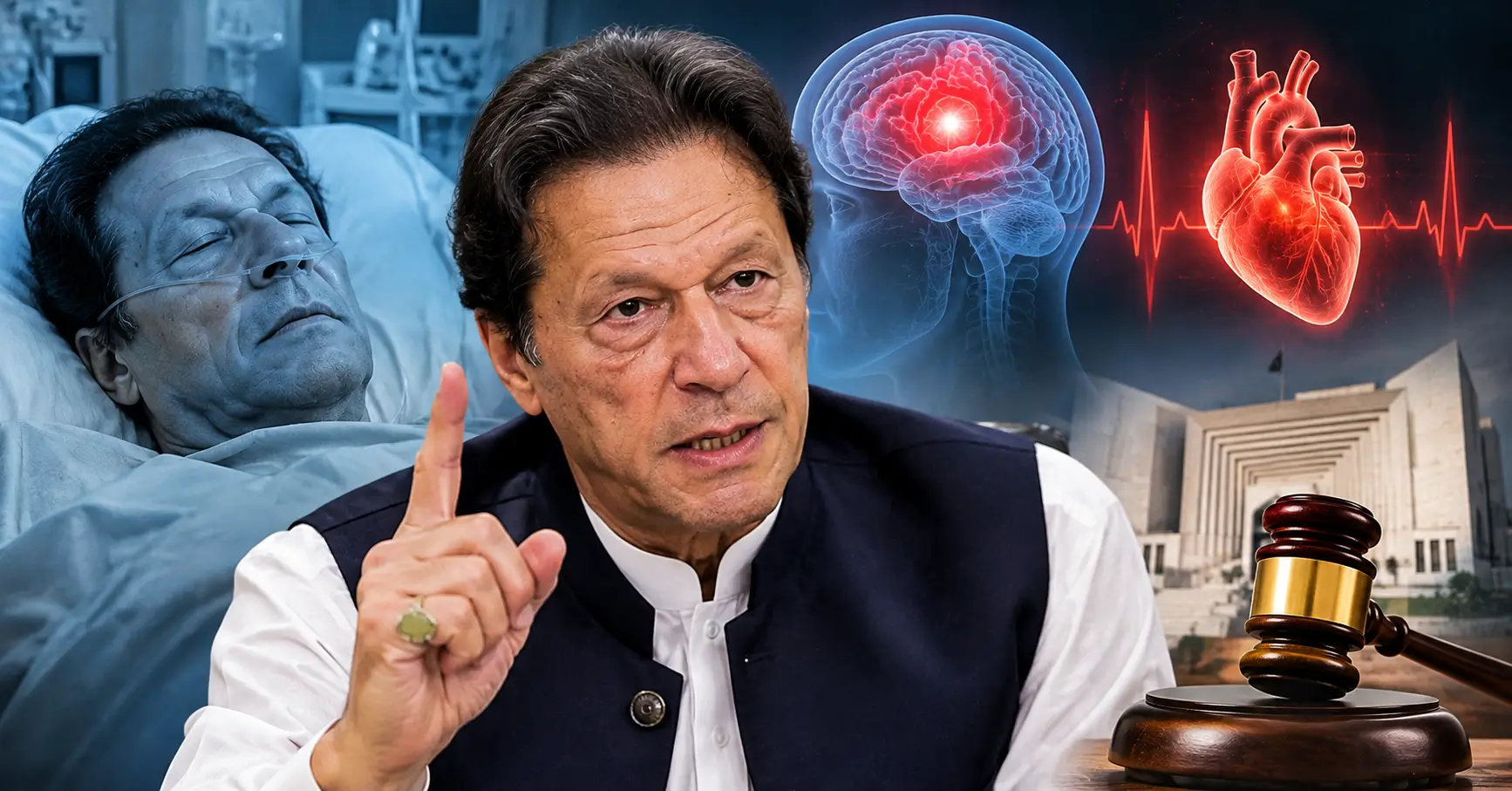

ISLAMABAD, November 16, 2026: Imran Khan brain haemorrhage risk has become a major concern after Pakistan’s jailed former prime minister warned that doctors had identified serious threats to his health, including cardiac arrest.
In an open letter addressed to the chief justices of three superior courts, Khan requested urgent medical treatment, implementation of previous judicial directions and better access to healthcare for himself and his wife, Bushra Bibi.
Why Imran Khan Warned of Brain Haemorrhage and Cardiac Arrest
The former prime minister said his health had deteriorated during his imprisonment at Adiala Jail. According to his letter, doctors warned that he was highly vulnerable to a brain haemorrhage and cardiac arrest, adding that his heart had already suffered damage.
Khan also expressed concern about his ability to survive the continuing conditions inside prison. At 74, he described his situation as increasingly dangerous and warned judges that he might not return alive without appropriate medical intervention.
What Imran Khan Revealed About His Blood Pressure
One of the most concerning details in the letter was Khan’s account of repeatedly elevated blood pressure readings. He said his measurements had increased from 130 to 150 and subsequently 170 before reaching 192 and 193 on November 10.
The letter did not identify who recorded each measurement or provide the underlying medical records. Therefore, these figures should be understood as Khan’s reported readings rather than independently verified clinical measurements.
| Reported reading | Blood pressure |
|---|---|
Earlier measurement | 130 |
Subsequent measurement | 150 |
| Later measurement | 170 |
November 10 | 192 |
| November 10 | 193 |
What Doctors Reportedly Told the Former Prime Minister
Khan attributed the warnings about brain haemorrhage and cardiac arrest to doctors who had assessed his condition. He also claimed that medical professionals had informed him that his heart had already suffered damage.
However, the complete medical assessment supporting these statements has not been independently made public in the available reporting. No named specialist has publicly confirmed the specific diagnosis or quantified his individual risk.
READ MORE: World’s 3 Most Powerful Countries Set to Meet in China Next Week
The distinction matters because a patient’s reported medical warning and an independently published diagnosis are not interchangeable. The available information establishes what Khan claims doctors told him, but further medical documentation would be needed to independently assess those concerns.
Imran Khan’s Medical Treatment at Adiala Jail

Khan’s medical concerns have developed alongside his continuing imprisonment at Adiala Jail. His letter alleged that prolonged isolation, restricted family contact and difficulties accessing legal representatives had affected his physical and psychological wellbeing.
He claimed that he had been confined for up to 22 hours daily and that access to his lawyers had been severely restricted. He also alleged that recommendations from the jail’s medical board concerning family interaction and reading materials were not followed.
November 11 Hospital Visit and PIMS Statement
Khan was taken from Adiala Jail to the Pakistan Institute of Medical Sciences (PIMS) in Islamabad overnight on November 10–11. Officials said he received treatment for blood pressure issues and underwent an eye examination before returning to prison.
The hospital administration reportedly stated that his vital signs remained normal before, during and after his eye procedure and described him as clinically stable. This statement provides an important medical update but does not independently resolve his separate cardiac concerns.
Why the August 18 Supreme Court Order Matters
Another central issue in Khan’s appeal concerns a Supreme Court direction issued on August 18, 2026. According to his letter, the court ordered authorities to transfer him to Shifa International Hospital within two days for specialised medical assessment.
The directions also reportedly included establishing a medical board to examine his condition and facilitating family communication. Khan argued that these instructions had not been implemented as ordered, leaving his medical appeal awaiting further judicial consideration.
The earlier hospital transfer also became controversial because authorities took him to PIMS instead of Shifa International Hospital. Government representatives previously cited security concerns, while his political party disputed that explanation and questioned the authorities’ compliance with the court’s instructions.
Allegations of Solitary Confinement and Restricted Access

Khan claimed that his isolation intensified following the December 20, 2025, verdict in the Toshakhana-II case. He alleged that he was disconnected from outside communication and frequently denied opportunities to interact with relatives and legal representatives.
According to his account, he was permitted to meet his lawyer only four times during 2026, while his wife received just one opportunity to meet her counsel. These allegations have become an important part of his request for judicial intervention.
He also raised concerns about access to his sons, Kasim and Sulaiman, and alleged that restrictions continued despite previous court directions. His letter argued that communication with family members and lawyers was essential for both his wellbeing and his ability to defend himself.
Bushra Bibi’s Health Concerns Add to the Appeal

The letter also highlighted concerns about Bushra Bibi’s medical condition. Khan alleged that his wife experienced retinal detachment in April 2026, underwent complicated eye surgery and subsequently developed further difficulties with her eyesight.
He claimed that during their recent meeting, she struggled to tolerate light and open her eyes. According to his appeal, she might require another operation to prevent permanent vision loss, making access to appropriate medical treatment an urgent concern.
Khan also questioned the availability of her medical records and access to doctors of her choice. The concerns have added another dimension to the couple’s appeal, with both seeking appropriate healthcare while remaining incarcerated at Adiala Jail.
What Happens Next in Imran Khan’s Medical Case?
Khan has asked the chief justices of the Supreme Court, Federal Constitutional Court and Islamabad High Court to ensure that previous judicial directions are implemented. His request centres on proper medical examinations, hospital access and appropriate treatment for both himself and Bushra Bibi.
The next significant development will depend on how the courts address the outstanding medical and procedural concerns. Independent medical documentation, clarification from prison authorities and implementation of judicial directions will be important in establishing what happens next.
The case raises wider questions about prisoners’ access to healthcare, communication with legal representatives and enforcement of court orders.
Will Pakistan’s superior courts intervene to address Imran Khan’s medical concerns before his condition deteriorates further?