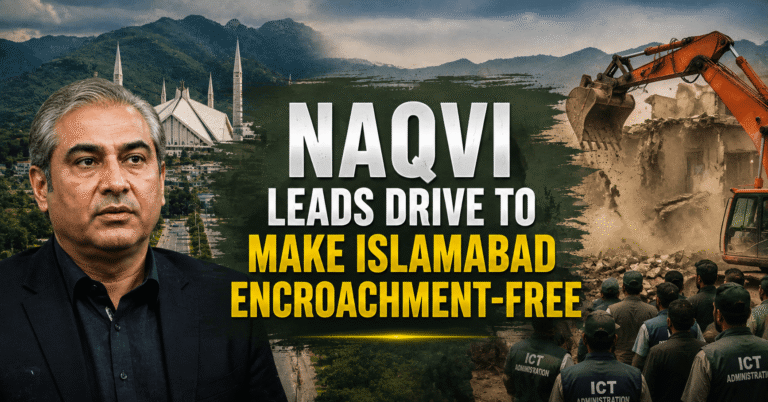

Islamabad’s encroachment-free drive has retrieved over 1,141 acres of state land in two years, according to official data tabled in the National Assembly.
But a closer look at a decade of enforcement records shows the campaign’s momentum has been far from steady.
What’s Driving Islamabad’s Encroachment-Free Campaign

The federal capital’s encroachment-free push is being run under a declared zero-tolerance policy, framed by Interior Minister Mohsin Naqvi as a bid to restore Islamabad “to its original state.” Officials describe it as an across-the-board operation with no exceptions for connected individuals or institutions.
That claim was tested in April 2026, when the Capital Development Authority demolished a Frontier Corps camp office built on a green belt near Ayub Chowk. Naqvi said an alternative legal site would be arranged — but the structure came down regardless of who built it.
Key Numbers Behind the Anti-Encroachment Drive
Numbers tabled in parliament give the clearest picture of scale. In a written Senate reply, Naqvi disclosed enforcement data spanning 2016-17 through 2025-26 — a decade that shows sharp acceleration in recent years.
- 1,141 acres of state land recovered from illegal occupants over the last two years
- 203 security cabins and guard posts removed from sectors F-6, F-7, F-8, G-10 and G-11
- 26,958 structures demolished in 2025-26 alone, against 1,156 operations
- 6,904 kanals retrieved in 2025-26, compared with just 423 kanals in 2016-17
- Rs 49.661 million in total penalties recovered across the decade
| Fiscal Year | Operations | Structures Demolished | Land Retrieved (kanals) |
|---|---|---|---|
| 2016-17 | 1,913 | 3,261 | 423 |
| 2017-18 | 1,984 | 3,236 | — |
| 2025-26 | 1,156 | 26,958 | 6,904 |
Naqvi’s Zero-Tolerance Stand on Illegal Structures

Naqvi has repeatedly tied his political credibility to this drive, insisting the crackdown “would continue until all illegal structures in Islamabad are eliminated.” He has framed resistance from any quarter — private or institutional — as unacceptable.
READ MORE: PIMS Tragedy: A Wider Warning for Public Hospitals
Officials close to the campaign describe it as reflecting what has been dubbed “Mohsin Speed” — a governance style built around fast decisions and visible, on-ground results rather than announcements that fade. Whether that pace holds beyond high-profile sectors remains an open question.
CDA, MCI, DMA and Frontier Corps — Who Does What
The operation runs on a multi-agency model rather than a single command. CDA handles land reclamation and demolition; the Metropolitan Corporation Islamabad manages municipal enforcement; the District Magistrate Administration issues legal notices and orders.
- CDA: demarcation, demolition, land recovery under Chairman Sohail Ashraf
- MCI: municipal-level enforcement under CEO Dr Anum Fatima
- DMA: notices and magisterial orders against occupants
- Frontier Corps/Rangers/Police: security cover during large-scale clearance operations
This coordination has cleared obstructive footpath structures in I-8, D-12 and G-7, officials say, alongside the sector-wide removal of unauthorized security cabins.
Katchi Abadis and the Human Cost of Clearance
Not every target of the encroachment-free drive is a commercial kiosk or an illegal guard post. Informal settlements — katchi abadis — have also been marked for clearance, and residents of these areas have pushed back.
A planned operation covering G-7, I-9 and Mehrabadi was set to issue one-month eviction notices before demolition, involving CDA enforcement, police and Rangers. For families with no alternative housing, “encroachment-free” carries a very different meaning than it does for a displaced FC office.
A Decade of CDA Enforcement Data

The Senate record shows enforcement was fairly modest through the mid-2010s, then scaled up dramatically by 2025-26 — nearly eight times more structures demolished than in 2016-17, despite fewer total operations. That suggests each operation is now hitting larger, more consolidated encroachments rather than scattered small violations.
Whether this reflects better targeting or simply a bigger backlog of unresolved land grabs is something CDA has not directly addressed in its public statements.
What It Means for Islamabad’s Master Plan and Residents
For CDA, the stated goal is restoring Islamabad according to its original master plan — reclaiming green belts, footpaths and public land earmarked decades ago for civic use. For residents in cleared informal settlements, the drive means displacement with limited certainty about where they go next.
The pace has clearly changed. What hasn’t been settled is whether “encroachment-free” will ultimately mean a more livable capital for everyone in it, or one reshaped mainly for those who can afford to stay within its formal boundaries.