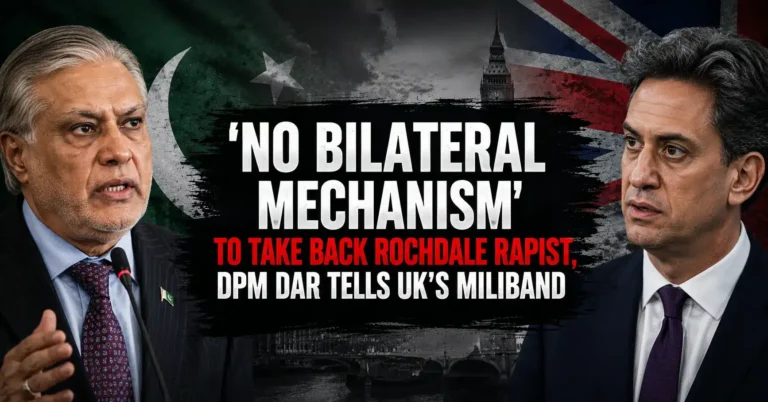

Pakistan has firmly rejected Britain’s push for Rochdale rapist deportation, with Deputy Prime Minister Ishaq Dar telling UK Foreign Secretary Ed Miliband that no legal pathway currently exists to send convicted child rapist Shabir Ahmed back to Pakistani soil.
The blunt message was delivered face to face on Thursday, at the Foreign, Commonwealth and Development Office in London, during what was billed as a routine bilateral review. It was anything but routine.
What Dar Told Miliband in London

According to reporting from the Daily Telegraph, Dar told Miliband there is no existing law or bilateral mechanism between Pakistan and the UK that would permit the transfer of a convicted sex offender like Ahmed. That single line has now become the crux of a growing diplomatic standoff.
A Pakistani source close to the talks put it plainly: Ahmed’s case is different because he sits on the sex offenders register, and no treaty exists between the two nations to exchange or extradite convicted sex offenders. Miliband reportedly pressed the point further, asking Islamabad to at least consider a workable path forward. Dar’s side agreed only to “consider” the request — while asking London to understand Pakistan’s own concerns.
Notably, the official joint statement issued after the meeting made no mention of Ahmed at all. It referred only to a broad review of the “full spectrum” of Pakistan-UK relations — a diplomatic sidestep that speaks volumes on its own.
Who Is Shabir Ahmed and Why Does This Matter

Shabir Ahmed, 73, was the ringleader of the Rochdale grooming gang, convicted in 2012 of 30 counts of child rape carried out over years against girls as young as 12 and 13. He was known to his victims only as “Daddy.”
He was sentenced to 22 years but walked free on 2 July after serving just 14. That early release reignited public fury in the UK and pushed the Rochdale rapist deportation question straight back onto the political agenda. A few key facts frame why this case carries such weight:
- Ahmed held dual British-Pakistani nationality and was stripped of his British citizenship following sentencing.
- He is now confined under electronic tagging with exclusion zones covering Oldham, where he lives, and Rochdale, where his crimes took place.
- The Ministry of Justice is reportedly spending thousands of pounds monitoring him.
- He has fought deportation for over a decade, losing appeals at the Court of Appeal and the European Court of Human Rights.
The Legal Wall — Why Britain Can’t Simply Deport Him
Here’s where the story gets genuinely complicated, and where most coverage glosses over the detail. Ahmed’s continued presence in Britain isn’t only about Pakistan’s refusal — it’s also about a decades-old British law.
READ MORE: Sindh CM suspends order accepting 63 sub-registrars’ promotion refusal
Under Section 7 of the Immigration Act 1971, Commonwealth citizens who arrived in the UK before 1 January 1973 and had lived there at least five years are shielded from deportation. Ahmed falls into that protected category, which is why Home Secretary Shabana Mahmood has moved to amend the Immigration and Asylum Bill currently before Parliament.
| Legal Barrier | Description |
|---|---|
| Immigration Act 1971, Section 7 | Protects long-term Commonwealth residents from deportation |
| No UK-Pakistan extradition treaty for sex offences | No legal channel to compel Pakistan to accept him |
| Citizenship already revoked | Removes one legal lever the UK previously had |
| Pakistan’s discretionary refusal | Islamabad says it has no obligation, and won’t act unilaterally |
Mahmood’s proposed amendment would let the Home Secretary disapply Section 7 for the most serious offenders. But even she has conceded in the Commons that changing British law alone won’t force Ahmed’s removal — Islamabad still has to agree to receive him, and right now, it isn’t budging.
Islamabad’s Counter-Demand: The Dissidents Angle

Sources briefed on the talks say the only route to a deal Pakistan has floated is a swap — Britain handing over Pakistani dissidents currently living in the UK, in exchange for taking Ahmed back. That’s a demand British officials are highly unlikely to accept, given the political and human-rights sensitivities attached to it.
Dar did not spell out Pakistan’s “concerns” publicly, but earlier reporting confirms Islamabad has previously linked the Ahmed case to its broader grievances about dissidents operating from British soil. This positions the Rochdale rapist deportation dispute as less a narrow legal question and more a bargaining chip within a wider, tense relationship.
A Pattern of Diplomatic Friction, Not Just One Case
It’s worth noting that cooperation between the two countries isn’t impossible in principle. In a separate case, convicted Rochdale-linked offender Choudhry Ikhalaq Hussain was tracked down in Punjab and put through extradition proceedings back to the UK following a joint operation involving Pakistan’s Federal Investigation Agency, Punjab Police, and Britain’s National Crime Agency.
That precedent shows the machinery for cross-border cooperation exists — but only when both governments are aligned on the terms. In Ahmed’s case, no such alignment currently exists, and the politics are far messier given the citizenship, treaty, and reciprocity questions all tangled together.
The UK government has also signalled it could threaten visa restrictions on Pakistani nationals if Islamabad continues to refuse. With roughly 200,000 visas issued to Pakistani applicants annually, that’s leverage London may eventually choose to use — though nothing concrete has been announced yet.
What Happens Next
For now, the Rochdale rapist deportation impasse remains unresolved. Pakistan has agreed only to “consider” the UK’s request, not to act on it. Meanwhile, Mahmood’s legislative amendment moves through Parliament, and public pressure in Britain continues to build through petitions and political statements demanding Ahmed’s removal.
Three things to watch:
- The Immigration and Asylum Bill amendment passes and how it’s worded
- The UK follows through on any visa-restriction threat against Pakistan
- Backchannel talks produce any narrower compromise short of a dissidents swap
Until one of those shifts, Ahmed remains in the UK under monitoring — and the diplomatic standoff between London and Islamabad shows no sign of easing.