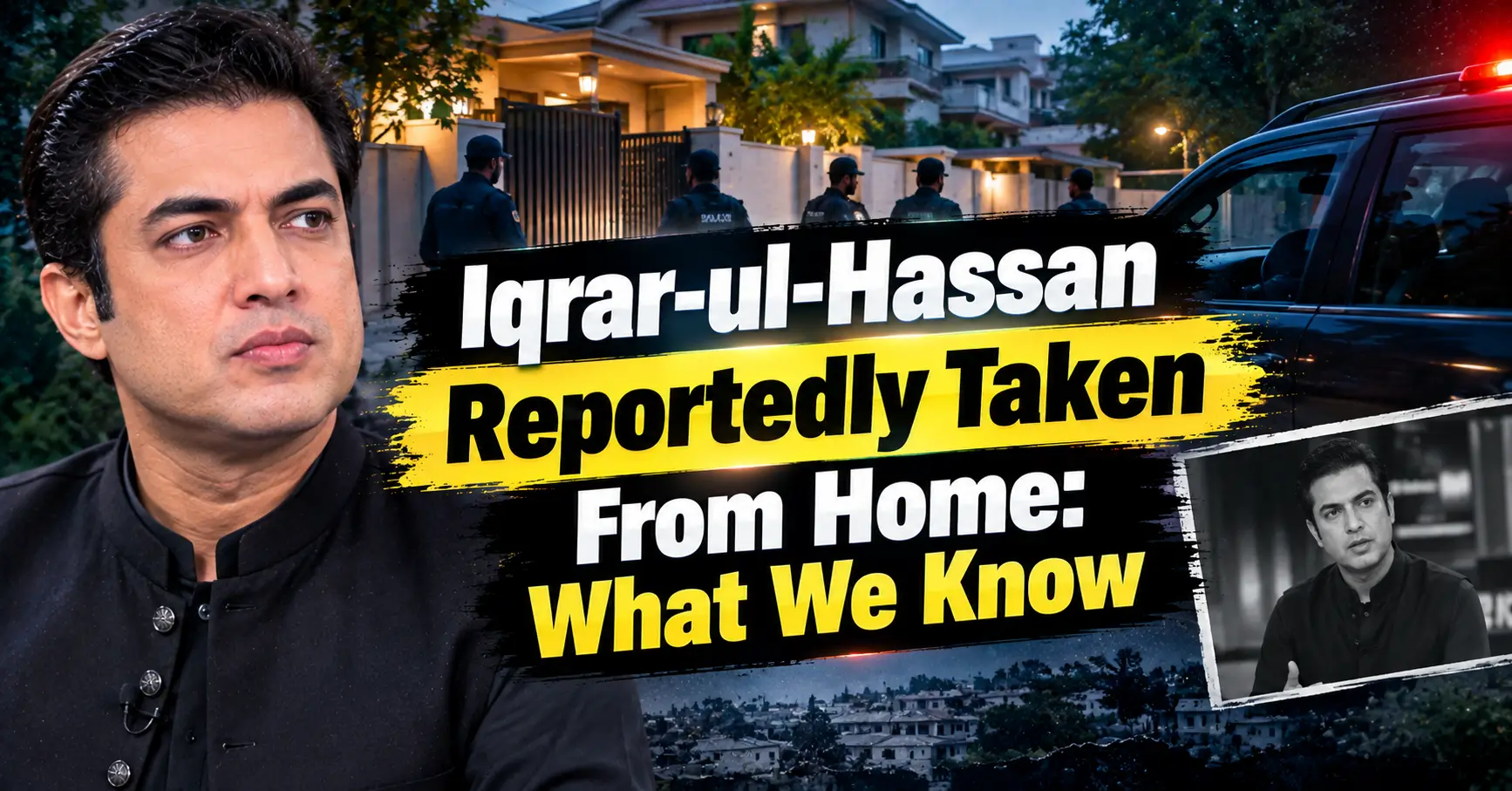

Iqrar-ul-Hassan was reportedly taken from his Lahore home around 2:40 am on 12 October 2026, according to his family. The agency named in the allegation says he is not in its custody.
The Late-Night Raid in DHA Phase 8
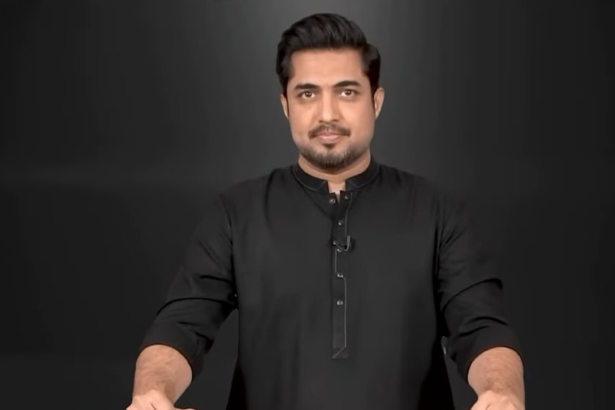
Reports place the incident between Sunday night and Monday morning, 11 and 12 October, at his DHA Phase 8 residence. The family puts the time between 2:40 and 3 am; plain-clothed personnel arrived and left with him.
Waseem Badami, a longtime colleague of Iqrar-ul-Hassan, confirmed in a video that he had received reports of the detention. The reasons and any registered case were not disclosed in early reports, and no authority has confirmed an arrest.
What Farah Iqrar Alleges
His wife, Farah Iqrar, says individuals forced their way in while the family slept, pushed her, and took phones, laptops, a DVR and CCTV footage. She says some of the intruders were women.
Farah says: “We were sleeping when the bell rang.” She also reports seeing NCCIA lettering on the intruders, and her attempt to file an FIR at Defence police station reportedly failed.
NCCIA Denies Holding Iqrar-ul-Hassan
The National Cyber Crime Investigation Agency has denied arresting him. Agency officials reportedly told a judicial magistrate that he was not in their custody, which conflicts with the badge sightings described by his family.
Another report said agency officials avoided giving any official position when the family approached them. Who actually took him, and under what authority, remains unestablished at the time of writing, and that gap matters.
Verified Facts at a Glance
| Detail | Status |
|---|---|
| Date and time | 12 October 2026, about 2:40 to 3 am (times vary) |
| Location | DHA Phase 8, Lahore (reported) |
| Agency named | NCCIA (alleged by family; agency denies) |
| FIR or charge | None disclosed |
| Court production | None reported |
| Legal action | Habeas corpus petition planned, per his lawyer |
The table separates what is consistently reported from what is only claimed. Only the date, location and family’s account appear across reports. Everything else about custody, charges and authority remains open.
No source reviewed for this article cited an FIR, a remand order or a charge sheet. If one is registered, it should name the offence, the investigating agency and the court that authorised custody.
Where the Accounts Conflict

Three discrepancies stand out in reports on Iqrar-ul-Hassan. Reports give the time as 2:40 am or about 3 am. Family accounts describe the entry differently: a broken gate, a scaled wall, a forced ground-floor door.
Third, some reports call it an arrest while others describe an alleged abduction. Without an FIR or custody record, the word “arrest” is unproven, and this article uses “reportedly taken” for that reason.
Who Is Iqrar-ul-Hassan?
Syed Iqrar-ul-Hassan, born 29 June 1984 in Lahore, is a journalist and former television host who became widely known for the investigative programme Sar-e-Aam. He now chairs Pakistan Awaam Raaj Tehreek.
One report says he left his long-time television channel in April 2026 to pursue politics. His show built its name on sting operations exposing bribery, which also brought him cases, attacks and, by his own account, torture.
A History of Confrontation With Authority

In April 2016 he was arrested after a sting at the Sindh Assembly and granted bail the next day in two cases under sections 452 and 188 of the Pakistan Penal Code.
In a separate episode, he accused intelligence officials of torturing him and his team after a corruption exposé; five officials were suspended. That history is context for the Iqrar-ul-Hassan case, not evidence about it.
What the Law Requires After an Arrest
Article 10 of the Constitution says an arrested person must be told the grounds as soon as may be, and may consult a lawyer of choice. Production before a magistrate must follow within 24 hours.
Journey time is excluded from that window, and detention beyond it needs a magistrate’s authority. Section 167 of the Code of Criminal Procedure lets a magistrate allow up to 15 days where investigation cannot finish.
The Habeas Corpus Route
Iqrar-ul-Hassan’s lawyer, Mian Ali Ashfaq, has decided to approach the Lahore High Court with a habeas corpus petition seeking his recovery and production before the court. The lawyer says it is unclear whether any case exists.
Under Article 199, a High Court can require production of a detainee and test the legality of detention. Where a person is not informed of grounds or produced in 24 hours, the detention is open to challenge.
What Remains Unanswered
Five questions will decide how this story develops. Each has a verifiable answer, and each can be tested against a court record, an official statement or a registered FIR on file.
- Where is he held, and since when?
- Which agency, if any, holds him?
- Is there a registered FIR, and under which law?
- Has he been produced before a magistrate?
- Was the seized equipment recorded as evidence?
Until those answers exist in the public record, the responsible position is attribution. The family’s account is serious and specific. The agency’s denial is equally on record. Neither amounts to a finding of fact.
Why This Case Matters
The case tests a basic rule: a person taken from home at night must be traceable to a lawful order, an agency and a court. The answer here depends on documents not yet produced.
Iqrar-ul-Hassan’s profile as a party chairman raises the stakes for his family, his party and the agency named. A documented process would answer most questions; continued silence would leave them open.
What Happens Next for Iqrar-ul-Hassan
The next verifiable steps are a High Court hearing on the habeas corpus petition, any statement from the agency or Punjab authorities, and a court appearance that would show where he is held.
His first wife, Qurat-ul-Ain Iqrar, has also appealed to Punjab Chief Minister Maryam Nawaz for his recovery. This report will be updated promptly as official confirmation, charges or court orders emerge.