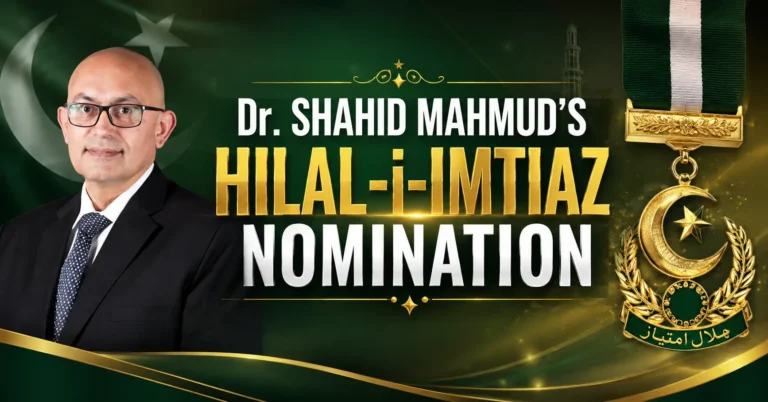

Dr Shahid Mahmud Hilal-i-Imtiaz recognition has landed at a moment when Pakistan’s tech ambitions are under global scrutiny. The Cabinet Division confirmed the recommendation on August 14, 2026, tied to Independence Day.
It places a private-sector technologist alongside bureaucrats, surgeons and broadcasters on a list built to honour national service. For an industry watching its own credibility, that inclusion carries weight.
Who Is Dr. Shahid Mahmud?
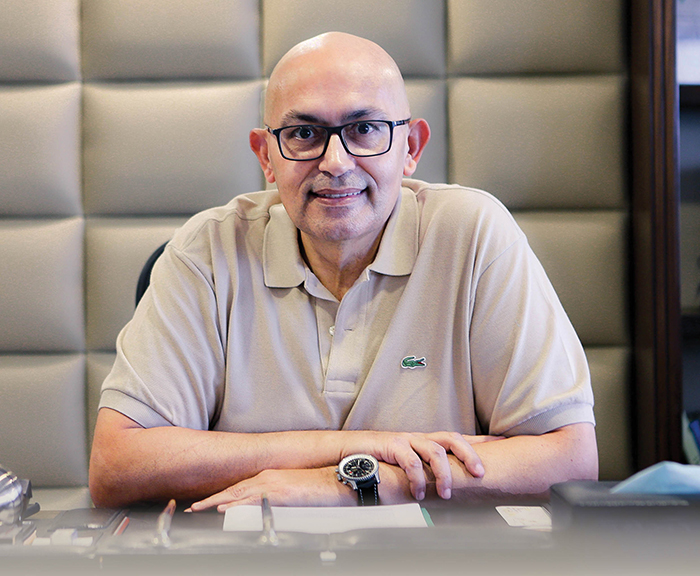
Dr Shahid Mahmud Hilal-i-Imtiaz honour recognises someone who has spent over four decades shaping Pakistan’s telecom backbone. He founded PAKTEL, the country’s first cellular company, and stayed on its board until 1998.
He now chairs Interactive Group of Companies, an ICT firm active in systems integration, satellite connectivity and public infrastructure. His reach spans banking too — he served over six years as an Askari Bank director.
The Hilal-i-Imtiaz Recommendation Explained
The recommendation credits Dr. Shahid Mahmud for contributions to science, technology, telecommunications and youth development. Supporting nomination material specifically references his role in telecommunications, satellite, software and public-infrastructure initiatives across Pakistan.
- Announced by the Cabinet Division on August 14, 2026
- Falls under the science category of Pakistan Civil Awards 2026
- Investiture scheduled for Pakistan Day, March 23, 2027
- Recognises “an ongoing contribution” to Pakistan’s digital and AI-driven future
Pakistan Civil Awards 2026: The Bigger List

President Asif Ali Zardari approved civil awards for 355 personalities this Independence Day, spanning science, medicine, bureaucracy, literature and the diaspora. Fifteen individuals were selected for Hilal-i-Imtiaz specifically.
READ MORE: Field Marshal Asim Munir: Pakistan’s First Chief of Defense Forces
Fellow science-category honorees include Prof Dr Syed Zafar Ilyas and Prof Dr Mudassir Asrar, recommended for Sitara-i-Imtiaz. NUTECH Rector Lt Gen (retd) Moazzam Ejaz also received a Hilal-i-Imtiaz recommendation in education.
Career Timeline: From PAKTEL to Interactive Group
Dr. Shahid Mahmud trajectory tracks Pakistan’s own telecom evolution — from analogue cellular infrastructure in the 1990s to today’s AI-strategy conversations. Interactive Group has grown under his leadership into a significant ICT and systems-integration force.
| Year/Period | Milestone |
|---|---|
| Pre-1998 | Founder-director, PAKTEL — Pakistan’s first cellular company |
| 2001 | Selected for a fellowship recognising IT-sector leadership |
| 2013–2016 | PhD in Computer Sciences, Coventry University, UK |
| 2016 | Named Eisenhower Fellowships’ Distinguished Fellow |
| 2026 | Recommended for Hilal-i-Imtiaz |
He also holds founder-director stakes in Indus Vision, Pak Globalstar and Shaheen Pay TV, broadening his footprint across media and satellite services.
Education and Credentials’

Academic grounding underpins the nomination. Dr. Shahid Mahmud completed his PhD in Computer Sciences at Coventry University in 2016, following a master’s in Defence and Strategic Studies from Pakistan’s National Defence University.
His bachelor’s in Engineering came from NED University, Karachi. That combination — engineering, strategic studies, and computer science — mirrors the interdisciplinary skill set Pakistan’s policymakers now say the tech sector needs.
Youth Development and Philanthropy
- Senior Fellow, Global Think Tank Network (GTTN)
- Co-Chair for ICT, Corporate Advisory Council, NUST
- Co-founder of Foresight Lab, a policy initiative with NGO AGAHI
- Involved with Buraq Planetary Society and youth-oriented community projects
These roles extend beyond commercial ICT work into policy formulation, having served on multiple federal committees shaping national telecom and IT strategy over the years.
What the Investiture Ceremony Involves
Civil awards recommended each Independence Day are formally conferred months later, at a Pakistan Day ceremony. This year’s investiture for the 2026 batch is set for March 23, 2027.
Between the announcement and the ceremony, the President’s Secretariat finalises documentation and protocol. Recommendation and conferral are treated as two distinct legal stages under Pakistan’s honours system.
Why This Recognition Matters
Pakistan’s tech sector has struggled for global visibility despite decades of infrastructure-building. A state honour for someone who bridged early cellular networks and current AI-policy discussions signals institutional acknowledgment of that continuity.
It also lands amid wider economic headlines — interest-rate debates, solar-subsidy costs, pension rulings — where technology policy competes for attention. Recognising a private-sector builder alongside civil servants reframes tech as national infrastructure, not a side industry.