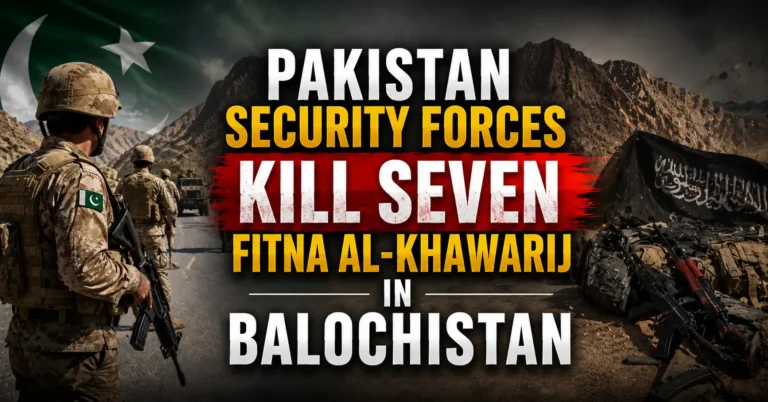

Fitna al-Khawarij Balochistan operations claimed seven more lives this weekend, as security forces struck a militant hideout in Kharan district’s remote Lajay area, security sources confirmed on Sunday. The raid adds to a mounting toll in one of Pakistan’s most volatile provinces.
The operation unfolded quietly, away from cameras, in terrain that has sheltered militant networks for years. But its outcome — seven dead, weapons seized, a hideout dismantled — fits a pattern security officials say is accelerating.
What Happened in Kharan’s Lajay Area

Fitna al-Khawarij Balochistan militants were tracked to the Lajay area of Kharan district after intelligence reports flagged their presence, according to security sources cited on Sunday. Troops moved in swiftly once the location was confirmed.
An intense exchange of fire followed. Seven militants were killed on the spot, while several others sustained injuries and reportedly fled the scene. No security personnel casualties were reported in this particular engagement, sources said.
Inside Operation Radd-ul-Fitna 3
The Kharan raid was carried out under Operation Radd-ul-Fitna 3, the nationwide counter-militancy campaign security forces have leaned on throughout 2026. It’s become the umbrella under which most Balochistan strikes now fall.
- Multiple districts targeted simultaneously, including Mastung, Bolan, Washuk, Awaran, Sibi, Khuzdar, Harnai and Nushki
- Operations run as intelligence-based strikes rather than large-scale sweeps
- A parallel campaign, Operation Shaban, has also been active in the province in recent months
Weapons and Equipment Recovered From Militants
Security forces recovered a substantial cache after the Kharan encounter — modern weapons, a large quantity of ammunition, and other military-grade equipment, according to sources familiar with the operation’s aftermath.
Two vehicles and a motorcycle used by the militants were also seized. Officials say such recoveries routinely disrupt logistics networks that keep smaller militant cells mobile and resupplied across Balochistan’s sparsely populated districts.
Fitna al-Khawarij: Who Are They
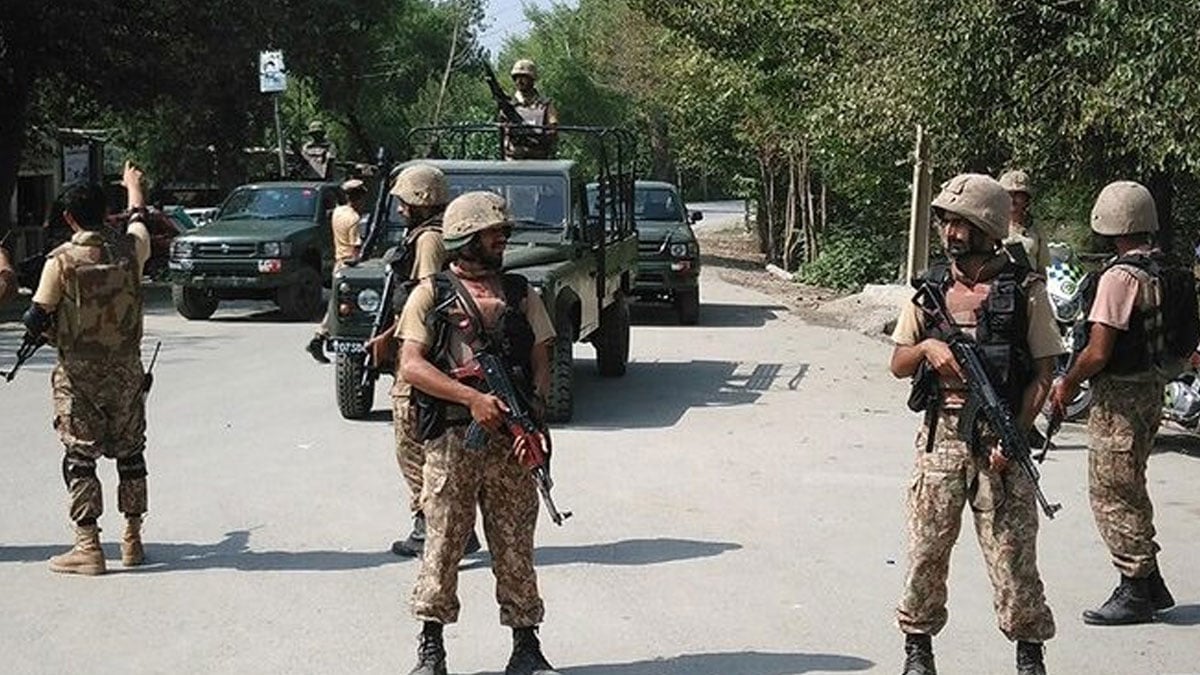
Fitna al-Khawarij is the term Pakistani state institutions use for terrorists affiliated with the banned Tehreek-e-Taliban Pakistan. Officials routinely describe the network as India-backed, a characterisation repeated across nearly every recent ISPR statement.
READ MORE: Field Marshal Asim Munir: Pakistan’s First Chief of Defense Forces
The label sits alongside “Fitna al-Hindustan,” used for separatist and India-linked militant groups active mainly in Balochistan. Both networks have been blamed for a string of attacks on security personnel, infrastructure and civilians this year.
Balochistan’s Wider Security Operations Landscape
Kharan is only the latest entry in a long list of 2026 operations. The scale becomes clearer when recent incidents are placed side by side.
| Date/Period | Location | Outcome |
|---|---|---|
| Sunday (this report) | Lajay, Kharan | 7 militants killed, weapons and vehicles seized |
| Early August 2026 | Mastung, Bolan, Washuk, Awaran, Sibi, Khuzdar, Harnai, Nushki | 15 militants killed |
| July 2026 | Sourab and Mastung | 10 militants killed, two female suicide bombers arrested |
| June 2026 (PICSS data) | Province-wide | 184 terrorists killed nationally, per independent monitor |
The June figure, tracked independently by the Pakistan Institute for Conflict and Security Studies, suggests operational tempo has stayed high even as overall violent incidents showed some decline that month.
Government and Military Response

Officials have repeatedly framed these operations as non-negotiable. Interior Minister Mohsin Naqvi has praised security forces after past Balochistan raids, commending what he called their “professional capabilities” in disrupting militant networks.
Prime Minister Shehbaz Sharif has said operations against Fitna al-Khawarij will continue “till complete elimination of terrorism.” President Asif Ali Zardari has similarly credited forces for actions against what he termed “Indian-sponsored” networks in the province.
Analyst and Regional Security Perspective
Security analysts tracking Balochistan note that intelligence-based operations, rather than broad sweeps, have become the preferred tactic — smaller, faster strikes aimed at specific hideouts rather than sustained area clearance.
- Analysts point to Balochistan’s economic stakes — mineral wealth and trade-corridor infrastructure — as a recurring motive behind militant targeting of security assets
- Independent monitors caution that official kill counts are difficult to verify independently, given restricted media access to conflict zones
What This Means Going Forward
The Kharan operation won’t be the last. Officials have signalled operations will continue “without interruption” across Balochistan’s militancy-prone districts, particularly as attacks on infrastructure and security convoys persist.
For residents of Kharan and neighbouring districts, the immediate question is whether disrupted networks stay disrupted — or regroup, as has happened before in this same stretch of terrain.