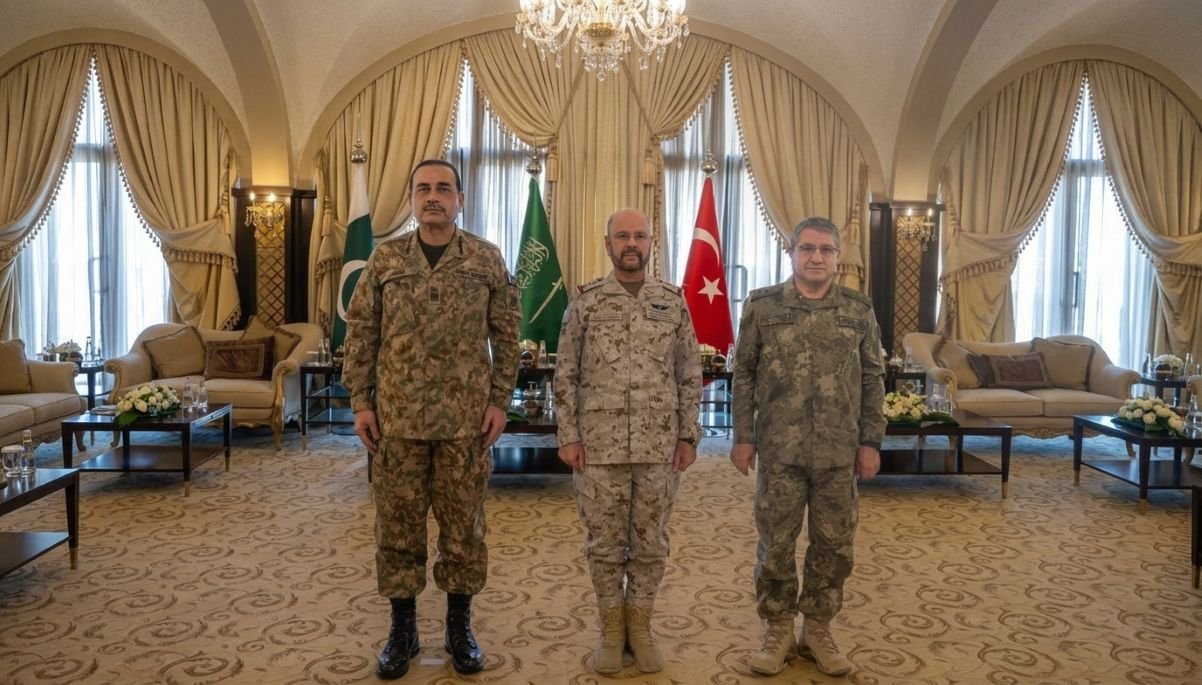


Field Marshal Asim Munir currently holds two of the most powerful positions in Pakistan’s military at once Chief of Army Staff and, since December 2025, the country’s first-ever Chief of Defense Forces. It’s a role that didn’t exist before, created specifically for him through a constitutional amendment, and it puts him at the top of a unified command structure over the army, navy, and air force. To understand how he got here, it helps to look at the career that came before it.
A Career Built Mostly Behind the Scenes
Asim Munir was commissioned into the Frontier Force Regiment back in the mid-1980s and spent much of his early career in postings that do not usually make headlines such as staff college instructor, brigade major, chief of staff for a corps. What set him apart was a long stretch in intelligence work. He eventually rose to lead Military Intelligence and then the Inter-Services Intelligence directorate, Pakistan’s most powerful spy agency, before moving into corps command and later becoming Quartermaster General at military headquarters. That intelligence background is often pointed to as part of what shaped his approach once he reached the top job.
Becoming Army Chief
General Munir was appointed Chief of Army Staff in late 2022, initially for a standard three-year term, and that term was later extended in 2024. As army chief, he became the most powerful uniformed officer in the country a position that in Pakistan, has historically carried enormous influence over national security policy and, at times, political affairs as well.
The May 2025 Conflict and Promotion to Field Marshal
Asim Munir’s public profile changed considerably after a brief but intense military confrontation with India in May 2025, which Pakistan’s military refers to as a decisive win. Just days afterward, he was promoted to the rank of Field Marshal, a five-star rank that Pakistan has used only once before, for Ayub Khan back in the 1960s. It is a largely symbolic rank in peacetime militaries, reserved for moments a government wants to mark as historically significant, and the promotion was framed by the government as recognition of his role in that conflict.
A New Post Created Around Him
In late 2025, Pakistan’s parliament passed the 27th Constitutional Amendment, which restructured how the country’s armed forces are commanded. It scrapped the old Chairman of the Joint Chiefs of Staff Committee position which was a largely coordinating role and replaced it with the Chief of Defense Forces, a post with real operational authority over all three services.
President Asif Ali Zardari signed off on Munir’s appointment to the role on the advice of Prime Minister Shehbaz Sharif, and Munir was formally sworn in as CDF in early December 2025, on top of remaining army chief. The term is five years, renewable once.
Officially, the goal behind creating the CDF post was to unify planning and speed up decision-making across the army, navy, and air force, rather than leaving each branch to operate somewhat independently, which was the case under the old system. Munir himself described the newly formed CDF Headquarters as a historic step toward that kind of integration.
Not without Controversy
The new role has not been universally welcomed. Along with the position itself, the legal changes reportedly granted Munir lifetime uniformed status and protection from arrest; provisions that drew sharp criticism from opposition politicians, including the party of jailed former prime minister Imran Khan, who argue that concentrating this much authority in one military officer weakens civilian oversight of the armed forces.
It’s a criticism that echoes a long-running debate in Pakistan about the military’s role in national politics, a subject where the military has historically held outsized influence regardless of which party holds parliament. The government’s position is the opposite that a single point of command makes the armed forces more coordinated and responsive, not less accountable.
Both views are represented in ongoing coverage of the appointment, and where the balance actually lands is something Pakistanis themselves are still debating.
What Supporters Say This Achieves for Pakistan
Setting the political argument aside for a moment, it is worth laying out plainly what the CDF structure is actually meant to deliver, according to its proponents in government and the military. A few points come up repeatedly:
- Faster, unified decision-making: Under the old system, the army, navy, and air force each answered up their own chain of command, with the Joint Chiefs of Staff Committee serving mainly as a coordinating body rather than an operational one. A single Chief of Defense Forces is meant to collapse that lag, letting Pakistan issue one coherent order across all three services rather than negotiating a joint response after the fact.
- Readiness for newer forms of warfare: Munir himself has pointed to cyber operations, space-based assets, artificial intelligence, and the electromagnetic spectrum as domains where a fight can now unfold, and where no single service has ownership. Centralizing authority over all three branches is presented as the way Pakistan keeps pace with adversaries already organized this way.
Where Things Stand Now
As of now, Field Marshal Asim Munir holds both titles simultaneously Chief of Army Staff and Chief of Defense Forces operating out of a newly established CDF Headquarters in Rawalpindi. He reports to the Prime Minister, and his term runs for five years with the option of a second term after that. Whatever one makes of how the office came about, it represents the most significant reorganization of Pakistan’s military command structure in decades, and Asim Munir is, for now, the only person who has ever held it. How it is remembered as a genuine collaboration, or the military writing itself a permanent seat at the top of the state will depend on what happens over the next five years, not just on what was written into law in 2025.