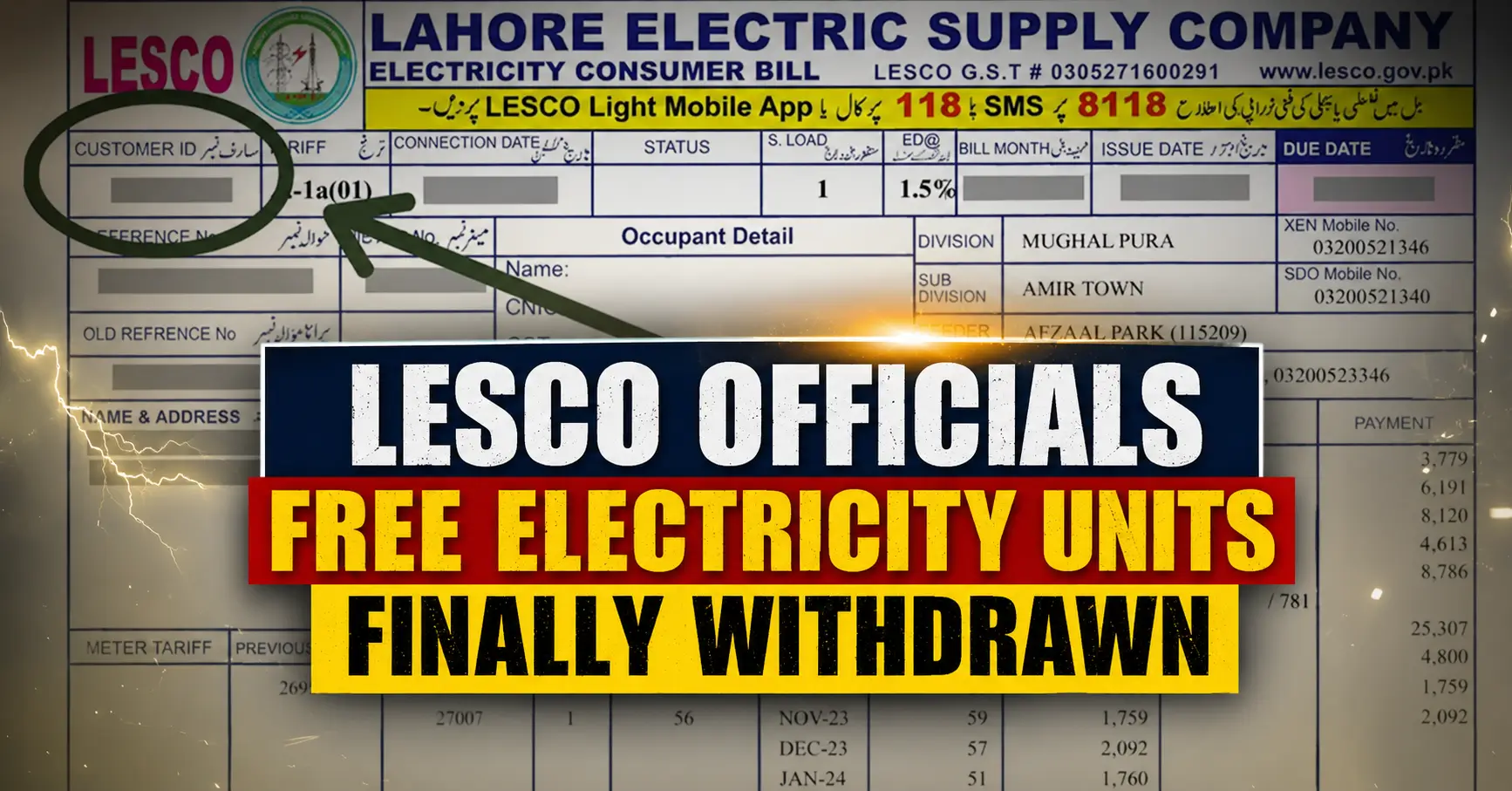

For the first time in decades, LESCO officials free electricity units withdrawn is no longer just a demand — it’s law. Grade-17 and above staff at the Lahore Electric Supply Company will now receive real bills, just like the millions of consumers they serve.
The change follows a landmark Lahore High Court ruling that closed the door on a perk power-sector employees had guarded fiercely since 1974. It’s a small but symbolic shift in a sector long accused of protecting its own.
What Actually Changed

LESCO officials free electricity units withdrawn became reality after the Lahore High Court dismissed a petition filed by the GEPCO Engineers and Officers Association. The court ruled that free electricity units were a service-related facility rather than a legal or fundamental right, meaning they could be modified or withdrawn through policy decisions.
Officers previously received between 450 and 1,300 free units a month depending on rank. The judgment confirmed that officers in grades 17 to 22 had been receiving between 450 and 1,300 free electricity units per month, and validated the government’s decision to end the benefit across WAPDA, DISCOs, GENCOs, NTDC, and PITC.
Background: A Perk Dating Back to 1974
The free-units culture wasn’t new. The facility was introduced in 1974 as a service benefit and remained in place for employees of corporatised power companies — DISCOs, GENCOs, NTDC, PITC, and WAPDA itself. Consumed units appeared on bills, while unused ones simply carried forward.
Pressure to end it built for years, especially as ordinary households struggled with soaring tariffs. The optics were hard to defend — power-sector staff paying little to nothing while everyone else absorbed fuel adjustments and surcharges.
How Much Officers Were Getting
Before monetisation, entitlements varied sharply by grade:
- Grade 17 officers: 450 free units per month
- Grade 18 officers: 600 free units per month
- Grade 19 officers: 700–880 free units per month
- Grade 20 to 22 officers: up to 1,300 free units per month
Officers from BPS-18 to 22 had previously received a combined 75 million units of electricity, with the annual cost estimated at Rs4 billion to Rs4.5 billion.
The Court’s Reasoning
Justice Malik Javed Iqbal Wains authored the verdict that settled the matter. He observed that officers in grades 17 to 22 had been receiving between 450 and 1,300 free electricity units monthly, and declared the withdrawal of the benefit lawful without any constitutional violation.
The petitioners had pushed back hard. They argued a 2023 notification had already replaced free units with a fixed allowance and claimed the benefit was contractually part of their employment terms, also alleging discrimination since Grade-1 to Grade-16 staff kept the perk. The court wasn’t convinced, ruling that courts cannot interfere in policy matters unless they are unconstitutional or unlawful, emphasising limits on judicial intervention in executive decisions.
What Officials Get Instead
This isn’t a straight cut with nothing in return. Under the new system, pay packets now include a fixed monetary allowance tied to previous entitlement levels — separate from the bill itself.
- Officers on 450 free units previously now draw an allowance close to Rs15,858 monthly
- Officers on 600 units get roughly Rs21,996
- Higher-grade staff on 700-plus units receive proportionally larger allowances
- The monetisation figure excludes 18% sales tax and other duties, meaning the compensation doesn’t fully offset the actual bill
Government’s Position

Power Division Minister Awais Leghari didn’t hold back after the verdict landed. He said the decision to discontinue free electricity units for senior officers was constitutional, and that the government welcomed the court’s dismissal of the challenge.
He framed it as overdue reform rather than punishment. According to Leghari, abolishing the facility was “a very old and long-standing demand of the people,” adding that it happened “for the first time in the history of Pakistan” under the current leadership. inary Consumers
LESCO, like other DISCOs, has been battling recovery shortfalls for years — a fact visible in its recent crackdown on installment plans and reconnections. Ending free units for officers, even if only partially, chips away at that internal drain.
It won’t fix circular debt overnight. The allowance replacing free units still costs the company money, and tax exemptions on that allowance mean the net saving is smaller than headlines suggest. Still, symbolically, it puts officials on the same billing system as the public they regulate.
Reactions From Employees and the Public
Not everyone inside the sector is happy. Officer associations across GEPCO, LESCO, and other DISCOs had resisted the change since it was first floated in 2023, arguing it altered long-standing service conditions without proper negotiation.
Public reaction, by contrast, has leaned firmly supportive. Years of viral bill comparisons — WAPDA staff paying a fraction of what regular households owe for similar consumption — had turned this into a recurring flashpoint on social media and in street protests over tariff hikes.
What Happens Next
The ruling closes the legal route for reversing the policy, at least for now. Free units for judges, parliamentarians, or retired employees — face similar scrutiny remains an open question that hasn’t gone away.
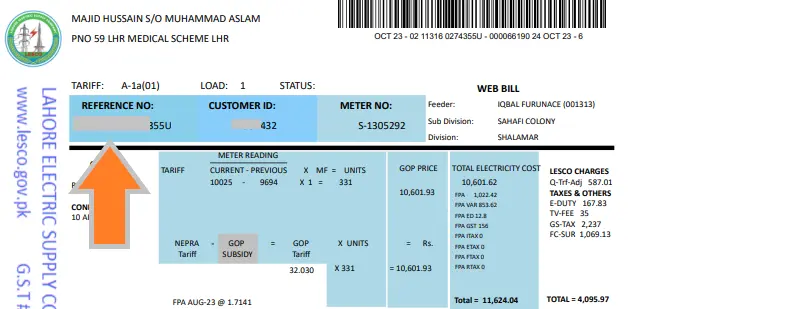
For now, LESCO officials will see the same reference numbers, the same due dates, and the same tax lines that every other consumer deals with each month.