
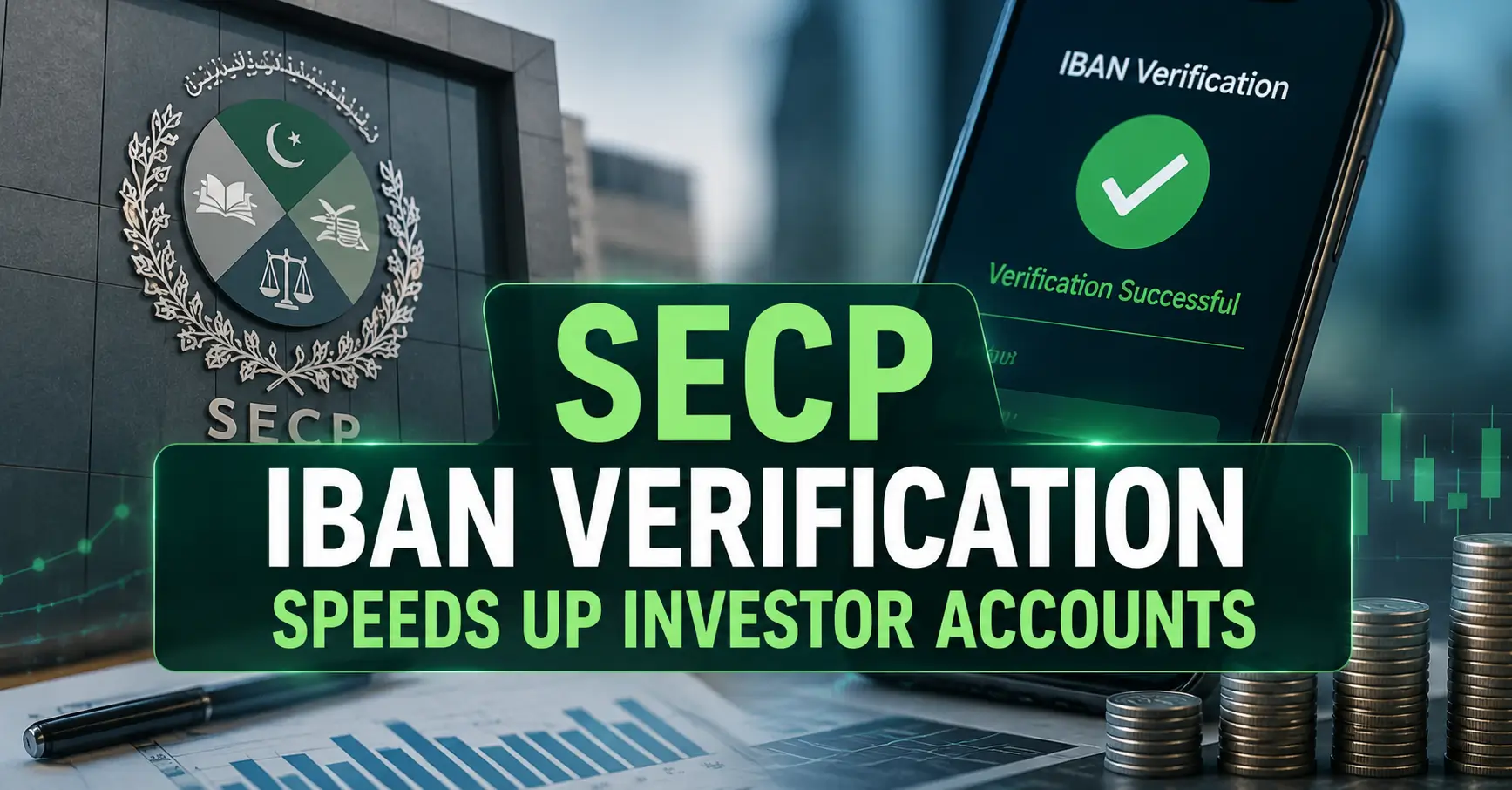

Opening a stock market account in Pakistan has meant one thing for years: a pile of scanned documents, repeated ID checks, and days of waiting. That changed this week.
SECP IBAN verification for investors is now live. The Securities and Exchange Commission of Pakistan has amended its Anti-Money Laundering Regulations 2020, allowing customers to be verified simply through their bank account’s IBAN details — no fresh biometric scan, no duplicate paperwork, every time they open a new financial account.
SECP IBAN Verification for Investors Replaces Old Paperwork Model

The SECP IBAN verification for investors framework was confirmed on July 11, 2026, under a fresh digital Know Your Customer system. It targets one specific pain point: repetition.
Until now, an investor verified by one bank still had to redo the entire process — CNIC copies, address proof, biometric checks — when opening an account with a broker or insurer. That duplication is gone.
- Brokers, insurers, NBFCs and Modaraba firms can now confirm identity through a customer’s registered IBAN
- No repeat biometric verification for new stock market accounts
- No resubmission of documents already on file with a regulated bank
What Changes for Brokers, Insurers and NBFCs
Regulated entities carry the compliance weight now, not the investor. SECP has been clear that brokers and asset managers remain fully responsible for due diligence, transaction monitoring, and AML compliance — the shortcut is procedural, not a loosening of oversight.
RED MORE: EWG Project Empowers Over 1 Million Women in Pakistan
Every transaction, going forward, must run through a customer’s own verified personal bank account. That single rule closes a gap that previously let money move through third-party or unverified channels with little traceability.
How IBAN Verification Actually Works
IBAN checks route through SECP-notified entities, chiefly the National Clearing Company of Pakistan Limited (NCCPL), using the Raast payment system for validation. It’s the same rail already used for instant bank transfers, repurposed here for identity confirmation.
- IBAN-linked accounts serve as valid proof of identity for onboarding
- Verification is instant, since it draws on data banks already hold
- E-wallets tied to a verified IBAN qualify under the same rule
Why SECP Moved Now — The Numbers Behind the Reform

This isn’t a reform happening in isolation. Investor accounts in Pakistan’s stock market rose a record 48% in the last fiscal year, according to SECP. Accounts increased to 583,052 by the end of FY2025-26, up from 392,775 a year earlier, with roughly 190,300 new accounts opened — the largest annual jump on record.
That growth skews young. Investors aged 18 to 30 accounted for 45% of new accounts opened between January and June 2026, while those aged 31 to 45 made up another 41%. A generation entering the market for the first time has little patience for repeat paperwork — and SECP’s data suggests it noticed.
- Sahulat Account investment limit raised to Rs 3 million from Rs 1 million
- Sehl Account limit raised to Rs 1 million from Rs 200,000 earlier this year
- SECP worked with PSX, NCCPL and CDC to design the onboarding reforms
Biometric Layer Still Stays in Place
Paperwork is lighter, but not security. The revised rules still fold in modern biometric checks, including facial recognition tied to NADRA’s systems, for cases where fresh verification is genuinely needed.
SECP Chairman Dr Kabir Sidhu said investment accounts linked to blocked NADRA identity cards can now be frozen immediately, framing the reform as making investing “safer, simpler and more transparent” rather than simply faster.
Expert and Regulatory Angle
The direction fits a pattern SECP has followed through 2026. In January, its circular on Sehl Accounts let asset management companies rely on identity checks already performed via NADRA Verisys or biometric verification, removing the need to repeat them.
In April, SECP signed MoUs with Askari Bank and NayaPay so newly registered companies could open corporate accounts almost instantly through eZfile integration — similar plumbing, applied to a different type of account.
Analysts tracking Pakistan’s capital markets have flagged financial inclusion as the throughline. Fewer verification steps mean lower friction for first-time, low-ticket investors — precisely the group driving the 48% account surge. It also aligns Pakistan’s onboarding process closer to markets where IBAN and API-based KYC checks are already standard practice.
What This Means for Small and Overseas Investors
For someone already banked in Pakistan, the practical effect is speed. A verified IBAN now does double duty — payments and identity — cutting out a step that used to add days to account opening.
- Existing bank customers can open brokerage or insurance accounts faster
- Overseas Pakistanis with verified local accounts benefit from reduced re-verification
- Smaller investors face fewer barriers to entering regulated Sehl and Sahulat accounts
This translates into another record year for new investor accounts will depend on execution — how quickly brokers and AMCs actually integrate with the IBAN verification system SECP has approved.
Do you think faster digital verification will be enough to bring more first-time Pakistani investors into the stock market, or do deeper structural barriers remain?