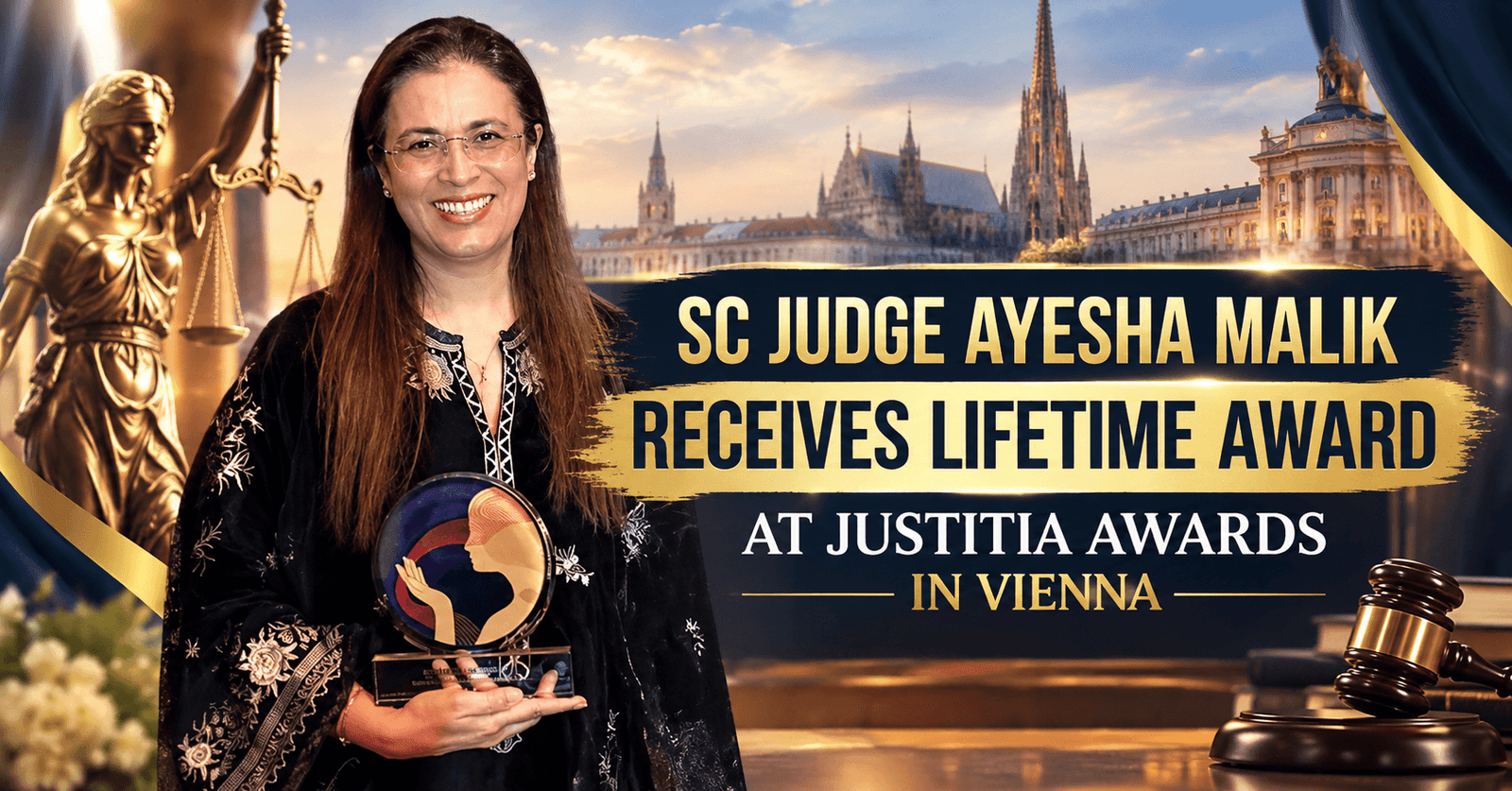

Justice Ayesha Malik has become the newest name on a very short list. The Supreme Court judge received the Justitia Award 2026 in the International Leader/Lifetime Achievement category, honoured at a gala in Vienna, Austria, for what organisers called her sustained contribution to law, justice, and gender equality.
The recognition places her among a small group of jurists worldwide singled out for shaping legal thought around women’s rights — and it puts Pakistan’s judiciary, briefly, at the centre of an international conversation usually dominated by European and North American courts.
What Is the Justitia Award and Why It Matters

The Justitia Award is presented annually by the Women in Law Initiative, an Austria-based network connecting female legal professionals across jurisdictions. The Lifetime Achievement category recognises what organisers describe as the most groundbreaking and innovative contributor of the year.
Winners are chosen through a nomination and shortlisting process open to peers worldwide. That structure matters: it means Justice Malik’s selection reflects visibility and respect built over years, not a single ruling or moment.
Justice Ayesha Malik Journey to the Supreme Court
Justice Ayesha Malik career trajectory is central to why this award landed where it did. She was appointed to the Lahore High Court in 2012, then elevated a decade later to become the first woman to sit on Pakistan’s Supreme Court, in January 2022.
READ MORE: Pakistan Needs Stronger Digital Infrastructure to Boost IT Sector: Shaza Fatima
That “first” is not incidental to the Vienna honour. Her rise through a male-dominated judicial hierarchy is precisely the kind of pathway the Justitia Award was designed to spotlight — representation translating into institutional influence.
Inside the Vienna Ceremony and Women in Law Conference

The award was conferred on 11 September 2026 at the Justitia Awards Gala, held at the Altes Rathaus — Vienna’s Old Town Hall — as part of the seventh Women in Law Conference running from 10 to 12 September.
The gathering pulled together judges, lawyers, and academics from multiple jurisdictions. Justice Malik also addressed a dedicated session, “Roadmap to Equality and Women’s Rights in Practice,” at the University of Vienna’s Faculty of Law on 11 September.
Key logistics of the event:
- Venue: Altes Rathaus, Wipplingerstraße 6/8, Vienna
- Conference dates: 10–12 September 2026
- Organiser: Women in Law Initiative, Austria
- Theme: “Women’s Rights are Human Rights: From Backlash to Equity 2.0”
Pakistan’s Third Justitia Laureate: A Growing Pattern
Justice Ayesha Malik is not Pakistan’s first Justitia laureate — she is its third, according to the Women in Law initiative in Pakistan. That repetition, over just a few years, suggests something beyond coincidence.
Pakistani legal professionals, particularly women, appear to be gaining sustained traction on this specific international stage. Each recipient has been recognised in a different award category, pointing to strength across multiple areas of legal practice rather than one narrow specialism.
Comparing Pakistan’s Justitia Award Winners
| Year | Laureate | Category |
|---|---|---|
| 2023 | Jalila Haider | International Game Changer |
| 2023 | Nida Usman Chaudhry | International Academia |
| 2026 | Ayesha A. Malik | International Leader/Lifetime Achievement |
The spread across categories — activism, academia, and judicial leadership — shows the recognition isn’t concentrated in one professional lane. It spans the full pipeline of legal careers open to women in Pakistan.
What Justice Malik Said About Gender and the Law
In her Vienna remarks, Justice Malik argued that equality on paper is not enough. She said the pursuit of equality must extend beyond formal legal guarantees and take into account the real contexts in which women experience and engage with the law.
She went further, stressing that legal principles and judicial institutions need to respond directly to women’s lived realities. She referenced aspects of her own jurisprudence dealing with dignity, equality, and the treatment of women within the justice system — tying her Vienna message to actual case law rather than abstract principle.
Her framing echoes a broader shift in comparative jurisprudence:
- Formal legal equality is treated as a starting point, not an endpoint
- Judicial reasoning is expected to account for lived, gendered experience
- Institutional design — not just statute — is scrutinised for embedded bias
Reactions From Pakistan’s Legal Community

News of the Vienna award travelled fast through Pakistan’s legal circles. Nida Usman Chaudhry, founder of the Women in Law Initiative Pakistan and herself a past laureate, marked the occasion publicly, tying it to the broader milestone of the conference’s seventh edition.
Women in Law Pakistan called the award a proud moment for the country. The reaction pattern — swift, public, and framed around national pride — signals that international legal recognition of this kind carries real domestic weight, not just symbolic value.
What This Recognition Means Going Forward
Justice Ayesha Malik Justitia Award lands at a moment when Pakistan’s judiciary is under regular international scrutiny, often for less flattering reasons. A lifetime achievement honour tied specifically to gender equality work offers a counter-narrative worth noting, without overstating its practical effect on case outcomes back home.
Awards recognise past contribution; they don’t guarantee future reform. That distinction matters for anyone tracking the actual pace of judicial gender parity in the country, rather than its ceremonial markers.
The gap between international recognition and domestic institutional change is where the real story usually lives — so what happens next, inside Pakistan’s own courtrooms, is worth watching just as closely as what happened in Vienna.