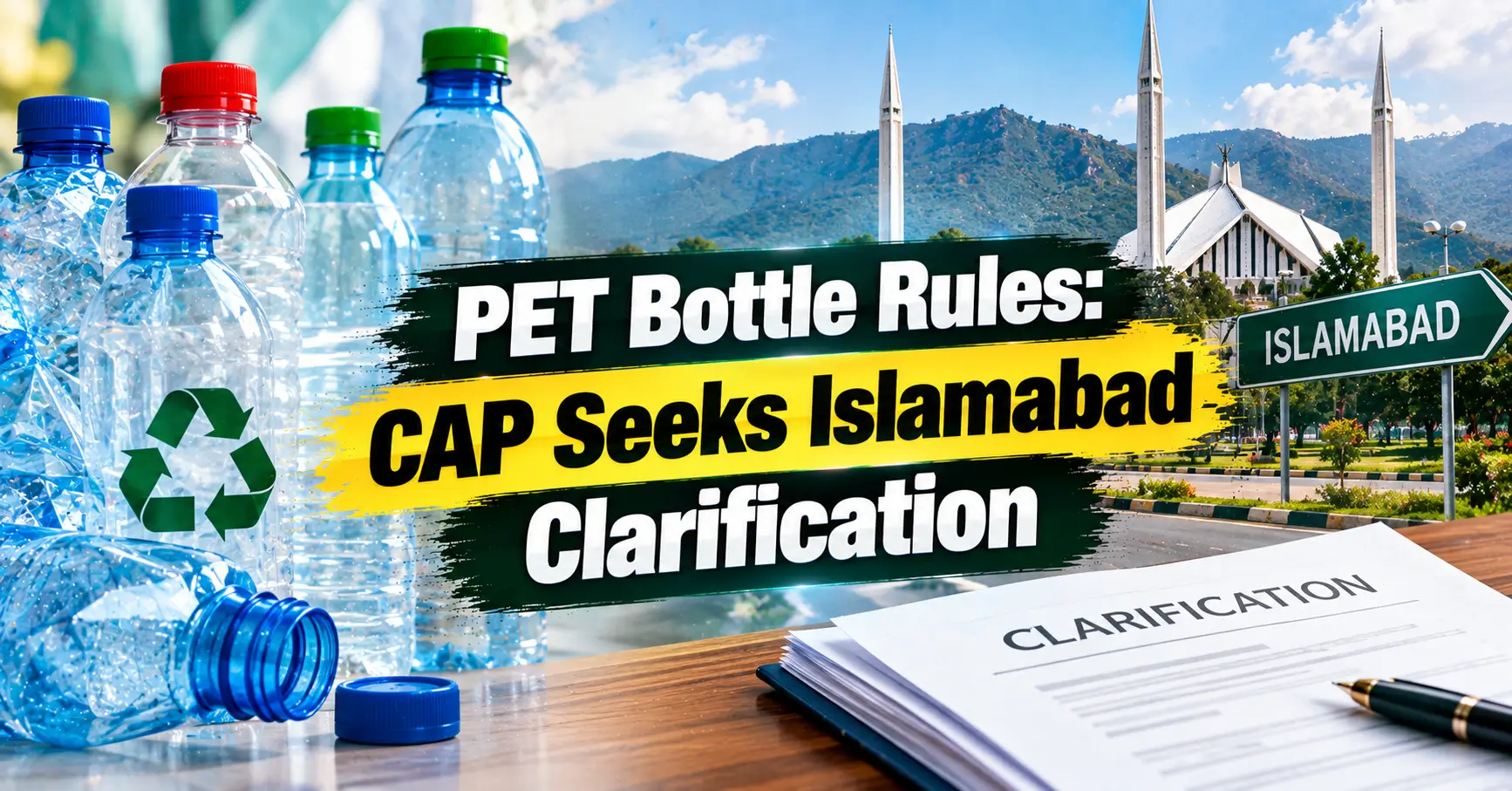

PET Bottle restrictions in Islamabad have triggered uncertainty among shopkeepers and consumers after authorities expanded their plastic-free campaign. The Consumers Association of Pakistan (CAP) is asking officials to clarify the legal position and prevent confusion over bottled beverages.
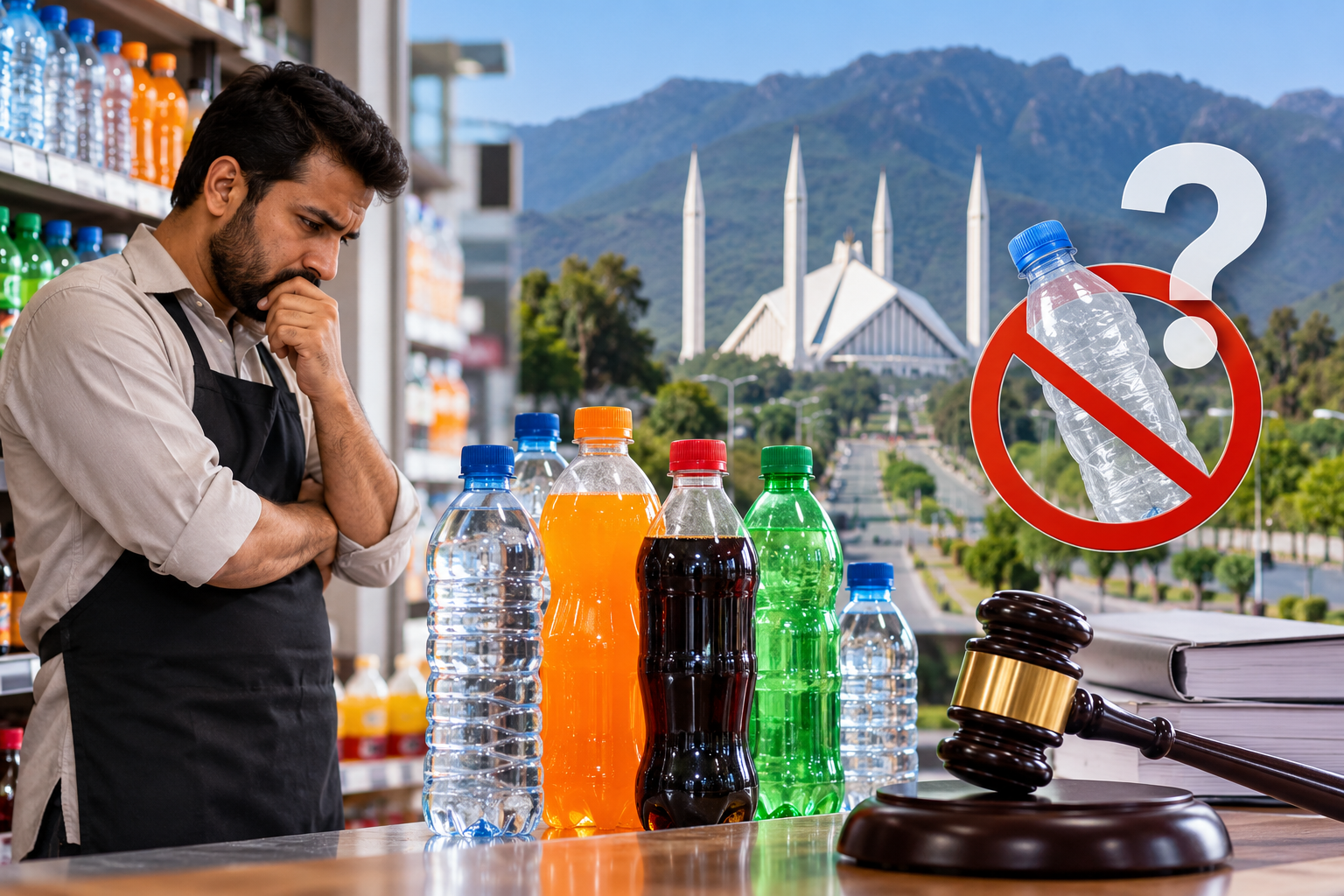
CAP Islamabad and North Pakistan Chapter Chairman Riaz Asher Siddiqui said some retailers had stopped stocking bottled water, juices and soft drinks as a precaution. The association argues that enforcement must follow clearly established legal provisions.
What the Islamabad Administration Announced
On October 12, 2026, the Islamabad district administration announced an expansion of its Plastic-Free Islamabad campaign to cover single-use plastic bottles. Enforcement operations were scheduled to begin on October 13, extending the initiative beyond plastic shopping bags.
The announcement followed a commitment by Minister of State for Interior Talal Chaudhry to make the capital plastic-free by December 31. However, the announcement’s broad wording about plastic products raised questions about whether beverage bottles were covered by existing regulations or a separate legal instrument.
What the 2023 Single-Use Plastics Regulations Say
The Islamabad Capital Territory Single-Use Plastics (Prohibition) Regulations, 2023, were notified under the Pakistan Environmental Protection Act, 1997. Regulation 3 prohibits specified single-use plastic items and separately addresses beverage containers made entirely from virgin plastic.
The distinction matters because the law does not treat every plastic product identically. Schedule I identifies prohibited categories, while Schedule II sets the timetable for restrictions on beverage containers. Any assessment of a blanket bottle ban must account for both provisions and their applicable dates.
The Difference Between Virgin and Recycled PET

Polyethylene terephthalate, commonly called PET, is used in beverage bottles. The regulations define plastic broadly enough to include PET, but that definition alone does not establish that every PET bottle is prohibited. The operative clauses and schedules determine the scope.
Reporting on the dispute says Schedule II provides for a minimum of 50% recycled content in beverage bottles from July 1, 2028. This future requirement is central to the disagreement over whether the existing framework supports recycling-based compliance rather than an immediate blanket prohibition.
| Issue | What the available evidence indicates |
|---|---|
Regulations | ICT Single-Use Plastics (Prohibition) Regulations, 2023 |
Enforcement campaign announced | October 12, 2026 |
| Reported enforcement start | October 13, 2026 |
Recycled-content milestone reported | July 1, 2028 |
| Outstanding issue | Whether a separate, legally effective order restricts retail sales |
The timeline and reported recycled-content milestone should not be confused with proof of a newly notified prohibition. The administration needs to identify the specific legal instrument, if any, supporting its enforcement action against PET-packaged beverages.
Why Pak-EPA’s Position Matters
The Pakistan Environmental Protection Agency has reportedly disputed the interpretation that existing regulations ban PET bottle outright. On October 15, according to subsequent reporting, agency official Dr Zaigham Abbas said there was no legal basis for removing these bottles from sale and that the administration had been informed.
READ MORE: Pakistan’s New Attestation System Goes Online
This position is significant because the 2023 regulations were issued by Pak-EPA with federal government approval. However, a reported statement is not a substitute for an official written clarification. The public needs the applicable notification, enforcement instructions and legal basis to be stated explicitly.
How the Confusion Is Affecting Retailers and Consumers

Retailers have reportedly stopped stocking some bottled beverages because they fear enforcement action. CAP says the uncertainty is inconveniencing consumers and creating apprehension among businesses that sell bottled water, juices and soft drinks.
The immediate concerns include:
- retailers can continue selling PET-packaged beverages.
- Which products, if any, are covered by enforceable restrictions.
- existing stock can remain on shelves.
- What instructions inspection teams must follow.
- penalties or shop closures can be imposed under a specific legal provision.
Without consistent instructions, shopkeepers may make precautionary decisions that affect product availability. Consumers, meanwhile, could face avoidable disruption even as the government pursues legitimate environmental objectives.
Industry Concerns Over Recycling and Economic Costs
Businesses and recycling stakeholders have challenged the reported restrictions, arguing that PET bottle support an established collection and recycling chain. The Collect and Recycle Alliance has described a blanket ban as potentially counterproductive, warning that it could undermine recycling activity and related livelihoods.
Industry representatives have also warned of substantial financial consequences. A report published on October 17 cited an industry estimate of at least Rs10 billion in potential federal tax revenue losses. This is an attributed estimate, not an independently verified assessment of actual losses.
The competing concerns require more than a simple choice between plastic use and prohibition. Effective policy needs clear compliance standards, workable alternatives, credible collection systems and consistent enforcement. Whether the current restrictions meet those requirements remains a matter for the authorities to clarify.
What Islamabad’s Administration Needs to Clarify
CAP has requested that Chief Commissioner Islamabad Lt. (Retd.) Sohail Ashraf issue clear instructions to officials and field staff. It has also sought a meeting with the administration and asked for no coercive action against retailers until an expert-level discussion clarifies the position.
The association’s chairman summed up its approach by saying, “Our request is for clarification, not confrontation.” The administration should respond by identifying the precise legal provisions being enforced, publishing any relevant written order and explaining how the rules apply to retailers and beverage manufacturers.
What Happens Next in the PET Bottle Dispute
The dispute remains unresolved in the available reporting as of October 19, 2026. A meeting involving government representatives and industry stakeholders was reported as inconclusive, with further discussions expected the following week. No subsequent written clarification was verified in the sources reviewed for this article.
A clear decision would help businesses understand their obligations while allowing environmental enforcement to proceed on a consistent legal basis. Until the administration publishes its position, the distinction between the announced campaign and the existing regulatory framework remains essential for consumers and retailers.