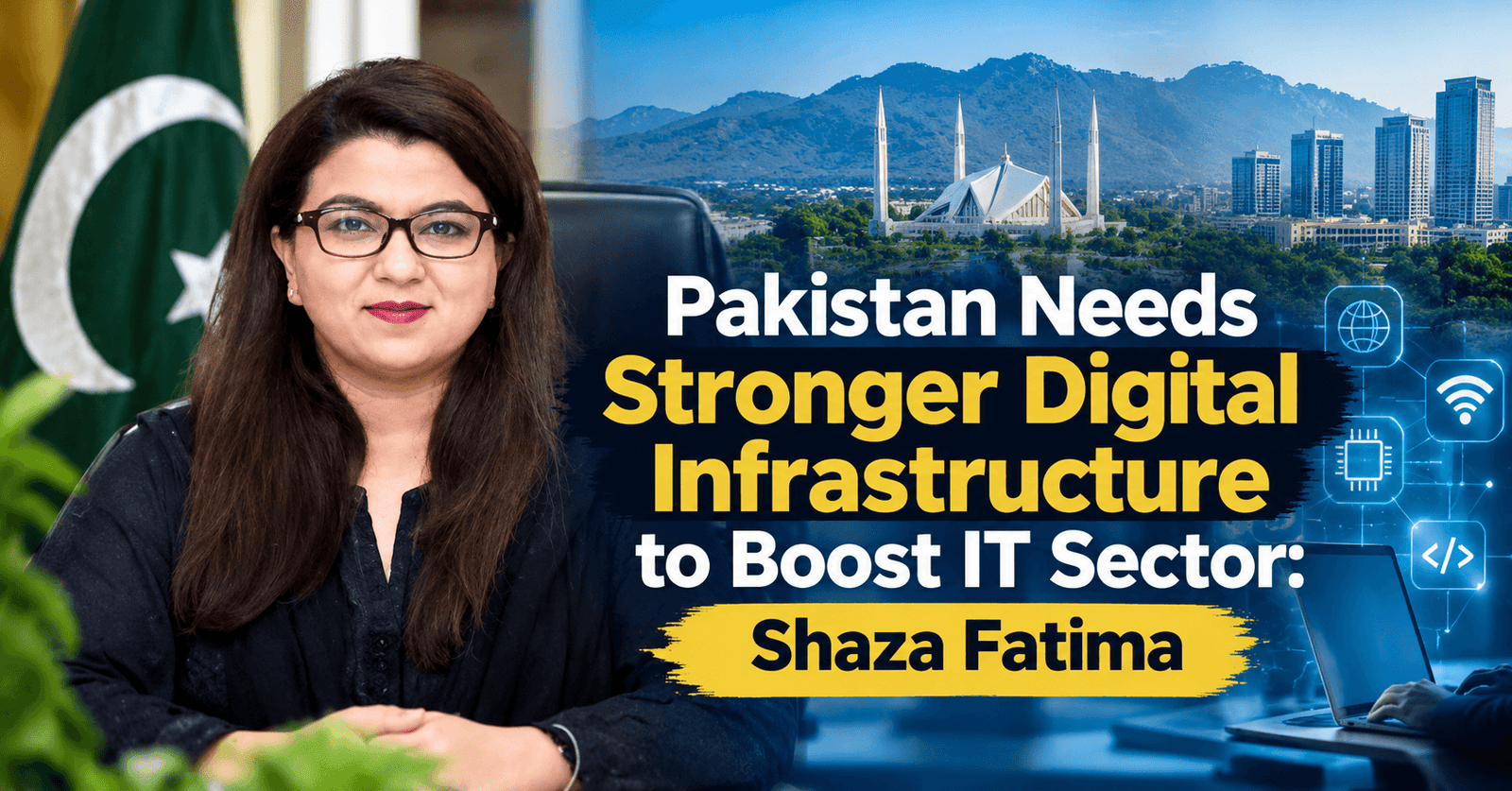

Pakistan’s digital infrastructure isn’t keeping pace with its ambitions. That was the blunt message from Federal IT Minister Shaza Fatima Khawaja over the weekend, delivered not in a press conference but in front of the very industry leaders whose businesses depend on faster fibre, cleaner spectrum and fewer internet outages.
Speaking at a thought-leadership session in Lahore, the minister laid out a case that was as much a warning as a roadmap: without fixing the basics of connectivity, Pakistan’s technology sector cannot compete globally — no matter how many policies are announced in Islamabad.
Pakistan’s Digital Infrastructure Push Takes Center Stage in Lahore

The venue was the Lahore University of Management Sciences, where the American Business Forum and LUMS jointly hosted a session titled “Taking Pakistan’s IT Industry to the Next Level.” It wasn’t a routine government briefing — academics, investors and founders shared the stage.
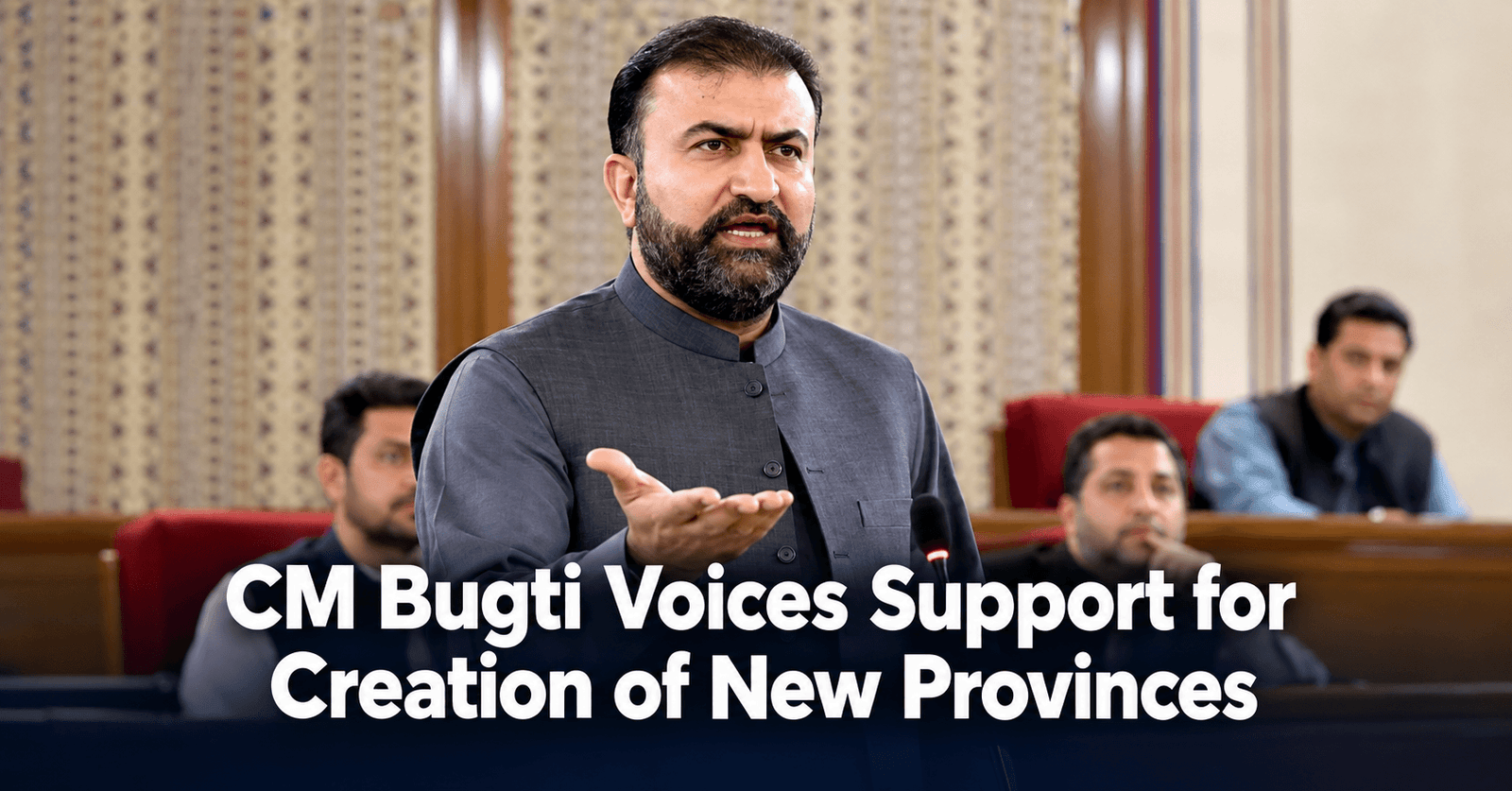
READ MORE: CM Bugti voices support for creation of new provinces
Khawaja used the platform to argue that fibre connectivity, mobile broadband, spectrum availability and satellite regulation together form the backbone the IT sector still lacks. She framed digital infrastructure not as a technical afterthought but as the precondition for investment.
What Shaza Fatima Told Industry Leaders at LUMS
The minister’s core argument was straightforward: opportunity exists, but the ecosystem around it is unfinished. She said improving digital infrastructure was essential for businesses to expand, attract capital and hold their own internationally.
On talent, she was equally direct. “The jobs are there. The opportunity is there,” she told the audience, before pointing to a much harder problem — that Pakistan simply doesn’t have enough people with the right skills to fill those roles.
Fibre, Spectrum and Satellite: The Building Blocks of IT Growth

What does “digital infrastructure” actually mean in practice? Officials have pointed to several concrete elements over recent months, and Saturday’s session tied them directly to export competitiveness:
- Fibre-based household connections rose from 1.9 million in 2024 to 5.1 million within two years, per the minister’s own testimony to the National Assembly in May
- Three submarine cables have landed in Pakistan in recent years, improving international bandwidth
- 5G has entered its rollout phase, with pilot services already active in parts of Islamabad
- Right-of-way charges were abolished under the National Fiberization Policy to speed up broadband rollout
Each of these feeds into the same goal: a technology sector that doesn’t lose money every time connectivity falters. Officials have separately flagged that mobile towers remain vulnerable to power outages, directly disrupting service for the roughly 98% of internet users who rely on mobile wireless broadband.
Skills Shortfall Exposed by National Employability Test
Infrastructure, however, was only half the minister’s message. The other half was uncomfortable reading for Pakistan’s universities. Khawaja disclosed results from a national baseline test given to around 33,000 seventh- and eighth-semester computer science students.
The test measured ten employability competencies. Only 0.4% of students scored above 80%. Roughly 4% cleared the 68% mark. Khawaja said this pointed to structural problems running from K-12 schooling right through to university curricula — not a talent shortage, but a training failure.
Chasing the $15 Billion IT Export Target
Pakistan’s official, long-term target is $15 billion in direct IT exports, alongside an additional $10 billion the government hopes to unlock through digital transformation programmes. Exports stood near $2.4 billion when the current government took office and have been climbing by roughly 20% a year since.
| Metric | Figure |
|---|---|
| IT exports at start of current government | ~$2.4 billion |
| Projected IT exports, current fiscal year | Over $4.5 billion |
| Annual export growth rate | ~20% |
| Official long-term export target | $15 billion (plus $10B via digital transformation) |
| Fibre-based household connections (2024 → 2026) | 1.9 million → 5.1 million |
Notably, in a separate address just a day earlier, Khawaja floated a far more ambitious $50 billion export figure, tying it to training 100,000 IT professionals who could each contribute toward that goal. The two numbers reflect different time horizons — a near-term milestone versus a long-range aspiration — but the gap has left some industry watchers asking which target the ministry is actually planning around.
Industry Voices Call for a Shift Beyond Freelancing

Government officials weren’t the only ones speaking. Umair Khan, Co-founder and Chairman of Folio3 and Founding Partner of Mentors Fund, argued Pakistan needs to outgrow its dependence on freelance work and build companies that can scale internationally.
He pushed for three specific fixes: stronger K-12 education, predictable taxation for tech firms, and deeper public-private partnerships. Dr. Syed Sohail H. Naqvi, Chairperson of Knowledge Streams, pushed back on the university-blame narrative directly, insisting “the logjam is in the jobs,” not just the classrooms.
Government’s Broader Digital Transformation Agenda
This session didn’t happen in isolation. It follows the Digital Nation Pakistan Act, which created the National Digital Commission and the Pakistan Digital Authority to give the country’s digital push institutional teeth rather than scattered policy announcements.
- Stewart Pakistan, represented by Director Operations Ahmed Azmat, has invested $1.3 million in a new office at the National NSTEP facility after 15-plus years operating locally
- Dr. Hadia Majid of LUMS’s Economics faculty highlighted freelancing and remote tech work as a route to higher women’s workforce participation
- The session was moderated by Dr. Ihsan Ayyub Qazi of LUMS’s Computer Science faculty
What It Means for Pakistan’s Tech Ecosystem
Taken together, the picture is one of a sector with real momentum but real bottlenecks. Export growth is genuine — nearly doubling in two years — but infrastructure gaps and a skills pipeline producing sub-1% top performers threaten to cap how far that growth can go.
The minister’s message to industry was essentially a trade-off acknowledgment policy alone won’t get Pakistan to $15 billion, let alone $50 billion. Fibre needs to reach further, spectrum needs freeing up, and classrooms need to catch up with what employers actually need.