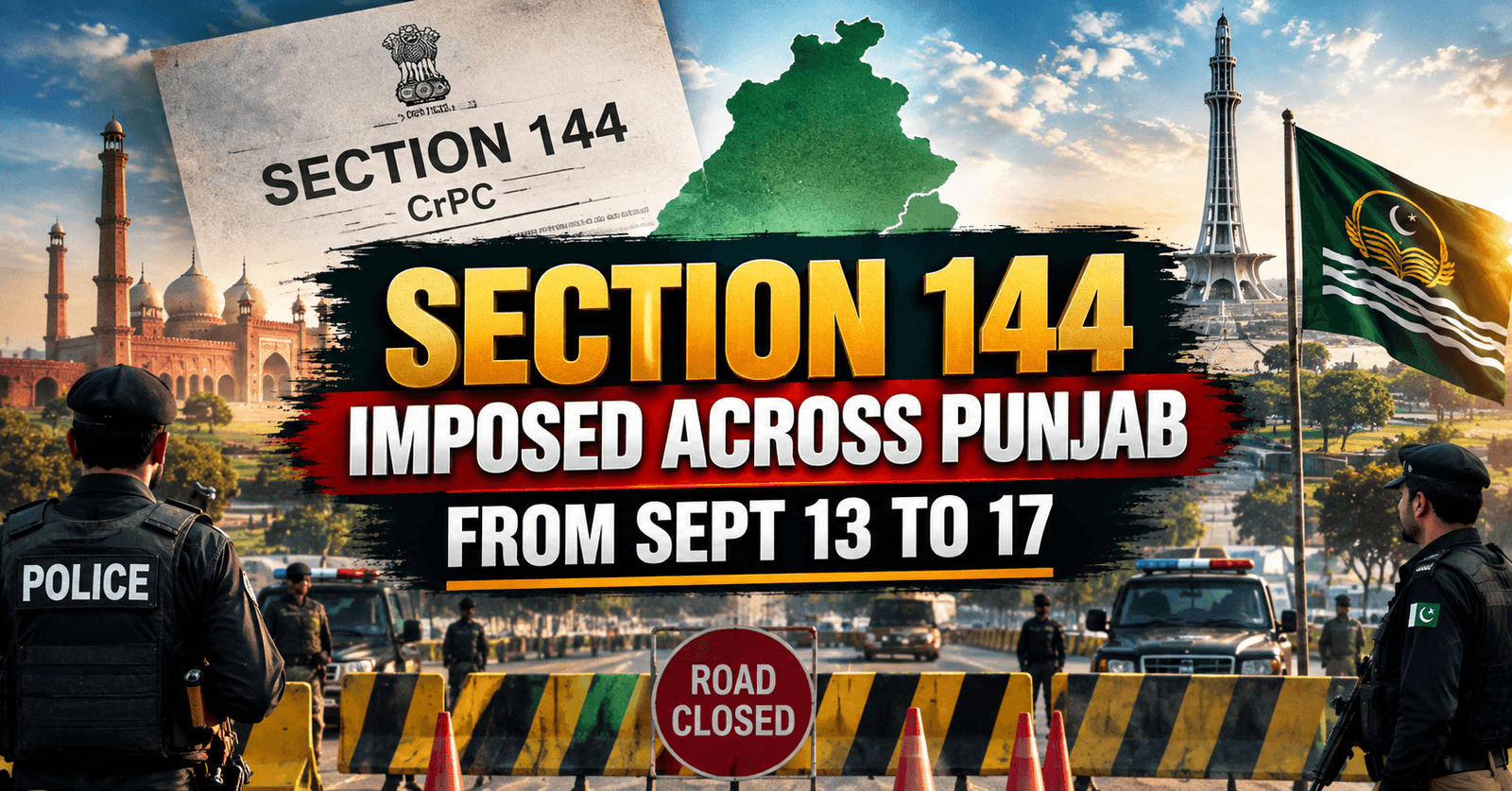

Section 144 Punjab restrictions took effect on September 13, sealing off public spaces across the province for five days. The order didn’t come with much warning. It came with a warning of a different kind — intelligence reports pointing to threats against public gatherings.
What the New Notification Says

The Punjab Home Department issued the order late on September 13, confirming that Section 144 Punjab rules will remain active until September 17. The notification bans assemblies of five or more people at any public place, highway, or open ground across the province.
Officials didn’t soften the language. The department said law enforcement and intelligence agencies had flagged “immediate security threats,” with reports suggesting proscribed terrorist organisations were eyeing public gatherings as targets. That’s a specific, urgent framing — not the routine boilerplate that sometimes accompanies these orders.
- Gatherings, processions, sit-ins and demonstrations are banned province-wide
- Carrying or displaying weapons in public places is prohibited
- Inciting others to join banned gatherings is a punishable offence
- The order runs under Section 144(6) of the Code of Criminal Procedure, 1898
What Section 144 Actually Is — And Why Punjab Keeps Reaching for It
Section 144 of the CrPC gives district and provincial authorities the power to restrict assemblies when there’s a perceived risk to public peace. It’s a colonial-era law, still very much alive in Pakistan’s legal toolkit, and Punjab has leaned on it heavily over the past two years — for elections, for Muharram, for political rallies, and now for a security threat that officials haven’t fully detailed publicly.
This isn’t the province’s first rodeo with blanket bans. Punjab imposed similar restrictions in June 2026 during Muharram, citing sectarian tensions, and has used the law repeatedly to manage political demonstrations. The recurring use raises a fair question: is this genuinely reactive, or has it become a default governance tool?
What’s Banned and What’s Exempted
Not everything grinds to a halt. The Home Department carved out specific exemptions, and they matter to anyone trying to figure out what’s actually allowed this week.
| Category | Status Under Section 144 |
|---|---|
| Public rallies, sit-ins, protests | Banned |
| Gatherings of 5+ people in open spaces | Banned |
| Carrying weapons in public | Banned |
| Wedding ceremonies | Exempted |
| Funeral prayers and burials | Exempted |
| Mosques and places of worship | Exempted |
That distinction is worth underlining. Daily life — weddings, funerals, religious observance — continues largely unaffected. It’s political and public assembly that’s frozen for five days.
Why This Order Comes Now

The timing matters. Officials say the trigger was “highly sensitive” intelligence pointing to a specific, near-term risk — not a generalised precaution. Law enforcement agencies reportedly requested the measure directly, which pushed the Home Secretary to invoke Section 144(6) with immediate effect rather than waiting for a scheduled review.
READ MORE: CM Bugti voices support for creation of new provinces
There’s no confirmed link to any political rally or planned protest in this instance, which sets it apart from several past orders that were explicitly timed around Pakistan Tehreek-e-Insaf demonstrations. This one reads as security-driven first, political second — though critics of repeated Section 144 use often argue the two motives are hard to fully separate in practice.
A Pattern, Not a One-Off

Look back over the last two years and a rhythm emerges:
- October 2024: Section 144 imposed across multiple Punjab districts ahead of PTI rallies
- February 2025: Province-wide restrictions tied to security threat assessments
- June 2026: Muharram-specific restrictions citing sectarian risk
- September 2026: Current order, citing terrorism threats to gatherings
Local district administrations, including Murree, have layered on their own restrictions too — Murree’s order also runs through September 17, with an added twist: Mall Road access during this window is limited to families, a measure aimed at crowd control in one of Punjab’s busiest tourist spots.
What It Means for Ordinary Citizens
For most residents, the practical effect is narrower than the headline suggests. Commuters, shopkeepers, and families attending weddings or funerals won’t notice much difference. The people most affected are those planning political events, public demonstrations, or large outdoor functions — all of which are off the table until September 17.
Legal action awaits anyone who organises or incites a banned gathering. That’s not an idle threat; Punjab police have enforced similar orders in the past with arrests and case registrations against violators.