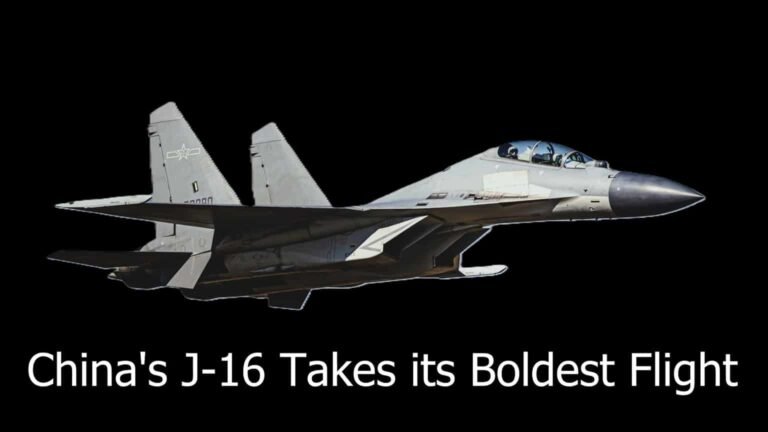

China’s J-16 Takes its Boldest Flight Straight into Rafale Territory. As Beijing sends its heaviest fighter jets thousands of kilometers from home to the air bases in Egypt. It becomes the first ever clash with French jet Rafale, turning a routine drill into a global curiosity.
A Fighter Jet Built for Distance and Firepower
The Shenyang J-16 has always been China’s best jet in the sky. It is a twin-seat and twin-engine strike jet, built on the Flanker bloodline. Pilots and analysts often call it the Hidden Dragon.
It normally flies on China’s east coast on the Taiwan Strait, and the South China Sea. This past week though it flew somewhere it had never gone before.
A 6,000-Kilometre Journey into New Territory
On August 21, a formation of J-16s touched down at an Egyptian air base. They had covered more than 6,000 kilometers across two continents. The flight took roughly nine hours from takeoff to landing.
This was no ordinary training flight. It marked the first time China had sent a heavyweight fighter to Egyptian air base. Officials framed the distance itself as the real message. Moving the best combat jets that far and that fast is not an easy task. Doing it successfully was meant to prove a point.
Enter the Rafale: A Historic First Encounter
The real story began once the J-16s landed. Egypt operates a growing fleet of French built Rafale jets. It also flies American F-16s, Russian MiG-29s, and Mirage 2000s. Few air forces manage that much variety on one runway.
During Eagles of Civilization 2026 joint training which was held on August 23, J-16s engaged Rafales in simulated combat for the first time on record. Neither air force disclosed exact locations or outcomes. That silence has not stopped defense watchers from debating who came out ahead.
China’s J-10 are Also Famous for Shooting Down Rafale
China’s J series jets are already famous around the world. China’s lighter Chengdu J-10 fighter drew global attention last year.
It performed really well against Rafales during the India-Pakistan conflict in 2025 shooting down multiple Rafales. This time the spotlight has shifted to the heavier and more advanced J-16.
Voices From the Cockpit and the Command Room
Chinese pilots who took part described the experience as valuable. “The joint exercises have provided a valuable platform,” said Ning Yiming a PLA Air Force pilot, describing the drills.
He also praised the discipline and coordination shown by Egyptian aviators throughout the training days.
Another PLA officer Shen Hao offered a broader view of where the partnership is heading. He said the exercises are moving beyond simple one on one dogfights. Both sides are now practicing more complex, coordinated combat operations together.
What did the Egyptian Side Say
On the Egyptian side, retired Major General Samir Farag offered a calmer, more measured reaction. He described Egypt’s broad web of military partnerships as routine.
“We benefit from them, and so do our partners,” he said, downplaying any deeper political signal. Rumours of Egypt eventually buying J-10C or J-35 aircraft have circulated for years, maybe after this event they buy some jets.
Why the Jet Matters Beyond One Exercise
The J-16 is more than a training curiosity for Beijing’s planners. Reports this year showed it carrying eight long range PL-15 missiles at once.
It has also been fitted with the even longer ranged PL-17 missile design. Alongside the stealthy J-20, it now forms the backbone of China’s air power.
Its dedicated electronic warfare version the J-16D also adds another layer of capability. That variant is built to jam enemy radar and protect strike formations from detection.
A Drill Watched Beyond Cairo’s Skies
The exercise unfolded against a tense regional backdrop, with conflict still shaking the Middle East. That timing gave the China Egypt drills extra weight in the eyes of observers worldwide. Training is due to continue for several more days before both air forces stand down.
For China, the message was about proving heavyweight jets can deploy far, fast, and reliably. For Egypt, it was one more partnership in an already crowded list.