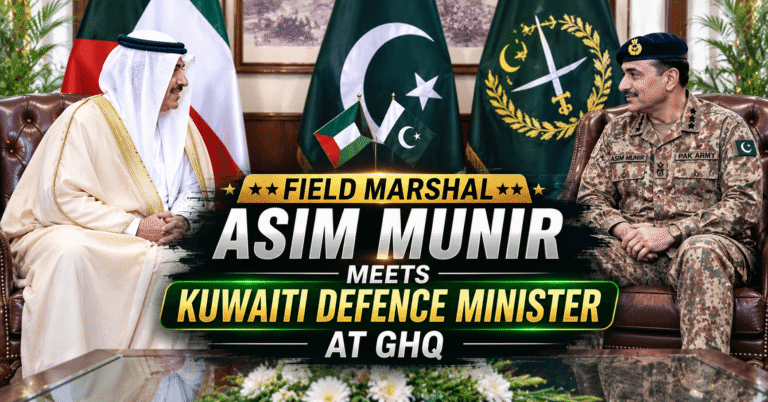

Asim Munir meets Kuwaiti Defence Minister Sheikh Abdullah Ali Abdullah Al-Saleem Al-Sabah at General Headquarters in Rawalpindi, in a visit that pushed Pakistan-Gulf security ties further into focus. The Field Marshal received the delegation in his capacity as Chief of Army Staff and Chief of Defence Forces.
The engagement, confirmed by the Inter-Services Public Relations (ISPR), came at a moment when Gulf states are recalibrating their security partnerships. It followed weeks of accelerating contact between Islamabad and Kuwait City on defence matters.
Key Highlights of the GHQ Meeting

According to ISPR’s official statement, the talks centred on regional security, institutional linkages and expanding practical cooperation between the two armed forces. Both delegations described the relationship as “brotherly,” a term Pakistani and Kuwaiti officials have used consistently through 2026.
Points raised during the meeting included:
- Reaffirming commitment to a “strong, enduring and mutually beneficial” defence partnership
- Discussing training, capacity building and border management support
- Reviewing the recently ratified 2023 Defence Cooperation Agreement
- Exploring joint military exercises and expertise exchanges
Who Was in the Room: Delegation Details
The Kuwaiti side was led by Sheikh Abdullah Ali Abdullah Al-Saleem Al-Sabah, accompanied by Lieutenant General Khalid Darj Saad Al-Shriaan, Chief of General Staff of Kuwait’s armed forces. Their presence signalled a military-to-military dimension, not just diplomatic courtesy.
READ MORE: Field Marshal Asim Munir: Pakistan’s First Chief of Defense Forces
On the Pakistani side, Field Marshal Syed Asim Munir hosted the delegation, while Defence Minister Khawaja Muhammad Asif separately met the visiting minister at the Ministry of Defence. The dual-track format reflected both civilian and military engagement.
Protocol Agreement 2026: What Was Actually Signed

Alongside the GHQ visit, Pakistan and Kuwait signed the Protocol Agreement 2026, expanding the framework built under the original 2023 pact. Khawaja Asif signed on Pakistan’s behalf during talks with the Kuwaiti minister in Rawalpindi.
Under the new protocol, Pakistan’s armed forces will assist Kuwait with:
- Military training and capacity building
- Border management support
- Other mutually agreed defence sectors
This moves the relationship from a general framework toward specific, actionable cooperation.
The 2023 Defence Cooperation Agreement
The base agreement was originally signed on June 11, 2023, in Kuwait, by Pakistan’s Ambassador Malik Muhammad Farooq and Kuwaiti Joint Planning Director Brigadier General Fawaz Khudair Muhammad Al-Harbi. Kuwait formally ratified it roughly a month before the August GHQ meeting.
| Provision | Detail |
|---|---|
| Signed | June 11, 2023, Kuwait |
| Ratified by Kuwait | Late July 2026 (Kuwait Al-Youm gazette) |
| Duration | Five years, auto-renewable |
| Oversight | Joint military committee |
| Scope | Training, intelligence sharing, logistics, defence technology, research |
Regional Security Context Driving the Visit

The timing is not incidental. Kuwait, along with other Gulf states, has faced heightened exposure during the prolonged Iran-linked regional conflict. Pakistan, meanwhile, recently joined a separate mutual defence arrangement involving Saudi Arabia and Türkiye.
Gulf states have grown increasingly cautious about relying solely on traditional Western security guarantees. Pakistan’s large standing military and indigenous fighter-jet production make it an attractive complementary partner for states like Kuwait seeking diversified defence relationships.
Pakistan-Kuwait Defence Engagements in 2026
The GHQ meeting was not an isolated event but part of a sustained diplomatic sequence through the year.
| Month | Engagement |
|---|---|
| July 2026 | Kuwait’s Foreign Minister visits GHQ, meets Munir and PM Shehbaz |
| Late July 2026 | Kuwait ratifies 2023 defence agreement |
| August 2026 | Kuwaiti Defence Minister signs Protocol Agreement 2026, meets Munir at GHQ |
What Officials Are Saying
Foreign Office spokesperson Tahir Andrabi earlier called the ratification “another important milestone” in a partnership dating to the early 1980s, built on “mutual trust, shared interests and close institutional cooperation.”
ISPR’s readout on the GHQ visit noted the Kuwaiti delegation praised the “professionalism and operational capabilities” of Pakistan’s armed forces, alongside their contribution to regional peace and stability efforts across the wider Gulf region.
What It Means Going Forward
For Pakistan, deepening Gulf defence ties offers both strategic weight and potential economic dividends, particularly around training exports and joint manufacturing. For Kuwait, it diversifies a security posture under regional strain.
The Protocol Agreement 2026 gives the relationship concrete deliverables rather than diplomatic language alone. Whether training programs, border-management support and joint exercises materialise on schedule will be the real test of this partnership’s depth.