
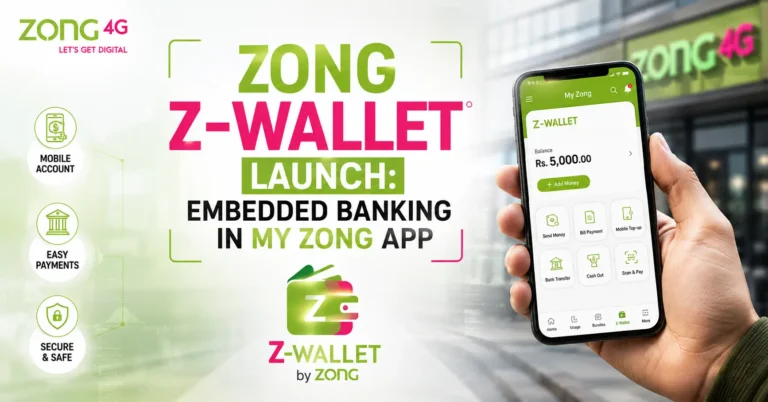

Zong and Zindigi Launch Z-Wallet: Embedded Banking Comes to Millions of My Zong App Users
Zong Z-Wallet is now live, and it changes how millions of Pakistanis will handle everyday money matters — without ever leaving their telecom app. The country’s largest mobile network operator has partnered with Zindigi, JS Bank’s digital banking arm, to embed regulated financial services directly inside the My Zong App (MZA).
For a market where mobile wallets have had a bumpy history, this launch is being watched closely. It’s not just a new feature. It’s a bet on a different business model entirely.
What Is Z-Wallet? Zong and Zindigi’s New Embedded Banking Push

Zong Z-Wallet is a digital wallet built into the My Zong App, powered entirely by Zindigi’s Banking-as-a-Service infrastructure. Zong, described as Pakistan’s leading technology services enterprise, partnered with Zindigi, powered by JS Bank, to launch the wallet through an embedded-finance model.
This isn’t Zong holding a banking license. The service runs under Zindigi’s regulated infrastructure, operating within the State Bank of Pakistan’s regulatory framework, meaning Zong supplies the interface while JS Bank carries the compliance weight.
Key Features of the Zong Z-Wallet Inside My Zong App
Zong Z-Wallet users get a genuinely functional banking layer, not a gimmick. With more than 22 million monthly active users on My Zong App, customers can access essential banking services within an app they already use, skipping a separate download.
Core features include:
- Interbank fund transfers to any bank in Pakistan via RAAST
- Utility and internet bill payments
- Mobile top-ups and bundle purchases
- Wallet-to-wallet and QR payments, plus a co-branded debit card for ATM withdrawals and online or offline shopping
- Single login and PIN access across services
All transactions sit inside one interface, which is the entire point of embedded finance — reducing friction, not adding another app to manage.
From PayMax to Z-Wallet: Zong’s Rocky Road Back to Fintech

Zong Z-Wallet isn’t Zong’s first attempt at mobile finance, and the earlier one didn’t end well. In October 2023, Zong surrendered its Electronic Money Institution license and shut down TimePay, later rebranded PayMax.
That failure stung. PayMax was one of only four companies holding an EMI licence, yet it exited the market less than a year after launch, with the company never publicly explaining why. Falling margins on debit card transactions, heavy regulatory overhead, inflation, and rupee depreciation all piled on the pressure.
How the Zindigi-Zong Partnership Actually Works
This time, Zong Z-Wallet sidesteps the licensing burden that sank PayMax entirely. Z-Wallet is offered by CMPak but powered by JS Zindigi, meaning Zong carries no payments licence, no capital requirements, and no direct regulatory exposure.
READ MORE: World’s Highest ATM Sits at Khunjerab Pass, Pakistan
The tradeoff is control. Zong controls a feature inside its own app rather than an entire product roadmap, and every transaction operates under JS Bank’s branchless banking framework. The roots go back further than this week’s announcement, too. My Zong App users could already open JS Zindigi wallet accounts within the app under a partnership signed in March 2024.
Who Can Open a Z-Wallet Account

Eligibility for Zong Z-Wallet is deliberately simple, matching the app’s mass-market user base. Any Zong customer with a valid CNIC and an active mobile number can open a Z-Wallet, subject to verification.
Onboarding is fully digital, but security checks remain strict. Customers complete account opening directly from the My Zong App through a simple digital onboarding and KYC process, and biometric verification may be required as per SBP regulations. Account upgrades follow a similar path through an agent or the Zindigi app itself.
Industry Voices: What Zong and Zindigi Are Saying
Zong’s leadership frames Z-Wallet as part of a broader identity shift. Sajid Munir, Head of Marketing at Zong, said the launch expands Zong’s digital product portfolio into financial services, building an integrated ecosystem and creating new avenues for digital inclusion.
He tied the move to Zong’s parent-company backing too. Munir said combining China Mobile’s global technology expertise with Zindigi by JS Bank’s financial capabilities brings connectivity, technology and finance together on one digital platform. It’s a line that signals ambition well beyond telecom.
What This Means for Pakistan’s Digital Finance Race
Zong Z-Wallet lands in a crowded field already dominated by JazzCash and Easypaisa, both years ahead in market penetration. Zong’s own initiative frames this as another step in the company’s transformation from a traditional telecom operator into a broader technology services enterprise.
The asset-light structure matters strategically, too. By leaning entirely on Zindigi’s licence rather than chasing its own EMI status again, Zong avoids repeating the PayMax mistake — but it also means long-term product decisions aren’t fully in Zong’s hands. Whether that tradeoff pays off will depend on adoption numbers over the next few quarters, not the launch headlines.
For everyday users, the appeal is straightforward: one app, one login, and access to RAAST transfers, bill payments, and a debit card without hunting for a separate banking app.