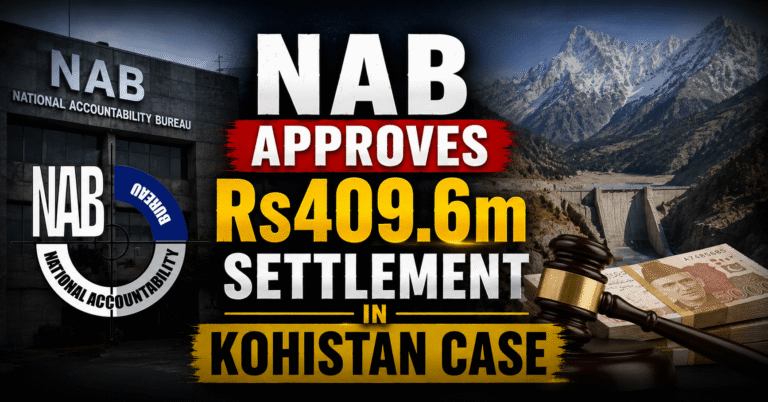

The NAB Kohistan settlement count has grown again. The National Accountability Bureau has approved a fresh settlement request worth Rs 409.6 million, adding another chapter to what officials now call the largest financial scandal in Khyber Pakhtunkhwa’s history.
The approval comes as NAB continues clawing back money from a scheme that investigators say drained more than Rs 37 billion from Upper Kohistan’s development budget — a district whose entire annual allocation runs under Rs 500 million.
What the Latest Settlement Involves

NAB Khyber Pakhtunkhwa chapter confirmed the settlement request was processed under Section 25(B) of the National Accountability Ordinance, 1999, the same provision used across earlier deals in this case. The applicant sought to clear their liability through voluntary surrender of assets rather than face prolonged trial.
Key details of this settlement:
- Amount approved: Rs 409.6 million
- Legal basis: Section 25(B), NAB Ordinance 1999
- Next step: referral to an accountability court in Peshawar for formal confirmation
- Standard consequence: disqualification from holding public office under Section 15 of the Ordinance, once the court ratifies the deal
Once confirmed by the court, the accused typically walks free from custody — provided they aren’t wanted in any other case — while the surrendered assets move toward the national treasury.
The Rs 37 Billion Kohistan Scandal: A Quick Background

The scandal traces back to an inquiry NAB authorised in 2024, which uncovered large-scale misappropriation of public funds in Upper Kohistan, with investigators establishing that more than Rs37bn had been embezzled through manipulation of treasury instruments and misuse of official financial procedures over nearly a decade.
READ MORE: Pakistan security forces kill seven Fitna al-Khawarij in Balochistan
Investigators say the fraud ran through a well-oiled machine of fake contractors, benami bank accounts, and forged treasury cheques. Officials from the Communication and Works Department, the District Accounts Office, and even a National Bank of Pakistan branch in Dasu are accused of colluding with private contractors to siphon funds meant for civil works that were never carried out.
How NAB’s Plea Bargain Process Works

For readers unfamiliar with Pakistan’s accountability framework, the plea bargain mechanism deserves a plain explanation. It isn’t a pardon — it’s a negotiated recovery tool.
- The accused files an application admitting liability and offering to return assets, cash, or property.
- NAB’s chairman must personally approve the request before it moves forward.
- An accountability court then reviews the agreement to confirm it was made without coercion.
- Once ratified, the accused is released from criminal liability for that specific case — but loses eligibility for public office.
This process explains why the Kohistan case has produced a steady stream of settlements rather than a single mass trial. NAB has favoured negotiated recovery because litigation across dozens of accused would likely take years, while plea bargains return money to the treasury faster.
A Running Tally: Settlements in the Kohistan Case So Far
The Rs 409.6 million approval fits into a much larger pattern of recoveries. Here’s how it stacks up against other confirmed settlements in the same case:
| Accused | Role | Settlement Amount | Status |
|---|---|---|---|
| Muhammad Ayub | Contractor | Rs 3.86–3.92 billion | Court-approved |
| Mumtaz Khan | Contractor/frontman | Rs 4 billion | Court-approved |
| Qaisar Iqbal | C&W head clerk (alleged mastermind) | Rs 1.235 billion (assets surrendered) | Ongoing |
| Sartaj Khan | Contractor | Rs 220 million | Court-approved |
| Jibran Malik | Construction firm owner | Rs 49.125 million | Court-approved |
| Latest accused | — | Rs 409.6 million | NAB-approved, pending court |
Beyond individual deals, NAB says assets recovered through plea bargains were worth over Rs10bn across the case as a whole, with total frozen assets exceeding Rs 27 billion. Six accused had already entered plea bargain agreements worth a combined Rs 8.43 billion as of late May 2026, according to NAB’s own figures.
Legal Consequences for the Accused
Settlement doesn’t mean the accused walks away clean. Along with surrendering assets, every confirmed plea bargain in this case has carried the same standing penalty:
- Permanent disqualification from holding public office
- Forfeiture of all surrendered property to the state
- No right to reclaim assets once the court ratifies the deal
- Continued exposure if linked to any other pending case
Judge Muhammad Zafar, who has presided over most Kohistan hearings, has repeatedly required accused individuals to affirm in court that their settlement was reached freely, without pressure or coercion — a standard procedural safeguard before any bargain is finalised.
What This Means for Public Accountability in Pakistan
The steady drip of settlements — now well past a dozen — reflects both progress and unfinished business. NAB has recovered billions, but the pace of individual plea bargains also means most accused avoid a full public trial, a trade-off that continues to divide legal opinion in Pakistan.
For a district with an annual budget under half a billion rupees, the scale of alleged theft remains staggering. Recovery through negotiated settlements delivers real deterrence, or simply lets well-connected accused buy their way out of prosecution, is a question likely to follow this case long after the last settlement is signed.