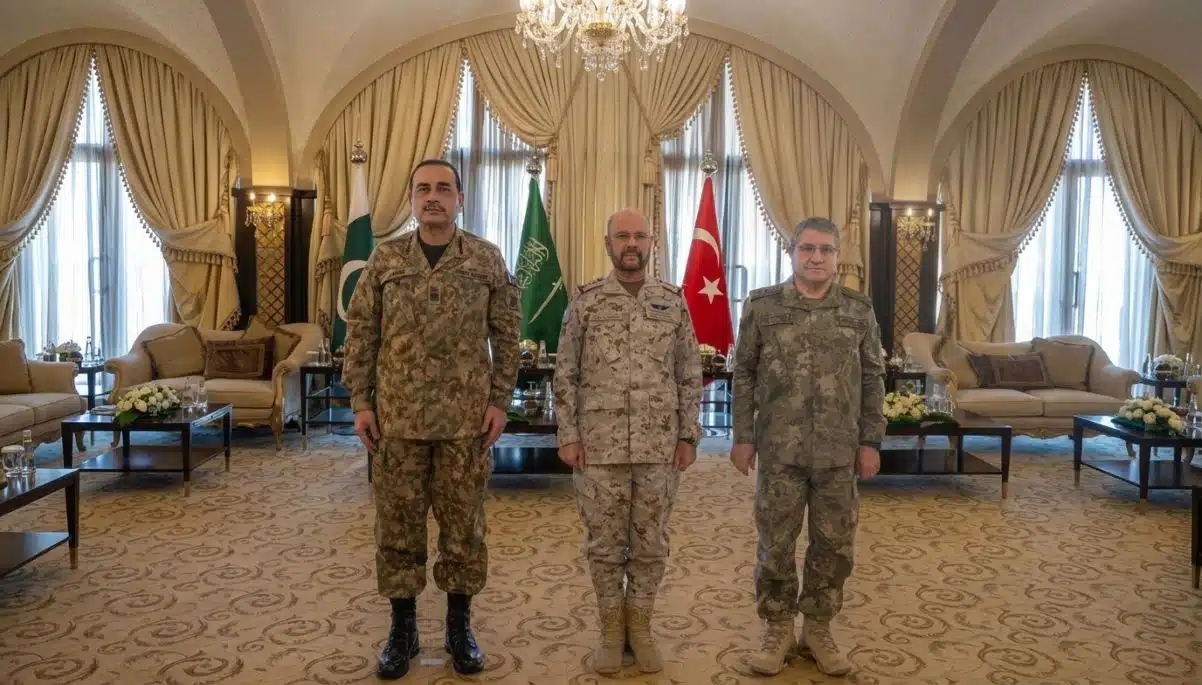

A landmark defence pact just took its first real step toward becoming something more than a signed document. On Friday, the top military chiefs of Pakistan, Saudi Arabia, and Turkiye sat down together in Riyadh, marking the first time since the Makkah Joint Defence Agreement was signed that the three countries armed forces leadership met to discuss turning words into action.
For an alliance that combines a major oil exporter, one of NATO’s largest armies, and the only nuclear-armed Muslim nation, this meeting carried weight well beyond a routine diplomatic photo opportunity.
Who Attended and What the Meeting Covered
According to Pakistan’s ISPR, the gathering brought together Field Marshal Asim Munir, Turkish Chief of General Staff General Selcuk Bayraktaroglu, and Saudi Arabia’s Chief of General Staff General Fayyadh bin Hamed Al-Ruwaili.
ISPR confirmed the core purpose of the meeting directly, stating that participants reviewed the security situation and threats currently facing Saudi Arabia. The statement described the session as reflecting the three militaries’ “resolve to strengthen the defence partnership,” which suggests this was meant as a working session rather than a purely symbolic gathering.
Beyond reviewing threats, the military chiefs also addressed recent violence head on. They strongly condemned attacks targeting the holy city of Makkah, along with civilian and economic infrastructure more broadly.
The Key Outcome: Turning Words Into Action
The single most significant line from this meeting was arguably the commitment to immediate follow through. According to ISPR, the three military leaders “agreed to immediately translate the Makkah agreement into practical and effective military cooperation.”
That emphasis on immediacy matters more given how these kinds of regional defence pacts have historically struggled. Similar arrangements throughout the region’s history, including older Arab League and Gulf Cooperation Council defence agreements, have often looked impressive on paper while delivering considerably less in actual military coordination when tested.
The statement also emphasized something less tangible but still meaningful. Participants “commended the longstanding relations and mutual trust that bind the people and the armed forces of the three countries,” framing this military cooperation as an extension of decades of existing goodwill.
How This Meeting Fits the Bigger Diplomatic Picture
This Riyadh gathering did not happen in isolation. It followed shortly after a separate meeting in New York, where Pakistan’s Deputy Prime Minister and Foreign Minister Ishaq Dar met with his Saudi and Turkish counterparts, Prince Faisal bin Farhan and Hakan Fidan, on the sidelines of the UN General Assembly.
Pakistan’s Foreign Office had actually flagged the possibility of this military chiefs’ meeting beforehand, noting in an earlier statement that the Makkah agreement, originally signed on August 7, stipulates that an attack against any single member should be treated as an attack against all three nations.
That New York meeting between foreign ministers reportedly also condemned, in the foreign ministry’s own words, attacks targeting Makkah and civilian infrastructure in similarly strong terms.
It is worth remembering the broader context driving all of this activity. The Makkah agreement itself emerged from a period of serious regional alarm, following both the Hamas attacks of October 2023 and the escalating US-Israel-Iran conflict that began earlier this year.
Pakistan’s Foreign Office has previously described the pact as “purely defensive” in nature and explicitly not directed against any third country, a characterization officials have repeated consistently since the original signing ceremony in Makkah back in August.
Questions That Still Remain
Despite Friday’s meeting of unity, some genuine uncertainty still surrounds how deep this cooperation will actually run in practice. During the first phase of the US and Israel’s conflict with Iran, Pakistan reportedly did not come to Saudi Arabia’s direct aid despite their existing bilateral defence agreement, and even helped Iran route trade around a US naval blockade through shared land corridors.
That history raises fair questions about how far military coordination under this newer, three-way Makkah pact will genuinely extend once real conflict pressure returns. Friday’s meeting, with its emphasis on moving “immediately” toward practical cooperation, appears as an important step taken.
Three of the Muslim world’s most militarily capable nations sitting together, publicly reaffirming mutual defence commitments while explicitly condemning attacks on Islam’s holiest city, sends a clear signal regardless of how the operational details eventually unfold.