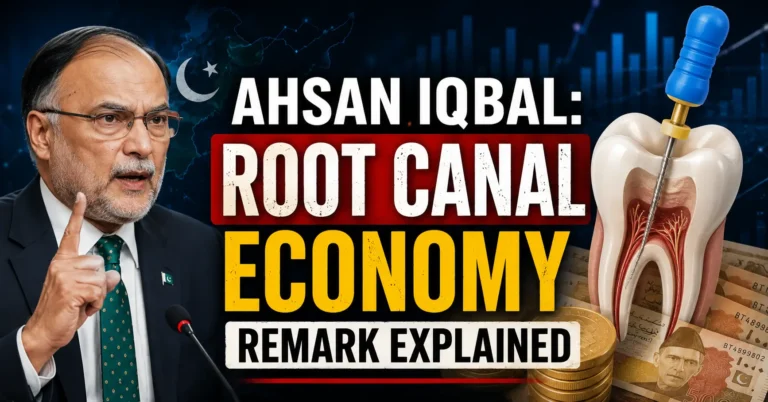

Ahsan Iqbal root canal economy remarks have set off a fresh round of debate over how far Pakistan has actually come since the 2022 near-default scare. Speaking at a dental conference on Friday, the Planning Minister chose an unusual metaphor to describe years of economic pain and stabilization.
What Did Ahsan Iqbal Say About Pakistan’s Economy?

Federal Planning Minister Ahsan Iqbal told delegates that the coalition government had performed the “best root canal” on Pakistan’s economy, restoring stability after conditions inherited in 2022 had pushed the country close to default.
He was addressing the first international dental conference organized by Shaheed Zulfiqar Ali Bhutto Medical University. Iqbal framed the 2018–2022 period as the source of damage requiring urgent economic treatment, drawing a direct line between fiscal mismanagement and dental decay.
The Root Canal Analogy Explained
The Ahsan Iqbal root canal economy comparison wasn’t accidental — it was built for the audience. He compared the damage done to Pakistan’s economy to teeth harmed by excessive sweets, arguing both problems stem from short-term indulgence.
- Excessive borrowing and unsustainable subsidies = “sugar” damaging the economy’s roots
- Stabilization measures since 2022 = the “root canal” procedure
- Restored investor confidence = the economy “smiling again”
- Ongoing political opposition = risk of relapse without continued care
Pakistan’s Economic Journey: From Default Risk to Recovery
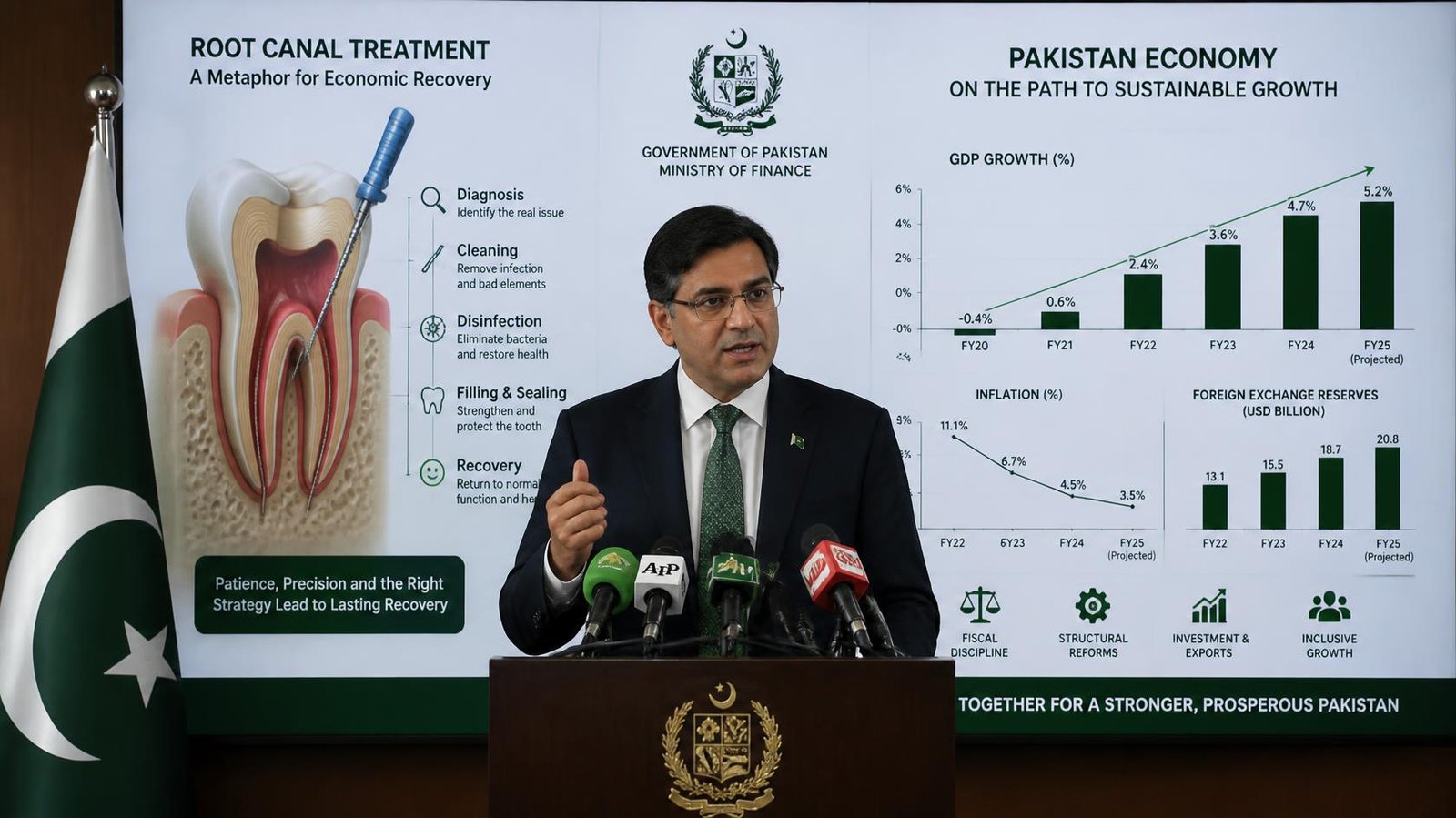
Iqbal’s remarks referenced a period widely seen as Pakistan’s most precarious in decades. By mid-2022, reserves had fallen sharply, inflation was climbing, and default speculation dominated financial headlines both locally and internationally.
READ MORE: Fourth Wall Studios English Theatre PNCA August 2026
Since then, the government has pointed to reserve rebuilding, a calmer currency, and IMF program compliance as evidence of recovery. Iqbal reiterated that this progress now faces political opposition, urging continued focus on long-term economic strengthening.
Key Economic Timeline at a Glance
| Period | Situation Described by Govt |
|---|---|
| 2018–2022 | Policies created serious economic challenges, per Iqbal |
| 2022 | Pakistan pushed close to default |
| 2022–2026 | Stabilization measures implemented |
| 2026 | Iqbal claims confidence “restored”; recovery faces opposition |
| By 2035 | Target: $1 trillion economy via Uraan Pakistan |
Uraan Pakistan and the $1 Trillion Economy Target
Central to Iqbal’s pitch is Uraan Pakistan, the government’s flagship growth initiative. He said the program aims to transform the country into a $1 trillion economy by 2035, a target he has repeated at multiple forums this year.
The plan runs on what officials call the 5Es framework: exports, e-Pakistan, environment and climate change, energy and infrastructure, and equity and empowerment. Officials elsewhere have suggested growth could stall near $600 billion without deeper reform.
Political and Public Reaction
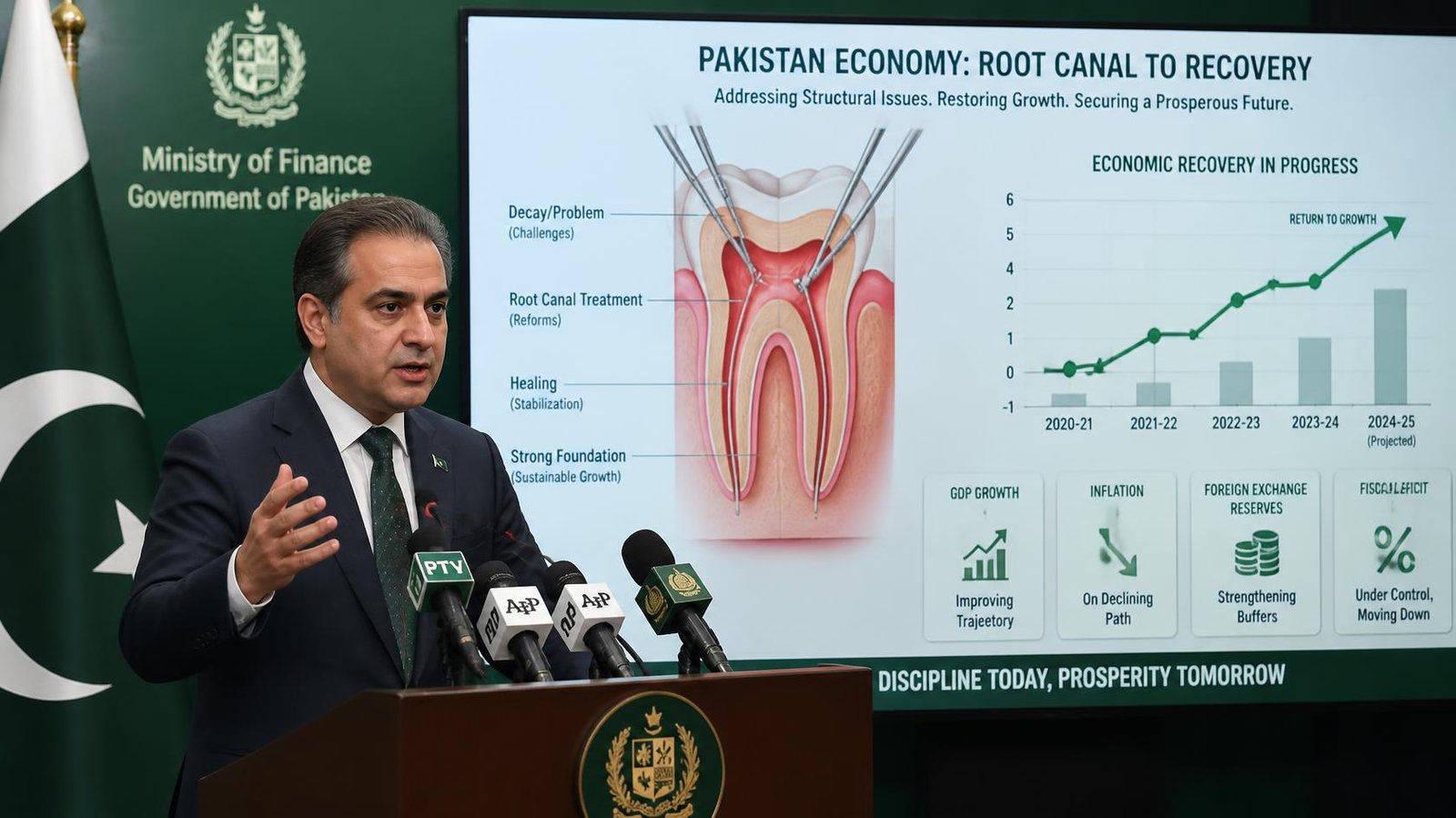
Not everyone is convinced by the dental metaphor. Public reaction following the minister’s comments included skepticism, with critics arguing that ordinary Pakistanis have borne the cost of stabilization through inflation and reduced purchasing power.
- Some commentators questioned whether “recovery” reflects lived economic reality
- Opposition voices have repeatedly challenged claims of a genuine turnaround
- Supporters point to reserve levels and currency stability as tangible proof
- Analysts note structural reform, not just stabilization, remains incomplete
AI’s Emerging Role in Pakistan’s Economy and Healthcare
Beyond the economy, Iqbal used the platform to discuss artificial intelligence in medicine and dentistry. He said AI is expected to become a key driver of healthcare innovation, and that global universities are already researching its applications.
He pushed Pakistani institutions to move beyond teaching and become genuine research centers capable of solving national problems. The minister also welcomed plans for nine new PhD programs in dentistry, a first for the country.
What This Means for Pakistan’s Future
The Ahsan Iqbal root canal economy narrative is ultimately a messaging exercise as much as an economic claim. It signals the government’s intent to frame painful stabilization measures as a completed procedure rather than an ongoing treatment.
Whether that framing holds depends on execution of Uraan Pakistan’s 2035 target, sustained export growth, and whether ordinary households start feeling relief rather than just reading about it in policy statements.
With roughly 60 percent of Pakistan’s population under 30, Iqbal argued young professionals — including future dentists and researchers — will determine whether this “smile” outlasts the next election cycle.