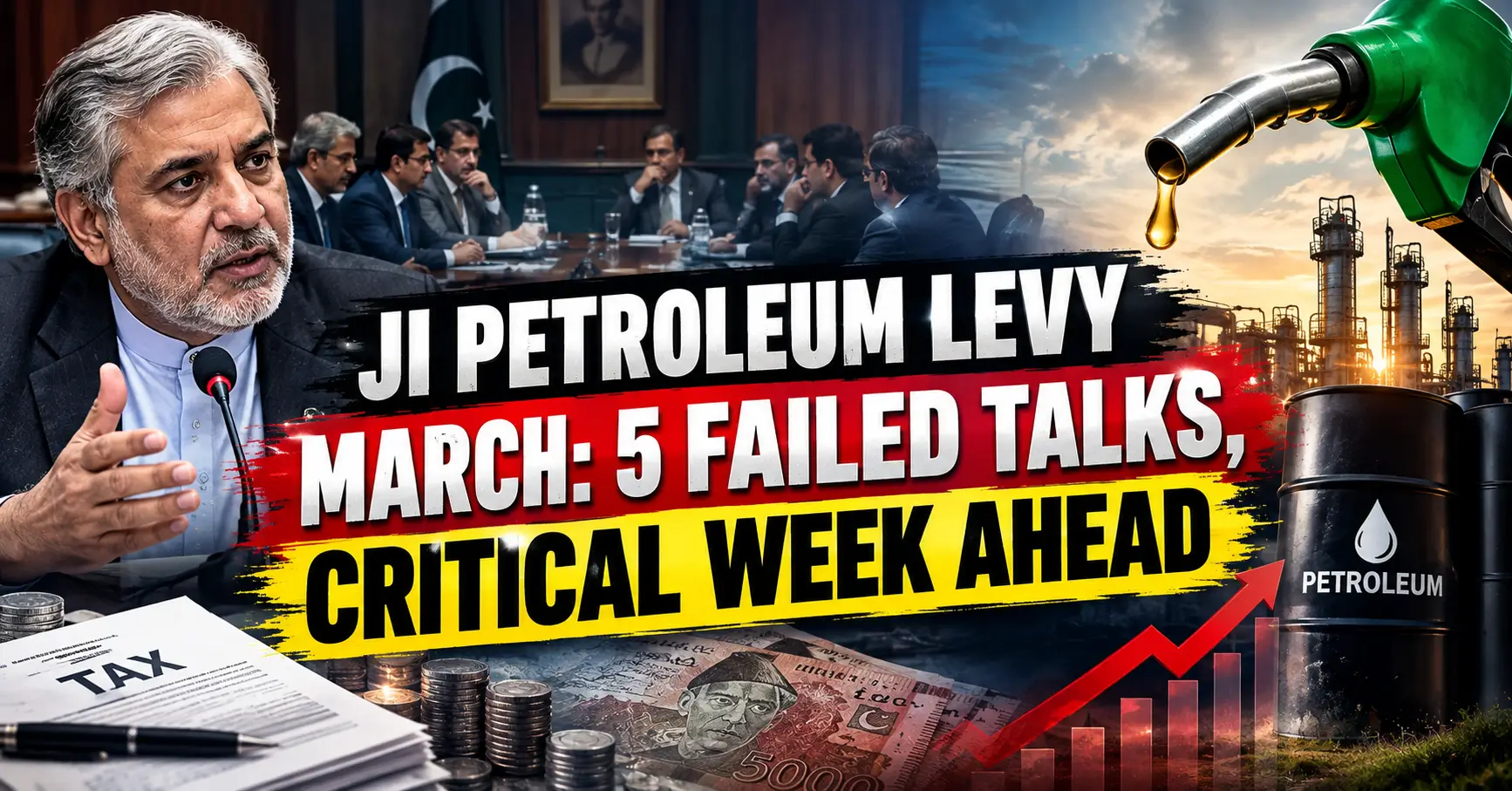

The JI petroleum levy protest escalated on Sunday, September 20, 2026, when Jamaat-e-Islami Emir Hafiz Naeemur Rehman led a train caravan out of Karachi Cantt Station towards Islamabad, declaring the march the campaign’s last stage.
The party says its sit-ins now span 42 cities and passed 35 days in provincial capitals on Saturday. Its demand is singular: withdraw the petroleum levy entirely, not trim it or offset it with targeted relief.
Five Rounds of Talks Ended Without a Deal
The fifth round of negotiations ended on Saturday at Mansoorah, Lahore, without agreement. Federal minister Ahsan Iqbal, Senator Rana Sanaullah and Punjab minister Khawaja Salman Rafique represented the government, while Deputy Emir Liaqat Baloch sat on JI’s side.
The government team asked JI to postpone the JI petroleum levy march over security threats and pointed to IMF pressure, with a Fund delegation due soon. Baloch replied that the march stays necessary until the levy goes.
What the Petroleum Levy Actually Costs at the Pump

Reports differ, so precision matters. Petrol carries Rs114 per litre in taxes and duties, of which Rs80 is the levy; diesel carries Rs100. An additional Rs5 climate support charge applies to both fuels.
Hafiz Naeem cites Rs106–107 per litre. By one account that figure bundles customs duty, the climate charge and the levy, so it should not be read as the levy rate alone.
| Item | Figure | Basis |
|---|---|---|
| Levy on petrol | Rs80 per litre | Reported rate |
| Total taxes and duties, petrol | Rs114 per litre | Reported rate |
| Total taxes and duties, diesel | Rs100 per litre | Reported rate |
| Petrol ex-depot price, September 19–21 | Rs389.14 per litre | Petroleum Division notice |
| Diesel ex-depot price, September 19–21 | Rs424.04 per litre | Petroleum Division notice |
| Levy collected in one year | Rs1,567 billion | JI claim |
| Daily disruption cost | Rs120 billion | Finance minister’s estimate |
| Relief per token | Rs500, four a month | IT minister |
Why Fuel Prices Keep Climbing
Ex-depot prices for September 19–21 stand at Rs389.14 per litre for petrol and Rs424.04 for diesel, after cuts of Rs1.65 and 88 paise. Brent crude traded near $104 a barrel on Friday.
Officials blame regional conditions, and reports tie the surge to the US-Iran conflict and disrupted Hormuz shipping. The JI petroleum levy campaign argues fuel taxes magnify every global shock, pushing up transport fares and everyday prices.
The Relief Scheme and Why JI Refused It

Prime Minister Shehbaz Sharif’s relief scheme gives eligible motorcycle, rickshaw and Qingqi users four Rs500 tokens a month, and covers vehicles up to 800cc. By Saturday afternoon, 1.75 million had registered and over 680,000 tokens were redeemed.
READ MORE: JI protest won’t end until withdrawal of petroleum levy: Hafiz Naeem
JI calls it charity and insists it cannot replace abolition. Hafiz Naeem says qualifying riders receive Rs500 a week, and that many motorcycle users would fall outside the criteria. On Saturday, the government widened eligibility to motorcycles registered from 2006.
The JI Petroleum Levy Case: Where the Money Could Come From
The JI petroleum levy campaign rests on one figure: the party says the government collected Rs1,567 billion from the levy in a year. Liaqat Baloch adds that receipts beat the budget target, and argues spending cuts could create fiscal space.
Its second lever is monetary: Hafiz Naeem says a policy-rate cut would save over Rs1,600 billion and rejects the claim that IMF commitments block it. “The government itself is forcing people to protest,” he said.
The Government’s IMF Argument
The levy sits within Pakistan’s IMF loan commitments, and the government team told JI a Fund delegation is expected soon. Planning Minister Ahsan Iqbal earlier said feasible JI petroleum levy proposals should be implemented without delay.
The trade-off is real. Published fiscal analysis describes the levy as hard to evade and central to primary-balance targets, so any cut needs a credible replacement, such as tighter enforcement or spending cuts.
The Finance Minister’s Rs120bn Warning, Examined

Finance Minister Aurangzeb warned on Sunday that marches and sit-ins could cost Rs120 billion a day, calling them “self-inflicted pain”. His breakdown lists Rs86 billion for services, Rs25 billion for industry and Rs17 billion in revenue.
The components sum to Rs128 billion, not Rs120 billion, and the figure is an estimate rather than a measured loss. He also said reserves stand at $21.4 billion and warned of export and internet disruption.
Route, Dates and Security in the Twin Cities
JI says caravans will converge on Islamabad on September 23 and 24 for the JI petroleum levy march, and that it will not block roads. Authorities have sealed the Red Zone with shipping containers, and reports describe closures across Rawalpindi.
Timelines differ between reports: intermediate stops such as Multan and Lahore appear under different dates. Only the party’s September 23–24 Islamabad window is consistent, so readers should treat city-by-city dates cautiously.
- Sunday, September 20: march leaves Karachi Cantt Station by train
- September 23–24: JI’s stated window for reaching Islamabad
- September 27: PTI’s separate protest date
- Not confirmed: exact timing of stops in Sindh and Punjab
Political Pressure Beyond JI
The JI petroleum levy campaign is not isolated. The Sindh Assembly unanimously passed a resolution seeking lower petroleum prices, and Hafiz Naeem says PTI backs JI’s stance on the levy. PTI has its own protest set for September 27.
Four separate march calls fall within September 20–27, straining police and administration. Reports say mobile internet may be shut during the marches, a disruption the finance minister warned could badly damage IT exports.
Implications for Households and the Budget
If the levy stays, motorists keep paying it on top of crude near $100 a barrel, and JI says fares and food prices follow. If it goes without replacement, the fiscal gap could collide with IMF programme targets.
The relief scheme reaches motorcycles, rickshaws and small cars, but not diesel users. JI says diesel drives economic activity, which is why it treats targeted relief as a poor substitute for cutting the levy.
What to Watch as the JI Petroleum Levy Standoff Deepens
The government tables a formal proposal to abolish the JI petroleum levy, marchers are allowed through the containers, and how an expected IMF visit shapes fiscal room for any concession.
Hafiz Naeem has warned that if the levy stays, the campaign could grow into a movement to remove the government. That is leverage or intent will show in the next four days.