
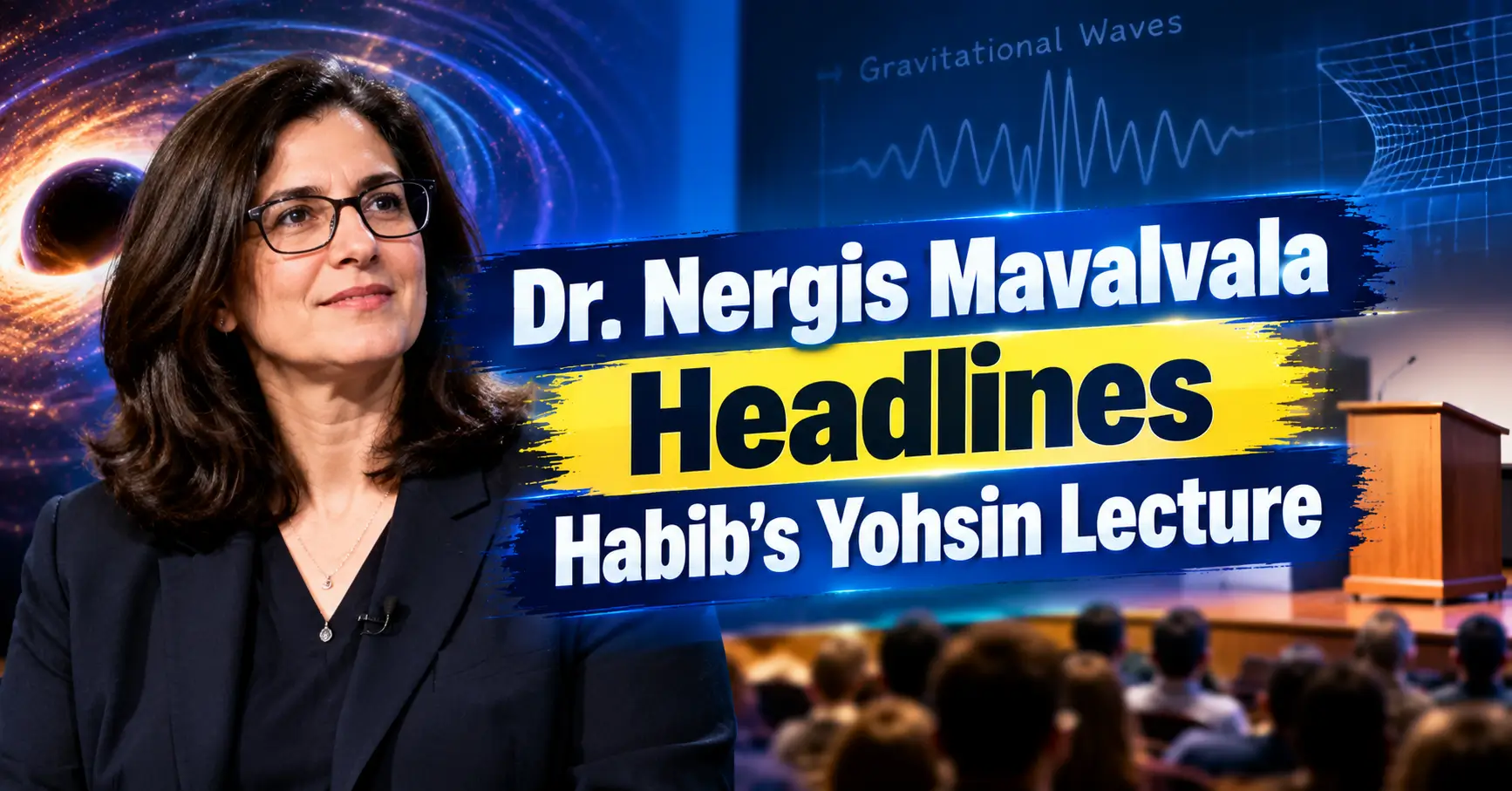

Dr. Nergis Mavalvala returned to her hometown of Karachi last week and told a packed university hall that curiosity does not need to justify itself before it is allowed to exist at all.
The MIT Dean of Science delivered Habib University’s 10th Yohsin Lecture on Friday, September 25, closing a two-day visit that university officials described as one of the busiest stretches on Karachi’s academic calendar this year.
Inside Habib University’s 10th Yohsin Lecture

The lecture, titled “The Joy of Discovery: Curiosity, Science, and the Pivotal Role of Universities,” filled Habib University’s auditorium with students, faculty, alumni, industry figures and members of Pakistan’s wider scientific community.
One published estimate put total attendance across the campus event at between four and five thousand people, though official university accounts describe a full but standard-sized auditorium rather than a crowd of that scale.
What the Physicist Said About Curiosity and Science
The scientist opened by asking why humans chase knowledge that appears to serve no obvious use at all, framing the question as one that has followed her since childhood in Karachi.
“Even pre-human cultures were looking up at the sky, in part because it was just mysterious,” she said, arguing that mystery alone has always been sufficient reason to pursue serious inquiry.
A Childhood in Karachi That Shaped a Scientific Career

Long before MIT, Dr. Nergis Mavalvala grew up near a bicycle repair shop on McNeil Road, where a shopkeeper handed back her broken bike unfixed and taught her to repair it herself instead.
That early habit of taking machines apart to understand them, she has said elsewhere, became a template for decades of later experimental physics work on gravitational-wave detection through the LIGO collaboration.
Research, Access and Opportunity in the Q&A Session
During an extended question-and-answer segment, the discussion turned to a theme with direct relevance for Pakistan: the gap between natural curiosity and the resources needed to pursue it as a profession.
“Every single person at birth is research-minded. The reason some of us get to do it in adulthood is [access to] opportunity,” Dr. Nergis Mavalvala said, tying curiosity to structural access rather than raw talent.
A Decade of the Yohsin Lecture Series
The Yohsin Lecture began in November 2011 with an inaugural address by Dr. Munir Fasheh and has since grown into Habib University’s flagship public event, free and open to the general public.
Named for the university’s founding philosophy of Yohsin, broadly translated as the thoughtful cultivation of the self, the series has hosted scientists, historians and public intellectuals across ten separate editions to date.
Past Yohsin Lecture Speakers Have Included
- Noam Chomsky
- Ashis Nandy
- Reza Aslan
- Azra Raza
- Thomas Blom Hansen
Why Universities Matter to Scientific Discovery

The lecture argued that universities carry responsibilities that go well beyond producing trained professionals for the job market, a point Dr. Nergis Mavalvala returned to more than once across her two days in Karachi.
Institutions, she said, must actively cultivate wonder, creativity, perseverance and intellectual freedom, since none of those traits tend to survive for long without deliberate, sustained institutional support over many years.
Key Facts From the Karachi Visit
| Detail | Information |
|---|---|
| Speaker | Dr. Nergis Mavalvala, Dean, MIT School of Science |
| Lecture title | The Joy of Discovery: Curiosity, Science, and the Pivotal Role of Universities |
| Date | Friday, September 25, 2026 |
| Venue | Habib University, Karachi |
| Series edition | 10th Yohsin Lecture |
| Related talk | ORIC Distinguished Lecture, University of Karachi, September 22 |
Reaction From Habib University Leadership
Habib University President Wasif Rizvi spoke about what the visit meant for the wider university community, crediting its Mohsineen donors for helping keep world-class education broadly accessible across Pakistan today.
READ MORE: Sindh Government Seeks NCCIA Assistance to Curb Fake News
Beyond the public lecture itself, Dr. Nergis Mavalvala toured the campus, held a working session with faculty on nurturing curiosity in classrooms, and met science and humanities students drawn from schools across Karachi.
A Second Karachi Lecture Earlier the Same Week
Three days before the Yohsin Lecture, Dr. Nergis Mavalvala addressed a separate audience at the University of Karachi as part of the ORIC Distinguished Lecture Series, focused more narrowly on gravitational-wave physics.
That earlier talk, titled “Listening to the Universe Above the Quantum Din,” was organised jointly by the university’s research office and its Department of Physics, reflecting sustained academic interest in her visit.
Implications for Pakistan’s Science and Research Investment
The closing argument tied curiosity directly to national policy, with Dr. Nergis Mavalvala stating plainly that no single government investment returns more long-term value than sustained, well-funded commitments to research and science.
Her remarks arrive as Pakistani universities continue competing for limited research budgets, making her Karachi homecoming a pointed policy moment rather than a purely ceremonial or nostalgic occasion for the university.