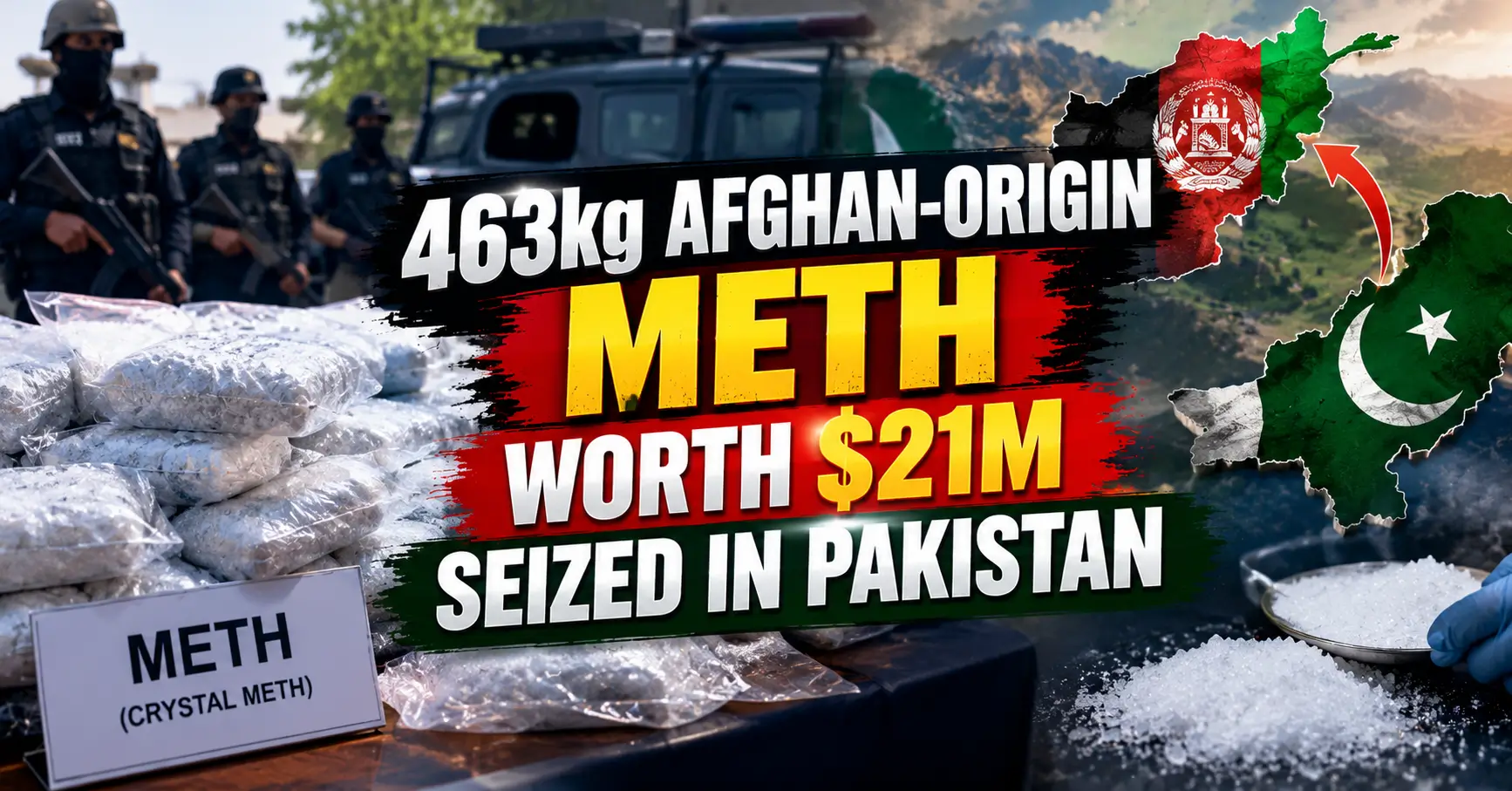

Afghan-origin meth worth $21 million has been intercepted at Karachi port, in one of the largest joint narcotics operations Pakistan and the United States have carried out this year, officials confirmed Monday.
The seizure of 463 kilograms of crystal methamphetamine took place on August 30 at Pakistan’s largest port. Investigators say the shipment was bound for Colombo before US and Pakistani agencies moved in.
Inside the August 30 Seizure

The US Embassy in Islamabad confirmed that DEA Islamabad and Pakistan’s Anti-Narcotics Force jointly carried out the seizure. Officials say the crystal methamphetamine, hidden inside shipping containers, was headed for international markets via Sri Lanka.
Several suspects were arrested during the operation, including individuals of Pakistani origin, the embassy said. Authorities have not yet disclosed the total number of arrests or the identities of those detained.
| Key Figures: Afghan-Origin Meth Worth $21 Million | Detail |
|---|---|
| Quantity seized | 463kg crystal methamphetamine |
| Estimated value | ~$21 million |
| Seizure date | August 30, 2026 |
| Location | Karachi port, Pakistan |
| Intended destination | Colombo, Sri Lanka |
| Announced | September 21, 2026 |
How the Operation Unfolded
The investigation began between August 14 and 29, when ANF’s Karachi-based Port Control Unit flagged containers scheduled for shipment to Colombo. Officials suspected the containers carried narcotics that originated in Afghanistan.
ANF alerted DEA Islamabad, which coordinated with counterparts across multiple countries. Sri Lanka’s Police Narcotics Bureau and DEA’s New Delhi office also joined the effort, leading to the seizure on August 30.
- Aug 14–29: ANF flags suspicious containers at Karachi port
- Aug 29: ANF alerts DEA Islamabad
- Aug 30: Joint operation seizes 463kg of meth
- Sept 21: US Embassy publicly confirms the seizure
The Agencies Behind the Bust

The operation involved four agencies working across three countries. Pakistan’s Anti-Narcotics Force handled the ground-level interdiction, while DEA offices in Islamabad and New Delhi provided cross-border coordination and intelligence support.
Sri Lanka’s Police Narcotics Bureau rounded out the coalition, reflecting how the Colombo route has become a transit point for Afghan-origin narcotics moving toward Southeast Asian and other international markets.
| Agency | Role |
|---|---|
| Pakistan’s ANF (Port Control Unit) | Identified containers, led interdiction |
| DEA Islamabad | Coordinated the US side, received the initial tip |
| DEA New Delhi | Supported cross-border intelligence sharing |
| Sri Lanka Police Narcotics Bureau | Regional coordination on the Colombo route |
How Authorities Calculated the $21 Million Value
The $21 million figure reflects the estimated international market value of 463 kilograms of crystal methamphetamine, based on standard narcotics-pricing benchmarks used by US and Pakistani law-enforcement agencies. Neither agency has published a detailed breakdown of the valuation method.
READ MORE: Houthi Missile Attack Shakes Riyadh As Yemen War Reaches Saudi Capital
Methamphetamine prices vary sharply by market, meaning the same 463kg haul could fetch a different figure depending on whether it was destined for South Asian, East Asian, or wider international buyers.
Afghanistan’s Shift From Opium to Methamphetamine

Afghanistan has long been known as a major source of opium and heroin. In recent years, however, seizures point to a parallel rise in synthetic methamphetamine production inside the country.
Pakistan’s Anti-Narcotics Force has repeatedly linked the growing supply of Afghan-origin meth to a spike in domestic drug abuse, particularly among younger Pakistanis, in statements issued over the past year.
A Second Bust in Weeks: Clearing Up the Numbers
This is not the only Afghan-origin meth network Pakistan has dismantled recently. In early September, ANF announced a separate 671kg seizure split between Karachi and Colombo ports, tied to an Afghan suspect.
The two cases are distinct: different dates, different quantities, separate arrests. Readers should not conflate this Afghan-origin meth worth $21 million with the earlier 671kg case reported weeks before it.
Pakistan’s Broader Anti-Narcotics Track Record
Pakistan’s Anti-Narcotics Force has intensified port and border operations in recent years, citing a steady rise in Afghan-origin synthetic drugs moving through the country toward international markets and domestic users alike.
The force has previously reported seizing thousands of kilograms of methamphetamine annually, alongside heroin, opium, and hashish, underscoring Pakistan’s position as both a transit corridor and an affected consumer market.
Official and Expert Reaction
The US Embassy said Washington continues to prioritise counter-narcotics cooperation with Islamabad under the current administration. It added that Pakistan’s Anti-Narcotics Force has grown more capable through sustained American training support.
Commenting on the earlier, related Afghan-linked bust this month, ANF spokesperson Kanwal Noor said coordination with international law enforcement agencies “enabled authorities to carry out the major seizure” and subsequent arrests.
What It Means for Regional Trafficking Networks
Analysts tracking regional narcotics flows say Karachi’s port has become a key transit hub for Afghan-origin synthetic drugs heading toward South and Southeast Asia, often disguised inside legitimate commercial cargo.
For now, the $21 million seizure stands as one of the year’s largest single interdictions. It disrupts the broader network long-term will depend on the arrests and prosecutions that follow.